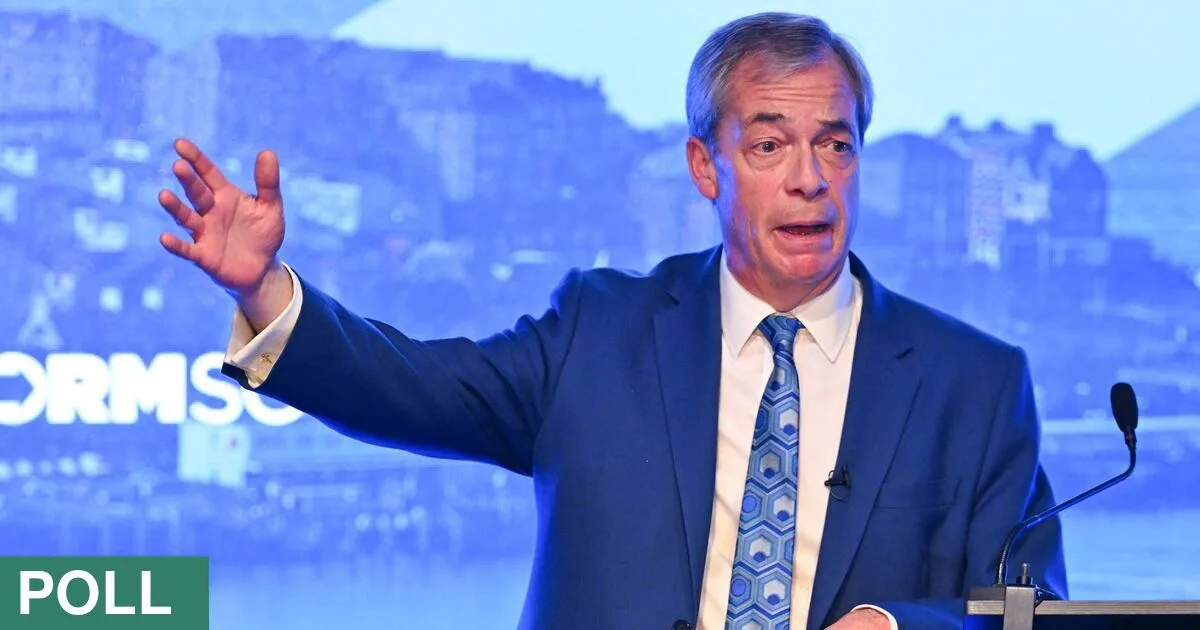
Reform UK leader Nigel Farage has ignited a fierce political debate by demanding a comprehensive ban on all mass religious observances in public spaces across the United Kingdom. His comments came during a speech at his party's Scottish conference, where he specifically criticised the Open Iftar event held in London's Trafalgar Square on Monday.
Farage's Controversial Stance on Public Religious Events
Addressing party members, Farage described the Ramadan gathering, which was attended by London Mayor Sir Sadiq Khan, as "an attempt to overtake, intimidate and dominate our way of life." He warned that similar mass observances would soon arrive in Scotland and vowed that Reform UK would "stand firm for the Judeo Christian principles upon which our nation was built."
Direct Call for Banning All Mass Observances
When questioned by the Press Association about whether he supported banning all mass religious observances, Farage responded unequivocally: "Yes." He elaborated that while individuals should retain the right to pray privately, mass prayer events in public spaces represented what he termed "provocative demonstrations" that should be prohibited.
"We have to stop this kind of mass demonstration, provocative demonstration, in historic British sites," Farage declared. He pointed to restrictions on mass Muslim prayer in some Middle Eastern countries as justification for similar measures in Britain.
Political Reactions and Wider Controversy
The Trafalgar Square event has become a significant flashpoint in British politics this week. Conservative leader Kemi Badenoch supported her shadow justice secretary Nick Timothy after he described the Iftar as an "act of domination and division." Timothy had posted on social media platform X that "mass ritual prayer in public places is an act of domination" and suggested such observances should be confined to religious buildings.
Badenoch's Nuanced Position
Mrs Badenoch offered a more measured perspective, stating that while the Conservatives support religious observances in public spaces like Trafalgar Square, they must be "inclusive and also respectful of British culture." She emphasised that Britain remains a country that believes in freedom of religion, but argued the debate centered on how religion is expressed in shared public spaces.
"This debate which Nick is having is not about freedom of religion," Badenoch explained at an event on Thursday. "It's about how religion is expressed in a shared public space and whether those expressions fit within the norms of British culture."
Prime Minister's Strong Criticism
Prime Minister Sir Keir Starmer delivered a forceful condemnation during Prime Minister's Questions on Wednesday, calling for Nick Timothy to be dismissed from his position. Starmer accused the Conservative Party of developing "a problem with Muslims" and noted that similar religious gatherings, including Jewish Chanukah celebrations and Christian Easter processions, have long occurred in London without controversy.
"I've never heard her party call out anything other than the Muslim events," Starmer declared. "It's only when Muslims are praying. The only conclusion is the Tory Party has got a problem with Muslims."
Event Details and Historical Context
The Open Iftar in Trafalgar Square was organised by the Ramadan Tent Project and attracted approximately 3,000 attendees. Such interfaith gatherings have become increasingly common in London's public spaces, reflecting the city's diverse religious landscape. Farage's comments have raised questions about religious freedom, cultural integration, and the appropriate boundaries for public religious expression in modern Britain.
The controversy has drawn attention to broader tensions surrounding multiculturalism and national identity, with political figures across the spectrum now forced to articulate their positions on this sensitive issue. As the debate continues, it highlights deepening divisions in British society regarding religion's place in public life.