Fact-Checking Trump's State of the Union Claims on Jobs, Crime, and Energy
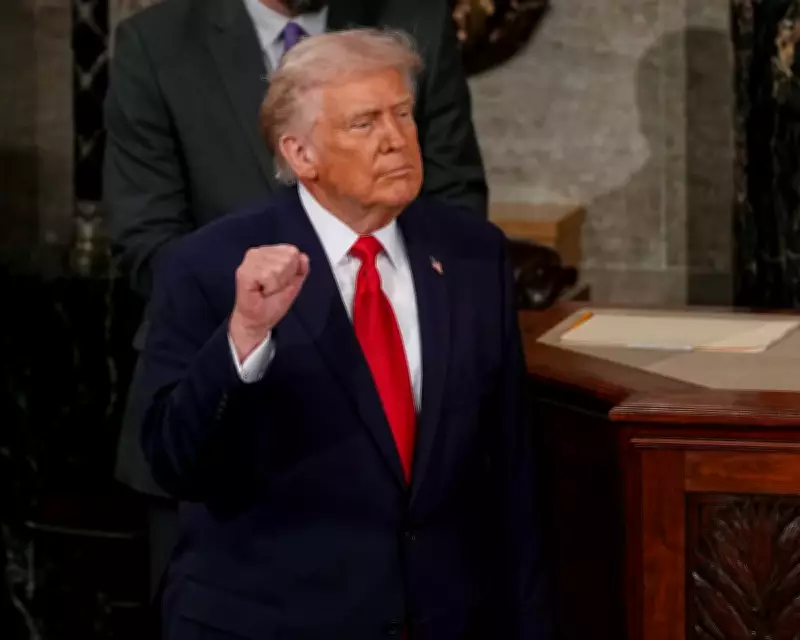
Donald Trump delivered the longest State of the Union address in history on Tuesday night, spanning over an hour and forty-one minutes. The speech, which outlined achievements from the first year of his second term, was filled with broad assertions that often strayed from factual accuracy. This analysis examines key claims made by the president regarding the economy, immigration, energy costs, and international conflicts.
Economic and Job Growth Claims Under Scrutiny
Trump repeatedly praised his economic record, stating, "we are the hottest country anywhere in the world" and asserting that "we have more jobs, more people working today than ever before in the history of our country." However, data reveals a different story. According to revised figures from the Bureau of Labor Statistics released earlier this month, the United States gained only 181,000 jobs in 2025. This number is significantly lower than the typical 1.5 million to 2.5 million job gains seen under both Trump during his first term and former President Joe Biden in non-pandemic years.
Additionally, Trump claimed that under his leadership, the U.S. secured $18 trillion in investments "pouring in from all over the globe." A review by CNN last year found that the White House was counting vague pledges rather than actual investments. The official White House website lists total U.S. and foreign investments at $9.7 trillion, highlighting a substantial discrepancy in the president's figures.

Immigration and Crime: Misleading Narratives
During his address, Trump introduced the mother of Iryna Zarutska, a Ukrainian woman killed on a train in Charlotte, North Carolina last year. He falsely claimed that her killer was "a hardened criminal set free to kill in America came in through open borders." In reality, DeCarlos Brown Jr., the man arrested and charged with the murder, is not an immigrant. This statement aligns with Trump's longstanding but inaccurate insistence that non-citizens are primarily responsible for violent crime in the U.S.
Data contradicts this narrative, showing that relative to undocumented immigrants, U.S.-born citizens are more than twice as likely to be arrested for violent crimes and 2.5 times more likely to be arrested for drug-related offenses.
Energy and Gas Prices: Contradictory Evidence
Trump suggested that energy prices are decreasing, stating, "When they see energy going down to numbers like that, they cannot believe it." Contrary to this claim, the average household energy bill in the U.S. increased by 6.7% from 2024 to 2025. This rise occurred despite Trump's repeated promise to cut electricity costs in half within his first year back in office.
Since Trump retook the White House, utility companies have raised or sought to raise rates by at least $92 billion, affecting 112 million electric customers and 52 million gas customers, according to an analysis from the Center for American Progress. Furthermore, the president's attacks on clean energy expansion are projected to increase electricity rates by up to 18% by 2035, as indicated by data from Energy Innovation.
The Trump administration has also undermined energy assistance programs. Last year, it eliminated tax credits for home energy-efficiency upgrades and attempted to cut the Low Income Home Energy Assistance Program, which aids 6 million low-income Americans annually. Although the program survived, it has been significantly hindered after the administration laid off its entire staff, leading to unprecedented delays in aid disbursement due to cuts and a government shutdown.
Regarding gas prices, Trump touted figures below $2.30 per gallon in most states, with some places as low as $1.99. However, AAA data shows that Oklahoma is the only state with gas at approximately $2.374 per gallon, while prices in other states exceed $4.60. Additionally, a recent environmental rollback by the administration, repealing the endangerment finding for greenhouse gas regulations, is expected to push gas prices higher, according to the administration's own data.

Foreign Policy: Exaggerated Claims of Peace
Trump boldly claimed to have ended eight wars in his first ten months, but this is an exaggeration. The U.S. has been involved in six peace agreements, not all of which credit Trump specifically, and some conflicts were not considered wars initially. For instance, while Trump helped broker a ceasefire in Gaza, Israel has continued airstrikes and civilian casualties since the truce was announced last October.
Another example is the century-long border dispute between Thailand and Cambodia. Trump presided over a ceasefire deal in October, calling it "a monumental step," after pressuring leaders with trade talk threats. However, the underlying causes rooted in colonial-era maps remain unresolved. The ceasefire broke down weeks later in November, and fighting resumed in December, displacing half a million people.
In summary, Trump's State of the Union address contained numerous inflated or misleading statements across key policy areas. From economic data to immigration narratives and energy costs, the claims often diverged from verified facts and official statistics, raising questions about the accuracy of the president's portrayal of his administration's achievements.