Mark Carney's Prescription for Middle Powers Falls on Deaf Ears in Australia
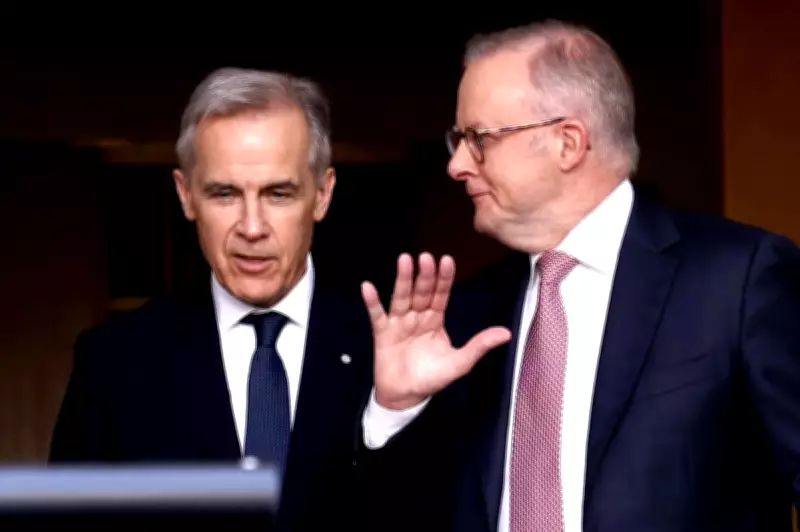
In a week that electrified Canberra, former Canadian Prime Minister Mark Carney delivered a compelling message to the Australian Parliament, urging middle powers to band together in a world where the post-Second World War rules-based order has collapsed. Despite his erudite and persuasive speeches, both the Labor and Coalition parties in Australia appear to be ignoring his call, pretending the "rupture" he identified has not occurred.
The Rupture in Global Order and Carney's Vision
Carney, who dominated headlines at the World Economic Forum in January, declared the end of the old international system built around the United Nations and established norms. He argued that in this uncertain era, middle powers such as Canada and Australia must trust each other to act swiftly and purposefully. "The world will always be shaped by great powers," he told a packed House of Representatives, "but it can also be shaped by middle powers that trust each other enough to act with speed and purpose."
Clarifying his earlier remarks, Carney noted at the Lowy Institute in Sydney that his speech intended to say mourning the loss of the old order should not continue "too long," emphasizing the need to move forward and build something better—more prosperous, resilient, and just. His vision calls for a proactive approach to shaping global outcomes, yet Australia's response suggests a stubborn refusal to heed this advice.

Australia's Stubborn Alignment with the United States
Prime Minister Anthony Albanese, who has met Carney ten times since both leaders were elected amid backlash against former US President Donald Trump, expressed enthusiasm for the visit. Alongside progressive leaders like Emmanuel Macron of France and Keir Starmer of Britain, Albanese and Carney see themselves as a bulwark against rising right-wing forces globally. They announced collaborations on trade, defence, artificial intelligence, and superannuation, with Australia joining a top-tier democratic group on critical minerals.
However, Australia's actions tell a different story. The country's involvement in the Aukus nuclear agreement and its response to recent bombings in Iran highlight a deep-seated reliance on the United States. Australia has committed over $1.6 billion to boost America's defence industrial capability, with an additional $310 million to Britain, and the total cost of Aukus is estimated at least $370 billion. This deal explicitly allows the US to withhold promised Virginia-class submarines if deemed in its national interest, raising questions about Australia's autonomy.
Contradictions in Labor's Foreign Policy
Labor has long championed the rules-based order, with Albanese stressing cooperation and coalition-building at the United Nations last year. Yet, the party's support for US and Israeli strikes on Iran, which lack a clear legal basis, undermines this stance. When asked about the legality of the bombings, Albanese and Foreign Minister Penny Wong squirmed, highlighting a disconnect between rhetoric and action.
Recent revelations that three Australian sailors were aboard an American submarine that sank an Iranian warship, killing at least 87 people, further complicate Labor's position. After initially denying involvement in the conflict, the government faced scrutiny, with only muted criticism from within the Labor caucus. This raises questions about what the opposition might have said under similar circumstances years ago.
The Path Forward: Ignoring Carney's Call at Our Peril
Carney expressed confidence in the Five Eyes intelligence alliance but warned that middle powers must not remain passive. For Australia, even considering a move away from US dependence seems beyond the imagination of current political leaders. The system appears too entrenched to shift, despite the clear rupture in global dynamics.
As the stardust of Carney's visit settles, Australia must confront a harsh reality: the world order has changed, and clinging to old alliances without critical evaluation could leave the nation vulnerable. It is time for clear-eyed honesty about how Australia will respond to this new era, rather than pretending the rupture has not happened.