America's Democratic Collapse Already Happened, Not Just Feared
The notion that "if your neighbors are not living in democracy, then neither are you" captures a stark truth about the United States. Americans are not confronting an imminent democratic collapse; they are enduring its aftermath. This perspective challenges the widespread illusion that democracy is something yet to be lost, revealing instead that its erosion has been a long-standing reality.
The Illusion of Imminent Breakdown
Since Donald Trump returned to the White House, American political life has settled into a familiar pattern. Each week brings court rulings framed as breaking points, elections cast as the last chance, and executive orders described as tipping points. Democratic party fundraising emails vow to "save the Republic," while commentators warn of guardrails giving way. Citizens anxiously refresh screens, awaiting a collapse that never seems to arrive.
This state of permanent panic rests on what Sigmund Freud termed an illusion: a belief embraced not for its truth, but to satisfy psychological needs. The illusion here is that the United States still has a democracy to lose. The more unsettling reality is that Americans are not under threat of future democratic breakdown; they are living inside the aftermath of one that has already occurred.

For tens of millions, democratic life has been absent for decades, marked by precarious housing, inaccessible healthcare, unchecked policing, debt servitude, vanishing public goods, and exclusion from meaningful political power. Conversely, the wealthy, politically connected, and oligarchs experience insulation and rationalize the deprivation underpinning their power. These are not signs of a democracy under threat but symptoms of one that eroded long ago.
A Defense Against Reality
In his essay on the "fear of breakdown," psychoanalyst DW Winnicott described patients consumed by dread of impending disaster, only to find it stemmed from a past breakdown never fully experienced. This concept applies to group dynamics and political collectives. Nations employ defenses like denial, idealization, and collective forgetting. America's fixation on democracy's near-death serves as both a defense and a political strategy.
It allows liberal politicians, institutions, media, and elites benefiting from inequalities to avoid confronting an uncomfortable truth: democratic decline did not start with Trump but unfolded over decades, including under Democratic party leaders now positioning themselves as democracy's defenders. Acknowledging this does not downplay Trump's authoritarian project but aims to understand it clearly for effective opposition, rather than remaining stuck in loops of elite complicity.
The narrative mired in nostalgia insists the US had a functional democratic order suddenly slipping away due to a singular figure—an aberration rather than a reflection. The proposed solution is preservation: defend institutions, restore norms, shore up checks and balances. But to what democracy are we returning? One built on settler colonialism, slavery, and Indigenous dispossession? One that excluded women until 1920, Black citizens until the 1960s, and trans people today? A government that hollowed out rights through mass incarceration, voter suppression, wealth extraction, and corporate capture enabled by the supreme court?
From Oligarchy to Democratic Imagination
Well before Trump's first term, evidence indicated the United States was already an oligarchy. Decades of bipartisan deregulation, privatization, union-busting, and welfare retrenchment dismantled public infrastructures, transferring democratic power to corporations, unelected judges, and billionaires. If democracy is a lived experience of shared fate and civic presence, millions have not lived in one for decades.
As long as democratic collapse is seen as something to prevent, political paralysis ensues, clinging to norms and leaders whose authority has evaporated. Fear of breakdown binds us to a non-existent past, hindering future building. Winnicott noted this fear diminishes only when the concealed truth is experienced. Confronting reality opens new directions.

Genuine democracy thrives on everyday public infrastructures: thriving public housing, childcare, schools, libraries, universal healthcare, unions, public media, community safety, and public health as social care. Where these wither, democratic imagination fades and fascist fantasies flourish. Where invested, democracy becomes a lived practice.
Ambitious policies like universal childcare, Medicare for All, guaranteed housing, debt relief, green investment, and community care workers are not just proposals but engines of democratic subjectivity. They help people feel part of something larger, encountering each other beyond fear-driven politics. These projects cannot magically heal a nation but create conditions to stop mourning illusions and make democratic life tangible.
Hope in Grassroots Movements
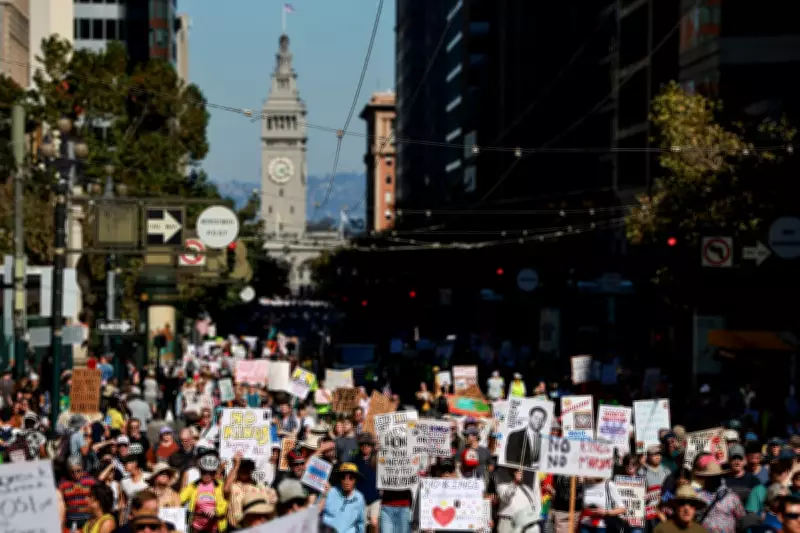
Even as Democratic party leaders retreat into caution amid rising fascism, ordinary Americans are not waiting. Across the country, including in Chicago neighborhoods, people organize to protect immigrant neighbors from ICE violence through rapid-response phone trees, monitoring, mutual aid funds, legal resources, and safe shelter.
These efforts emerge not from Democratic party courage but its absence. People step in where representatives cower, defending neighbors directly rather than waiting for unwilling institutions. These small, improvised acts reveal democracy does not start with politicians promising salvation but when people refuse to abandon each other. Following this instinct—building care and protection ourselves—is essential for democratic renewal.
If Americans insist good government grows from the bottom up, refusing to let grassroots movements be co-opted for political careers, the possibility of real democracy may yet live. This shift from illusion to action marks a path forward in a post-collapse era.