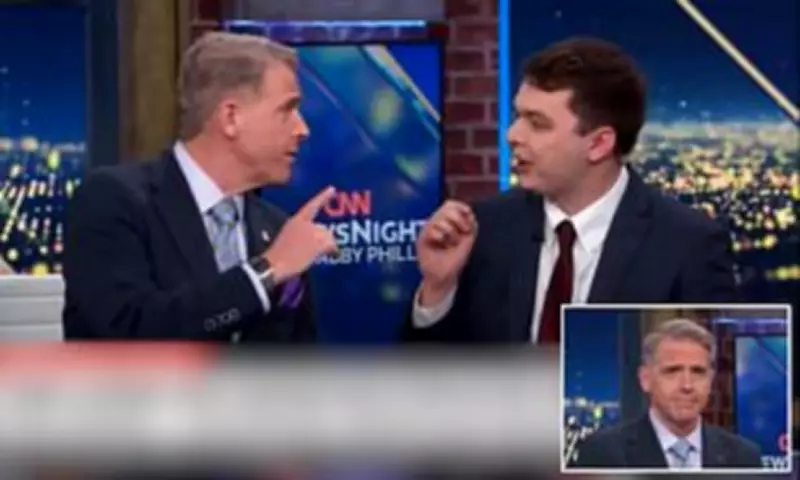
A heated verbal confrontation unfolded on CNN Thursday evening between conservative commentator Scott Jennings and liberal pundit Adam Mockler during a debate over the ongoing conflict in Iran. The exchange grew so intense that host Abby Phillip was forced to intervene and shut down the segment.
Jennings and Mockler Trade Barbs
The dispute began when Jennings asserted that Iran has been at war with the United States for 47 years. Mockler quickly retorted, accusing Jennings of being eager to defend a war with a country starting with 'Ira' that is failing and will plunge the nation into trillions of dollars in debt. Mockler, who noted he was a child during Jennings' time in the administration defending previous endless wars, claimed the current war is also failing.
Jennings fired back, questioning Mockler's attention span by asking, 'Eight weeks is endless to you? You have the attention span of a gnat?' Mockler recalled debating Jennings weeks earlier, when Jennings said the war was weeks from ending. He accused Jennings of making condescending remarks because he cannot defend the war's failure.

Escalation and Intervention
The confrontation peaked when Jennings snapped at Mockler, 'Get your f***ing hand out of my face,' adding, 'I'm not gonna have this guy's hand in my face.' Host Abby Phillip interjected, urging calm and allowing Jennings to respond to Mockler's points. When Mockler pressed Jennings to name a political concession, Jennings stated the simple goal of preventing terrorists and a terrorist regime from obtaining a nuclear weapon that could threaten the US, its allies, and Europe.
Mockler dismissed Jennings' response, saying, 'So you can't answer the question. I would get mad too.' Phillip then ended the debate, moving on to other topics.
Broader Context: Iran Tensions
The heated exchange comes amid escalating tensions between the US and Iran. Ayatollah Mojtaba Khamenei declared that the only place for the US in the Persian Gulf is 'at the bottom of its waters,' dismissing the US naval blockade as doomed to fail. In a written message for National Persian Gulf Day, Khamenei asserted that a new chapter is unfolding for the region without America, following what he described as the US's shameful failure.
Khamenei also claimed that US bases in the region lack the capacity to ensure their own security. Meanwhile, the US military has briefed President Trump on new plans for potential strikes on Iran, as the standoff has effectively closed the Strait of Hormuz to commercial shipping.
US Diplomatic and Military Plans
The State Department has sent an internal cable to US embassies urging diplomats to convince other nations to join the 'Maritime Freedom Construct,' a US-led coalition to share information, coordinate diplomatically, and enforce sanctions to reopen the waterway. The plan includes the State Department serving as a diplomatic operations hub and US Central Command providing real-time maritime domain awareness.
Another option under discussion involves a possible special forces operation to secure Iran's enriched uranium stockpile. Trump has warned that a naval blockade could last months, causing oil prices to spike to their highest level in over four years. International benchmark Brent crude soared more than 7 percent to $126 a barrel before easing.
International Energy Agency chief Fatih Birol described the situation as 'the biggest energy crisis in history,' adding that oil prices are putting pressure on many countries. Trump contends that the blockade is more effective than bombing, and he has instructed national security officials to prepare for a long blockade to force Tehran to suspend uranium enrichment for 20 years.
Iran's Response
Iran has threatened to respond if the blockade continues. Mohsen Rezaei, a military adviser to Khamenei, warned that Iran will not tolerate the naval blockade and will respond if it persists. He cautioned that a new war could result in US ships being sunk and soldiers killed, with Iran taking a large number of prisoners.