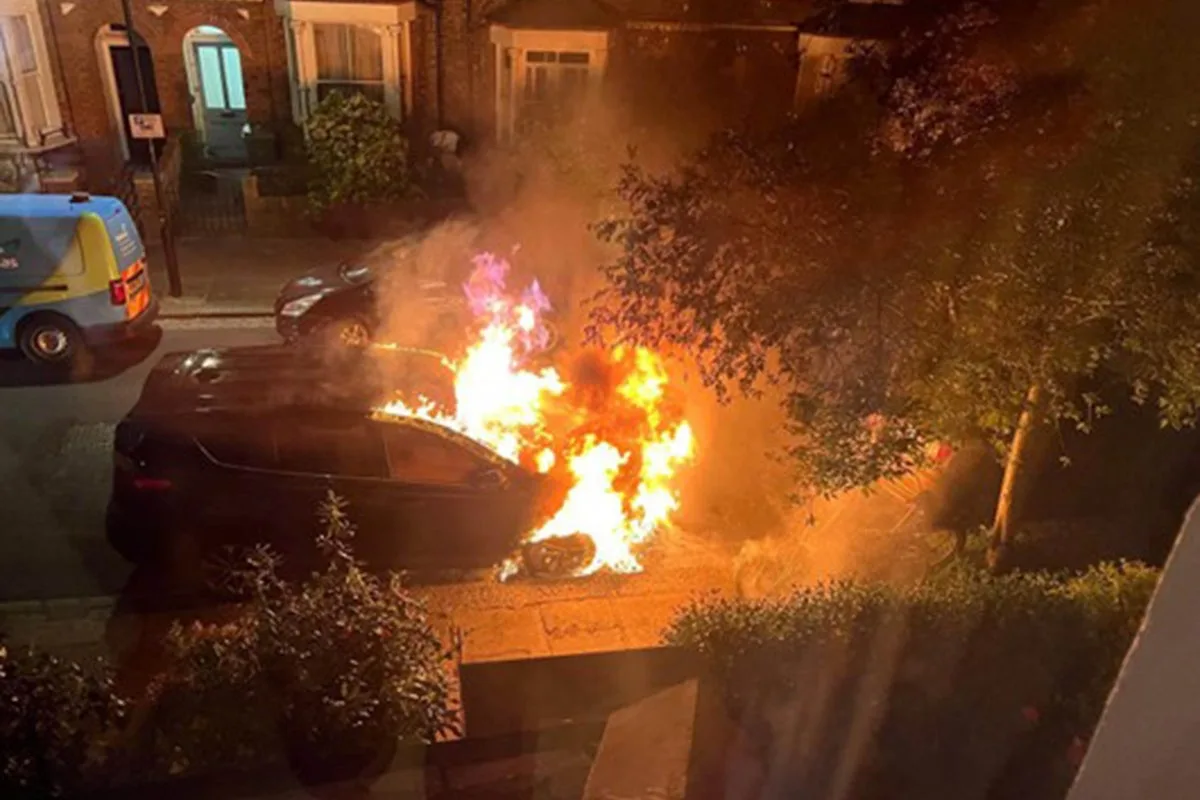
A British court has heard that two Ukrainian men and a Romanian national were allegedly offered payment by a Russian-speaking contact to set fires last year at properties linked to Prime Minister Keir Starmer. The trial at the Old Bailey on Wednesday heard that the three defendants were involved in a series of arson attacks in London between May 8 and 12, targeting a car and two houses associated with the prime minister.
Prosecution Details the Attacks
Prosecutor Duncan Atkinson told the court that Ukrainian nationals Roman Lavrynovych, 22, and Petro Pochynok, 35, along with Stanislav Carpiuc, a 27-year-old Romanian citizen, are accused of conspiracy to commit arson. Atkinson stated that Lavrynovych was identified by police as the primary perpetrator behind all three fires. He faces additional charges of damaging two properties by fire with intent to endanger life, or being reckless as to whether life was endangered.
The defendants deny all charges against them. The court was not informed of the amount of money allegedly offered, nor whether any injuries resulted from the fires.
“Three fires in the same area within five days would be pretty unusual. However, three fires all involving property linked to the same person were beyond a coincidence,” Atkinson said.
Timeline of Events
According to the prosecution, a Toyota car was deliberately set ablaze in the early hours of May 8 in the Kentish Town area of north London. This was followed by a house fire on May 11 and a second house fire on May 12. The property fires were started with similar materials and “were set in the dead of night, when the occupants of the addresses would inevitably have been asleep,” Atkinson argued, asserting that the defendants must have intended to endanger the lives of those inside.
The car had once belonged to Starmer. The first house, on Ellington Road, was managed by a company where the prime minister had previously been a director and shareholder. The second house, on Countess Road, was occupied by Starmer’s sister-in-law and still owned by him.
Planning and Payment
The attacks were “planned and directed, with those involved promised payment for their participation,” Atkinson said. Lavrynovych was offered payment to set the fires via the messaging app Telegram by a contact using the name “El Money.”
In both house fires, the occupants were awakened by the blazes. On May 11, the occupant of the top-floor apartment in the converted house woke to the smell of smoke at around 3 a.m. The resident opened the front door to find communal hallways filled with smoke, had difficulty breathing, and retreated to the roof for safety.
The following day, the prime minister’s sister-in-law heard loud bangs and saw billowing smoke coming through the front door at around 1 a.m. She also struggled to breathe, and her 9-year-old daughter was “very frightened,” Atkinson said.
Motivation Not a Factor
Atkinson told the jury that it did not need to decide what motivated the defendants to carry out the alleged attacks. “It does not matter whether they knew that the property they were targeting was connected to the prime minister or whether that formed part of their motivation,” he said.
The court heard that over 320 messages dating back to September 2024 were recovered between Lavrynovych and “El Money.” However, Atkinson instructed the jury not to concern themselves with who “El Money” was or why they decided to recruit people for the attacks.