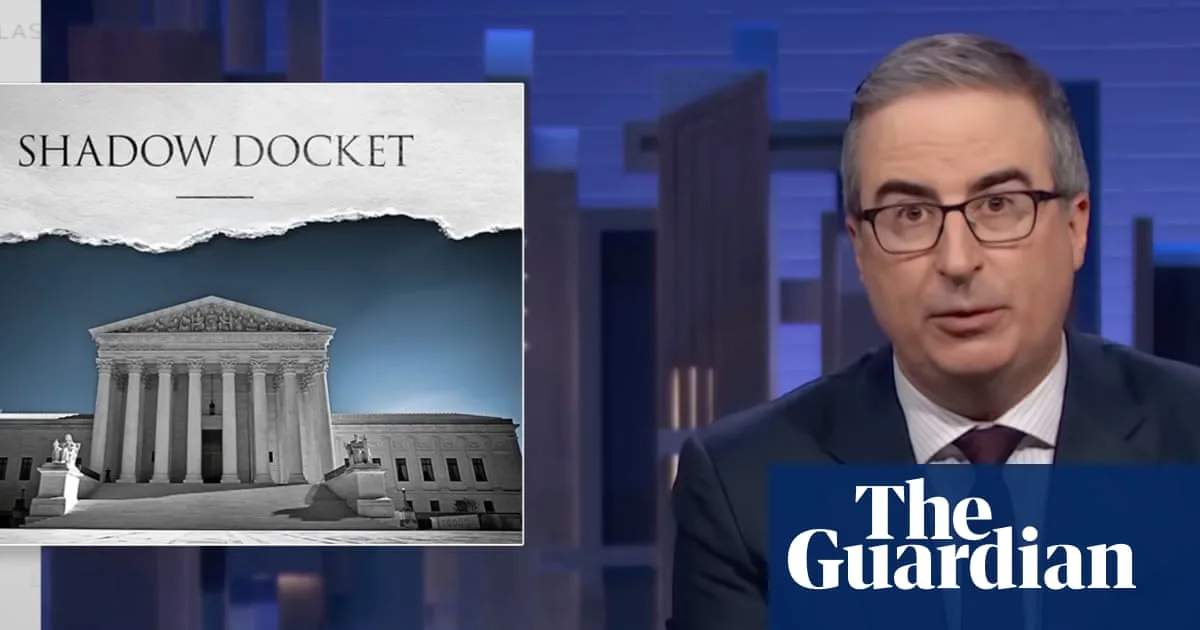
On Sunday's episode of Last Week Tonight, John Oliver scrutinised Donald Trump's use of the US Supreme Court's shadow docket, describing it as the president's preferred method to bypass traditional legal processes. The segment aired after the Court granted several presidential executive orders, allowing Trump's agenda to proceed while cases remain unresolved.
Oliver explained how litigants can circumvent the standard judicial process by requesting emergency rulings from the shadow docket, which requires five of the nine justices to agree that the applicant would suffer 'irreparable harm' otherwise. Historically, this mechanism was reserved for extreme cases, such as death row appeals, but Trump has increasingly used it to overturn lower court rulings that pause his executive actions.
In his second term, Trump has appealed to the shadow docket a record number of times. Oliver noted that this strategy has paid off, citing decisions that allowed the administration to cut grants to universities, dismiss transgender service members, reduce the Department of Education, fire federal employees, and withhold congressionally approved foreign aid. 'It's now become his go-to method to get his way,' Oliver said.
The host criticised the conservative majority on the Court for enabling Trump's policies through shadow docket rulings, which often lack detailed reasoning. He highlighted the 2025 case Noem v Vasquez Perdomo, where Justice Brett Kavanaugh justified pausing a lower court's injunction against racial profiling by ICE agents, claiming such stops were 'typically brief'. Oliver dismissed this, noting that plaintiffs described being pushed against fences and taken to warehouses for questioning.
Oliver argued that these rulings have caused 'irreparable harm' to individuals, contrasting with the minimal inconvenience to Trump of waiting for regular rulings. He also pointed out that the shadow docket does not require justices to explain their decisions, though Justice Amy Coney Barrett acknowledged the challenge of working quickly on emergency orders.