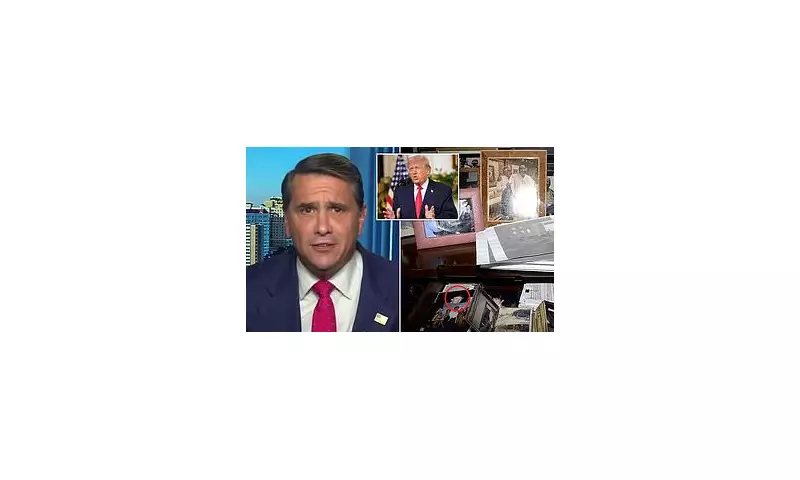
A senior US Justice Department official has provided a detailed explanation for the sudden removal of files, including a photograph of former President Donald Trump, from the recently released trove of documents related to the late financier and convicted sex offender Jeffrey Epstein.
Controversial Removal Sparks Speculation
More than a dozen documents, made public last Friday, were mysteriously taken down shortly after their release. Among them was an image found in a drawer of Epstein's desk, showing Donald Trump posing with a group of women. Another photograph depicted the former president alongside his wife Melania, Epstein, and his longtime associate Ghislaine Maxwell.
The swift removal of these files ignited a wave of speculation and fury online. Many commentators suggested the action was a deliberate attempt to shield the former president from potential embarrassment by distancing him from the controversial figure of Epstein.

Deputy AG Sets the Record Straight
However, Deputy Attorney General Todd Blanche has firmly rejected this claim. Appearing on NBC's Meet the Press on Sunday, Blanche was questioned by host Kristen Welker about the reasoning behind the move.
"Absolutely, positively not," Blanche stated emphatically. "It has nothing to do with President Trump." He pointed out that dozens of photographs showing Trump with Epstein are already in the public domain, noting that Trump himself has acknowledged socialising with Epstein in the 1990s and early 2000s.
"So the absurdity of us pulling down a photo, a single photo, because President Trump was in it, is laughable," he added.
The Official Reason: Protecting Victim Privacy
Blanche then outlined the genuine protocol that led to the temporary removal. He explained that a New York judge has issued an order requiring the Justice Department to consider concerns from any victim or victim rights group regarding the material being published.
"And so when we hear concerns, whether it’s photographs of women that we do not believe are victims, or we didn’t have information to show that they were victims, but we learn that there are concerns, of course we’re taking that photograph down, and we’re going to address it," Blanche said.
He clarified that the process involves reviewing the specific concerns, which could lead to redacting faces or other identifying information before republishing the documents. "If we need to redact faces or other information, we will, and then we’ll put it back up," the Deputy Attorney General concluded.
This incident highlights the sensitive and complex process of releasing evidence from high-profile cases involving alleged sexual abuse, where balancing public interest with the privacy and protection of victims and unrelated individuals is paramount.