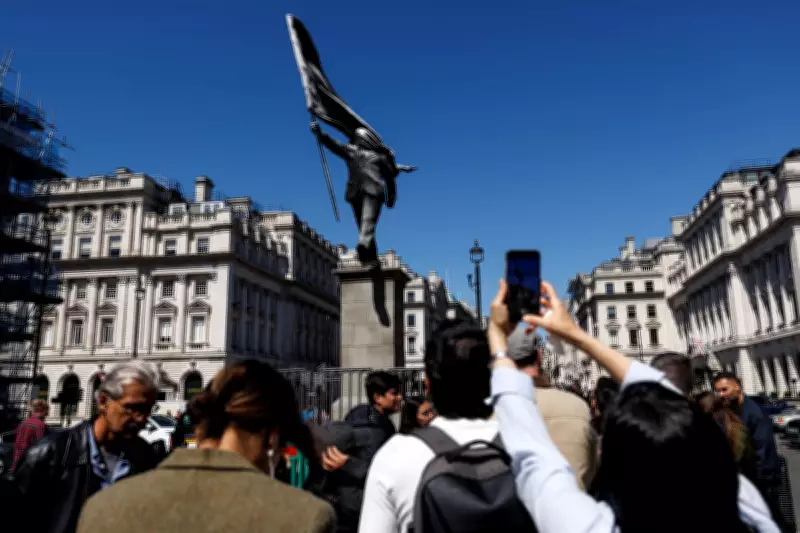
A mysterious new sculpture has appeared in central London and has been claimed as the work of elusive street artist Banksy. The statue, depicting a suited man stepping off a plinth with his sight obscured by a waving flag, was first spotted on Waterloo Place in St James on Wednesday, 29 April.
Confirmation of Ownership
Those who encountered the piece noticed Banksy’s name scrawled at the bottom. The artist has since confirmed the artwork is his on his official Instagram page, a typical method for him to claim ownership after a piece surfaces. Banksy, more commonly known for his graffiti, usually takes ownership of his work on his website shortly after they appear.
Previous Installations
This is not the first time Banksy has installed a statue in London. In 2004, he erected a piece on Shaftesbury Avenue named The Drinker, his own take on Rodin’s The Thinker. That sculpture was stolen shortly after being erected.

Banksy, long thought to have been born Robin Gunningham, began creating street art in Bristol in the 1990s and became one of the world’s best-known artists. His paintings and installations sell for millions of dollars at auction, and he has gained particular notoriety for his political artworks.
Mystery of Identity
The mystery of his identity has long been part of the value of his art, but earlier this year, Banksy was reportedly “unmasked” by Reuters. His apparent identity has been an open secret among protective fellow artists and has long been easy to find online for those who wanted to know. Gunningham has denied being Banksy.
Recent Works
The most recent confirmed Banksy was a mural depicting two children lying down and pointing up at the sky, which surfaced on the side of a building in Bayswater in December 2025. Two months prior, he made headlines with a mural showing a judge holding a gavel looming over an unarmed protester holding a blood-splattered placard. While the artwork did not make overt reference to a particular event or cause, some activists saw it as a comment on the UK government’s ban on the group Palestine Action. That piece, which appeared on an external wall of a Royal Courts of Justice building, was swiftly covered up, and authorities said it had to be removed out of consideration of the building's historical significance.