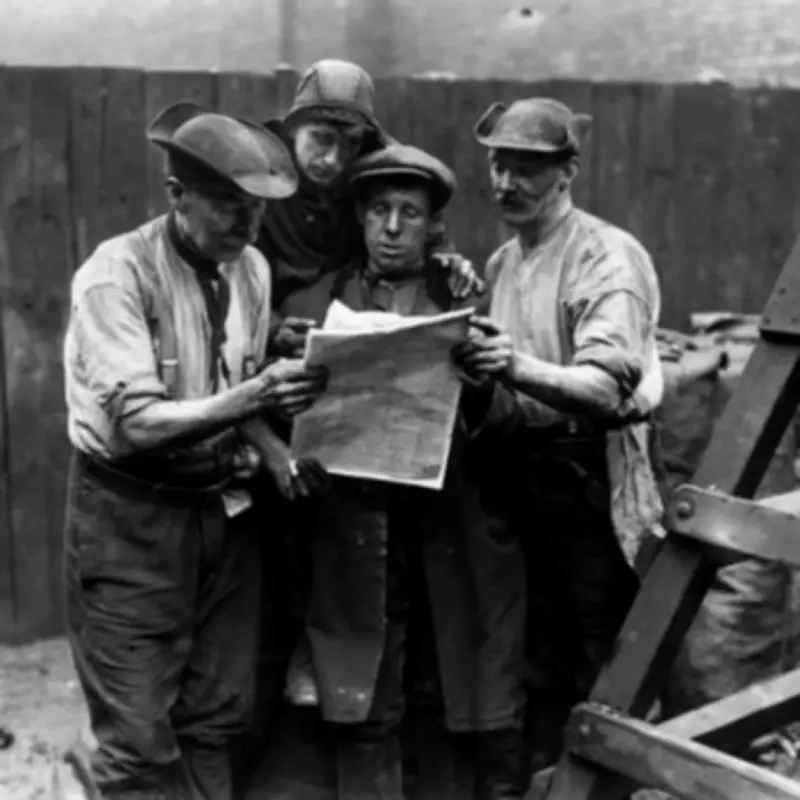
On 4 May 1926, the British people awoke to an eerie silence. Trains, trams, and buses remained in their depots; factory chimneys that once belched smoke over industrial towns stood idle. The general strike had begun. For nine days, over 2 million workers—dockers, railwaymen, bus drivers, printers, and factory workers—downed tools in solidarity with 1 million coalminers locked out after refusing severe wage cuts.
The Coal Crisis and the Road to Strike
Britain’s coal owners, described by a government minister as “the stupidest men in England,” refused to invest in modernisation. When times were hard, they imposed pay cuts. British coal had become less competitive, worsened by Chancellor Winston Churchill’s decision to return the pound to the gold standard. Miners, who powered the Empire under harsh conditions, demanded nationalisation and pit modernisation. Their leaders, Herbert Smith—a Yorkshireman who started work aged ten—and A.J. Cook, a radical follower of Lenin, coined the slogan: “Not a penny off the pay, not a second on the day.”
In summer 1925, matters came to a head. Miners rejected pay cuts and appealed to the Trades Union Congress (TUC). The TUC agreed to embargo coal movement if miners were locked out. The government backed down, granting a temporary subsidy and establishing the Samuel Commission to examine the coal industry. This victory, dubbed “Red Friday,” infuriated Churchill. “You have done it over my blood-stained corpse,” he told Cook. The subsidy lasted only until April 1926, setting the stage for confrontation.

Government Preparations and Fears of Revolution
Stanley Baldwin’s Tory government prepared for conflict. Since the 1917 Russian Revolution, the establishment feared communism, believing a national strike could spark revolution. Hardline Home Secretary William Joynson-Hicks asked: “Is England to be governed by Parliament and the Cabinet or by a handful of trade union leaders?” Moderate TUC and Labour leaders, equally scared of revolution, sought compromise. On the eve of the strike, Jimmy Thomas begged the government to extend negotiations. But when printers at the Daily Mail refused to set an anti-union article, hardliners broke off talks. Baldwin shook TUC secretary Walter Citrine’s hand, saying: “I believe if we live we shall meet again to settle it…if we live.” The strike began.
Propaganda War: BBC, Newspapers, and the Battle for Public Opinion
With print workers on strike, a propaganda war erupted. The TUC’s British Worker insisted the strike was about wages, not the constitution. The government’s British Gazette portrayed it as a revolutionary plot. The BBC, only four years old, played a crucial role. Thousands bought wirelesses to hear news bulletins. Though claiming neutrality, the BBC relied on government sources. Director John Reith allowed Baldwin to broadcast from his study, where the Prime Minister declared: “I am a man of peace…but I will not surrender the safety and security of the British Constitution.” When the Archbishop of Canterbury and opposition leaders sought airtime for a compromise proposal, Reith refused under government pressure. The BBC and Gazette also reported Cardinal Bourne’s sermon calling the strike “a sin against the obedience which we owe to God.”
Solidarity on the Ground and Volunteer Strike-Breakers
The strike proved more solid than expected. Activists struggled to keep non-strikers at home. A London union official noted: “All the flunkeys in the whole West End of London could blow out all their teeth without getting a ghost of a response from a taxi driver.” Strike committees issued permits for essential supplies; lorries carried signs stating “By permission of the TUC.”

Thousands of middle-class volunteers signed up to break the strike. Despite high unemployment, few were manual workers—they supported the unions. Instead, Oxbridge students, encouraged by their colleges, worked on Dover’s docks and drove buses in Hull. Inexperienced volunteers caused railway accidents that killed at least four passengers and one volunteer. Gentlemen’s clubs in Piccadilly provided special constables. Some volunteers were billeted in bus depots or docked ships to avoid picket lines. London’s Hyde Park became a logistics depot where society ladies peeled potatoes and made tea for strike-breaking drivers.
Escalation and Repression
As volunteers replaced strikers, ugly scenes erupted. At Tilbury dock, convoys were stoned. In Plymouth, after strikers beat police 2-1 in a friendly football match, a crowd rioted and attacked trams. Working buses had tyres slashed and engines sabotaged. On 10 May, the Flying Scotsman was derailed after miners removed a rail; remarkably, only one person was injured. State repression intensified. Thousands were arrested under emergency regulations giving police sweeping powers. By the second week, Churchill prepared a paramilitary force, the Civil Constabulary Reserve, to unleash on picket lines.
Surrender and Aftermath
Union leaders, as worried as the government about spiralling unrest, explored backchannels for talks. They found a friend in Sir Herbert Samuel, who met Thomas at a mutual friend’s home. They hammered out a compromise, enough for the TUC to call off the strike. At noon on 12 May, union leaders attended Downing Street to surrender. Baldwin immediately made clear Samuel had acted alone; the government was not bound to his compromise and had no intention of negotiating. Workers returned, but thousands were victimised, some unable to find work for years.
The miners fought alone for seven bitter months. Cook praised the workers’ solidarity but denounced the TUC: “Never have we been bullied by the employers or the Government to the extent that we were bullied by certain trade union leaders to accept a reduction in wages.”
Legacy: The Nine Days Wonder
The strike became known as “the Nine Days Wonder,” after which everything returned to normal. Pop culture set in the 1920s—like Downton Abbey—often ignores it, or—like Peaky Blinders—reduces the organised working class to a feral gang. But in mining areas, the strike lived long in memory. Churchill was reportedly still booed in cinemas when he appeared on newsreels, even after the war. A century later, it remains a powerful example of working-class solidarity and the lengths to which the establishment will go to protect its power and privilege.
Britain’s Revolutionary Summer by Edd Mustill, a trade unionist and Labour historian based in Sheffield, is published by Oneworld, priced £16.99.