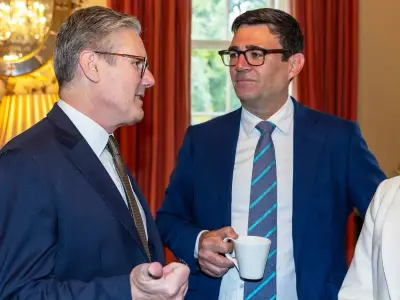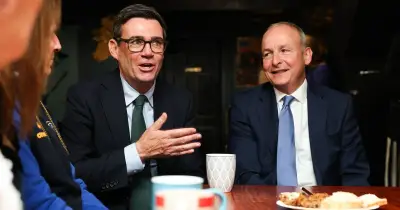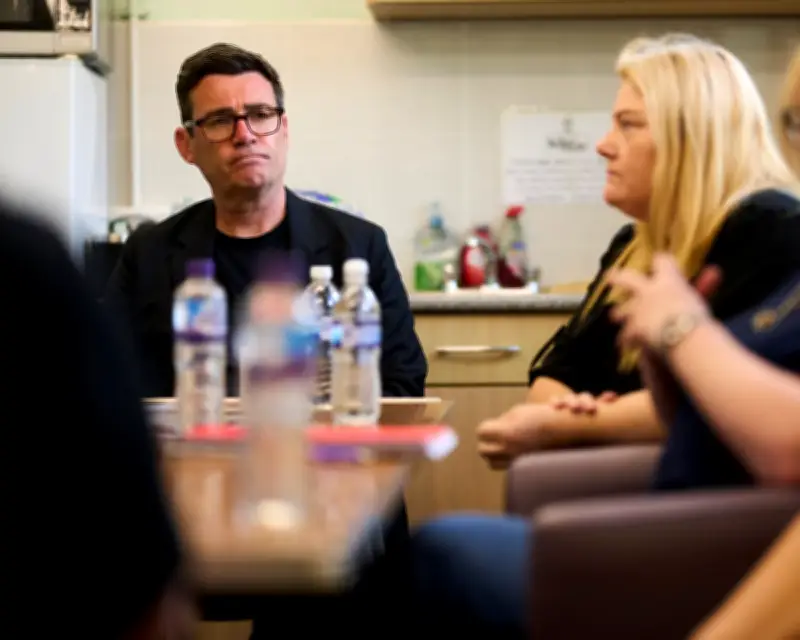
Andy Burnham at Platt Bridge community centre in the Makerfield constituency where he is standing as the Labour candidate in the 18 June byelection, 2 June 2026. Photograph: Christopher Thomond/The Guardian
'Labour had their chance – they flopped.' Two days in Makerfield show me the scale of Burnham's task
John Harris in Makerfield

Touring this bitterly divided constituency, what strikes you most is people want something better. But what exactly? Keir Starmer teeters. The defence secretary exits, and thereby seems to confirm the prime minister's demise. Andy Burnham scents a final, belated breakthrough, while most of the national talk is of violence, a country in crisis and malaise. And in Platt Bridge, a neighbourhood at the heart of the constituency where the fates of the Labour party, the current government and the country are all about to be decided, life still seems to be locked into an endlessly familiar pattern.
Amid all the redbrick terrace houses, too many shops are shuttered and empty. The latest casualty was a proudly independent baker who had traded for 40 years, apparently to be replaced by another tanning lounge. The main roads are clogged with traffic, while other streets tend to be eerily quiet. People speak of closed-down pubs, impossible private rents, and that ubiquitous British complaint: 'There's nothing for the kids to do.'
There is community spirit aplenty here, and optimism about a £20m 'pride in place' grant recently confirmed by the government. But amid chatter about who people might vote for in this week's Makerfield byelection, what you feel most strongly is something that seems to run through this corner of Greater Manchester: the sense of somewhere stoically waiting for something better.
Outside the local bike repair business – whose owner, Paul Bullen, says he makes almost no money, and sees what he does as a community service – I meet Billy, a twentysomething on his way to work as a 'mechanical and assembly operative' at a local engineering firm. He says he has never voted before, but is determined to this time. 'Come on, Reform,' he says, and then pauses. 'I don't think they'll be able to fix everything, but they're a step in the right direction. Definitely.'
What does he think of Burnham?
'He's done good. I'll give him that,' he says. 'He has done good. But I think Labour's had their chance. They had 14 years to come up with a plan, and they've just … flopped.'
What kind of country does he want to live in?
'A free country. Without two-tier policing. Where the British people are put first. Working-class people, who keep the country running.'
Do the Britons he means include people who are not white? An inevitable tension suddenly intrudes; he steps slightly to one side. 'It's not to do with what colour your skin is,' he says. 'Absolutely nothing to do with that. But I stand with Farage: like, if you're here illegally, you should be deported.'
Neighbouring homes in Ashton-in-Makerfield show their support for Labour and Reform UK, 10 June 2026. Photograph: Christopher Furlong/Getty Images
Ten minutes later, I fall into conversation with Meah. In 2019, she thought she was temporarily relocating from London to the place where she was brought up, but decided to stay put. Platt Bridge, she tells me, 'needs a lot of TLC'; she talks animatedly about people still waiting for compensation after the infamous local floods that happened more than a decade ago.
'I like Andy Burnham,' she says. 'Years ago, I started watching him. I just think he'd make a really good PM.' And if Reform won? 'I'd die. I was born in the 50s. We fought against racism, and the National Front and the BNP. We marched. So I'd be devastated.'

There it is, instantly crystallised: the clash of morals, priorities and understandings of recent history at the core of this hugely consequential vote. On one side, Burnham's homely communitarianism, his emphasis on council housing, local high streets and the urgent need to reconnect the political mainstream with everyday life. On the other, Robert Kenyon, the conspicuously out-of-his-depth Reform candidate, whose party nonetheless issues messages that appeal to thousands of voters – about immigration, grooming gangs and such ground-level topics as fly-tipping. And to his right, the apparently lavishly funded campaign launched by Rupert Lowe's Restore Britain, an attempt to pull the local discourse even further towards the fetid sludge of the far right, which is evidently causing Farage and co no little worry.
Some positives. The bookies make Burnham the favourite: at the time of writing, William Hill had him at 1/5, with Reform at 4/1. In contrast to the strange, noncommittal mood that defined 2024's general election, it is not hard to find Labour voters, and enthusiastic ones at that. The idea that a Reform government would cut people's benefits and privatise the NHS has had clear cut-through. There again, Reform posters and placards seem to outnumber Burnham's (most of which feature a caricature by the Mancunian artist Stanley Chow, and simply say 'Vote Andy for us', with no mention of his party) by a ratio of two to one. At nearby Wigan's town-centre Premier Inn, whose breakfast room is packed each day with pundits, journalists and pollsters, there is a rough consensus that Burnham will almost certainly win, but some think that it might be a bit closer than the latest predictions suggest.
One feeling in particular seems to sum up the local condition, not least among women, and it centres on a common left-liberal blind spot: an awful anxiety about crime and personal safety. At Tudor House, a community centre down the road from Platt Bridge in Hindley, I spend well over an hour chatting to a dozen or so women who are loyal members of a group called Craft Hive, and out it all comes: 'I never, ever go out in the evenings … It's just not safe … you look over your shoulder all the time … where are the police?'
Up until a year ago, one woman I speak to – who wants to stay anonymous – ran a cafe in the middle of Wigan. She says she is still traumatised by a stabbing that happened nearby, and what ensued: people – including mothers and babies – sprinting inside her premises, as she frantically locked the doors. She recently split from her partner, and is now homeless: 'living out of bags' with her daughter, and wondering how she will get through each day. And she says she is drawn to backing Reform.
Reform and Restore are both hard right and poisonous – but their differences could be their undoing | Andy Beckett
'I just think we need to give someone else a chance,' she says, 'and I like what they say about keeping the streets safe … there needs to be a change.' This is what all the UK's progressive parties should really worry about: the kind of Reform-leaning voters who know about precarity and worry as a matter of everyday experience, and see the party as a last desperate roll of the dice, for want of anything more worthy of their support.
Recent crime figures show that local knife crime fell by 16% in 2025, with burglaries down 24%, but that doesn't really get to the heart of what I hear. A lot of it is about the plain facts of women's lived reality. And what people say about crime of all kinds feels like it is partly bound up with all those eerily silent streets and closed-down pubs, and the stress and anxiety that comes from the belief that no one in power has your back. Put another way, economic gaps and social vacuums abound here, and are sometimes filled, to paraphrase Farage, with pure, cold fear.
Two days spent here fills me with a sense that, as he presumably well knows, all this represents Burnham's defining challenge. If he makes it to Downing Street, more than anything, his job will be to somehow convince places such as this that the future can feel that bit rosier, and some of that fear can at least recede. If everything works out, he will have a mere three years; possibly even less. Such, for all the local quiet, is the frightening urgency of everything swirling around this coming Thursday.
John Harris is a Guardian columnist