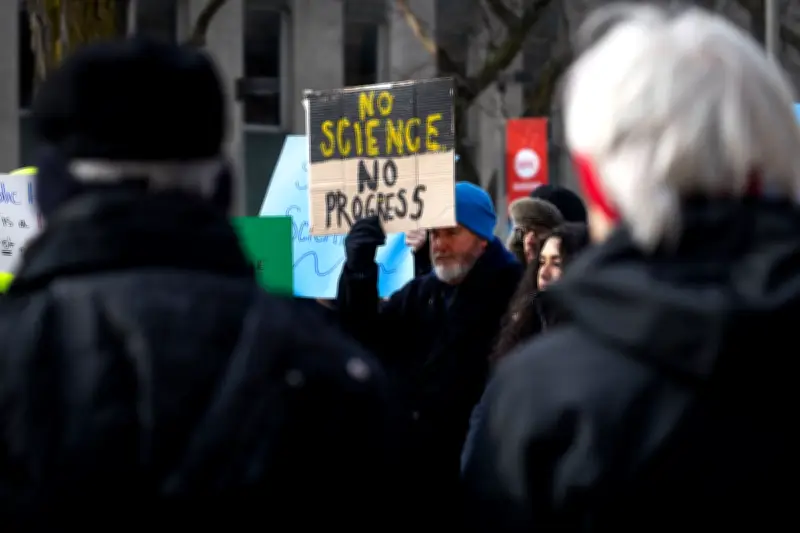
A proposal from the Office of Management and Budget (OMB) under President Donald Trump would overhaul the federal grant-making system, potentially putting nearly $1tn in funding under the control of political appointees. The plan has sparked widespread outrage among scientists and organizations, who warn it could disrupt research across fields from healthcare to environmental protection.
Background and Immediate Impact
The proposal, quietly introduced in May, would replace the current grant-making process with one that allows political appointees to make funding decisions based on presidential priorities. It criticizes so-called "woke" policies, bans diversity, equity, and inclusion (DEI) programs, and prohibits undefined "anti-American values." The rule would also discourage international collaboration and allow cancellation of grants deemed not in the federal government's "interest."
Scientists have already experienced similar disruptions. In spring 2025, the National Institutes of Health (NIH) canceled grants on discrimination and gender research. Harvard professor Nancy Krieger lost her nearly $1m grant to study how discrimination affects population health. "It was complete shock and dismay," Krieger said. She now juggles teaching, litigation, and supporting her team's morale.

Scope and Opposition
The OMB rule affects an estimated $1tn in federal grants, including $150bn for science and technology. The NIH, the world's largest public funder of biomedical research, has a $47bn budget. The proposal has drawn nearly half a million public comments, with analyses showing 95% in opposition. Twenty-two state attorneys general have united against it, with California's Rob Bonta calling it an attempt to "weaponize essential federal funding."
Critics argue the rule would undermine decades of peer-reviewed research. "Healthcare, education, social services, environmental protections – it's way beyond just research," said Sara Rosenbaum, professor emerita at George Washington University. Lawrence Gostin of Georgetown Law called the 45-day comment period a "subterfuge," as the administration is unlikely to heed feedback.
Legal and Political Challenges
If enacted, legal challenges are expected. Gostin noted that a grant denial might be needed for standing, but he anticipates lawsuits from state attorneys general and institutions. However, outcomes in conservative courts are uncertain. Democratic Senator Tammy Baldwin accused the administration of "endangering the health and safety of Americans" and using grants as a "cudgel to punish political enemies."
The White House fraud taskforce defended the rule, saying it ensures taxpayers don't fund "woke NGOs." The Heritage Foundation, author of Project 2025, supports it. OMB director Russell Vought dismissed criticism as a "freakout by those on the left."
Broader Implications
The rule threatens to disrupt clinical trials, long-term research, and young scientists' careers. Krieger emphasized unity among scientists studying "the farthest reaches of the galaxy to the deepest depths of the sea," all facing censorship and ideological agendas. The public comment period closed this week, with the administration expected to formalize the rule soon.