Commentators left, right and centre are now trying to grasp the bouncing ping-pong ball that is One Nation, which has been hiding in plain sight. When Donald Trump descended the golden escalator in 2015 to announce his run for president of the United States, the world laughed. And when I landed in Washington late that year to lead the ABC’s coverage of the election, there was an expectation that Hillary Clinton would walk into the Oval Office.
Throughout that campaign, as other correspondents and I crisscrossed America trying to understand the grievance politics creeping across the nation, especially the inland states, we battled a perception from Australia that Trump was just a sideshow. Yet he masterfully commanded centre stage, attracting outsized mainstream media coverage because he drove clicks and ratings, creating a massive unfiltered Maga echo chamber via social media and successfully undermining journalism as fake news.
By the time the media snapped back at him, along with the whiplashed political classes trying to hold him to account, it was too late. Criticism was read as conspiracy against the will of the people. Those who stormed the US Capitol in January 2021 were accused of treason, but in their minds it was the reverse. They believed the election had been stolen from Trump. Even attempts to hold Trump to account via impeachment merely fed his popularity.
He was able to capitalise on a fragmentation of trust in politics, the media, and the global order. Mystifyingly, given his wealthy background, he framed himself as the “everyman”, the one who would stand up for real people and call out the elites. By the time the media realised he was building a movement, it was too late. “I could stand in the middle of Fifth Avenue and shoot somebody, and I wouldn’t lose any voters, OK?” he famously said in 2016. “It’s, like, incredible.”
Now in Australia, a similar phenomenon is unfolding
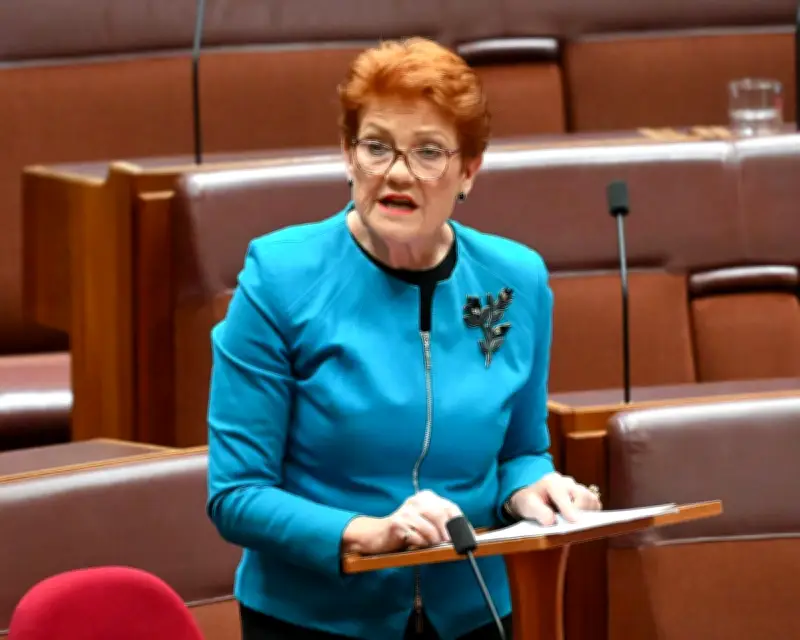
Right now, in Australia, commentators left, right and centre are similarly trying to grasp the bouncing ping-pong ball that is Pauline Hanson’s One Nation, which has been hiding in plain sight. If only journalists had been as quick to catch on to the shortcomings of the major parties as the voters have. This is partly due to the lack of media resources for ongoing field reporting, but also to the media’s own attachment to the two-party system.
While they now marvel at the rise of a party that has been a sleeping threat for years, the ping-pong ball has escaped the arena and is already bouncing down the hill. As it stands, we have already passed Trumpism stage 1 – outsized media coverage in response to ratings and public fascination, stage 2 – controlling the social media algorithm by unleashing both spectacle and paid bots, and stage 3 – undermining journalism and banning and avoiding those who ask hard questions.
In stage 4 – the post-truth era – no matter what evidence is mounted against Hanson, her previous voting record, lack of policy depth, or lack of attendance in parliament, it does not matter. Once a fish and chip shop owner, always a woman of the people. That is despite being a politician, celebrity, and property investor for all of the 30 years since. The fact that neither the major parties nor the mainstream media saw it coming is, on reflection, surprising.
The rise of community independents is different but related
As the numbers show, votes for the major parties are on the slide. The independents built a movement to provide people with an alternative. One Nation is now borrowing from that. As South Australia’s One Nation state president and MLC Carlos Quaremba told The Australian: “That’s why I think that One Nation is going to keep building because it is transcending the rules of what it means to be a political party.” People are “just so sick of business as usual and are coming to us”, he said. The crowdfunding movement that supports it sounds very familiar, as does the sentiment.
As ABC’s US bureau chief during the first Trump administration, I spent years trying to understand his supporters. By and large, they were everyday people who were angry with the way they were being led. Often, but not always, they lived in towns and regions that had lost their manufacturing base, been negatively affected by global trade rules, seen or perceived their jobs taken by migrant workers, could not afford to pay for their children’s education, struggled to access healthcare, and struggled to make ends meet. They had lost hope.
Some were doctors, lawyers, teachers, successful in business. All felt disempowered. Many had misgivings about Trump, especially regarding his treatment of women and multicultural communities. A lot supported him anyway. It was seen as a way of taking power back. From a journalistic perspective, it was full of contradictions. There was no real way of rationalising it. The only approach was to listen.
In a few days, Hanson will speak at the National Press Club officially for the first time in her sporadic three-decade political career. It is being billed as both a risk and an opportunity for her and for the reporters who may reflexively go for gotcha moments. Doing so will only cement the very public trust gap that is driving the political upheaval. Questions absolutely must be asked and answered, but the answers may be more likely to be found outside the four walls of the National Press Club than inside it, by listening to everyday people.