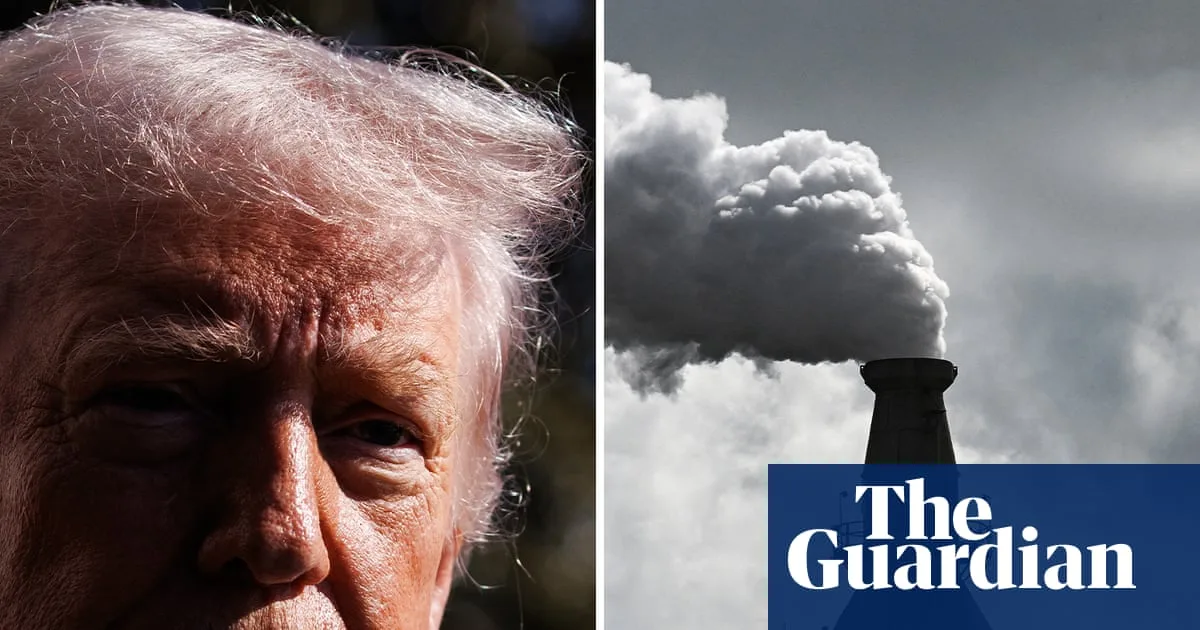
Trump's Climate Rule Reversal May Expose Big Oil to Legal Onslaught
Trump's Climate Rule Reversal May Expose Big Oil to Lawsuits

Trump's Climate Rule Reversal May Expose Big Oil to Legal Onslaught

The Trump administration's repeal of the endangerment finding, initially perceived as a victory for major oil corporations, could ironically render the fossil fuel industry more susceptible to litigation and local policies, according to legal analysts. This foundational climate determination, established in 2009, recognized greenhouse gases as a threat to public health and welfare, enabling federal emissions limits.

Legal Shield Under Threat

Earlier this month, the Environmental Protection Agency (EPA) finalized a rule revoking the endangerment finding, eliminating federal controls on climate-warming emissions from vehicles and potentially extending to all pollution sources. Critics argue this move was intended to reward oil companies, which contributed record amounts to Trump's campaign. However, it may also undermine a critical legal defense the industry has used against climate damage lawsuits across the United States.

In recent years, dozens of states and local governments have filed climate-focused lawsuits against big oil. Since 2024, Vermont and New York have enacted "climate superfund" policies, forcing oil majors to help cover costs related to climate disasters. Fossil fuel firms have contended these actions should be dismissed due to preemption by the federal Clean Air Act. The endangerment finding rollback could dismantle that argument, as noted by Pat Parenteau, an environmental law expert at Vermont Law School.

"I don't see how oil companies can, with a straight face, any longer make that argument," he stated. In 2011, the Supreme Court dismissed a climate lawsuit by Connecticut against a power company, ruling emissions should be regulated by the EPA under the Clean Air Act, not courts. Since then, nearly a dozen similar cases have been dismissed on comparable grounds, with many appeals pending.

Supreme Court Test Looms

The future of this legal shield faces a significant test as the Supreme Court considers a petition from fossil fuel companies to quash a climate lawsuit filed by Boulder, Colorado. The companies claim federal law prohibits seeking climate damages in state court. If the justices side with the oil industry, they could invalidate the Boulder case and potentially other climate accountability lawsuits and superfund laws. However, this decision could become complicated if the court later addresses the endangerment finding repeal.

Michael Gerrard, founder of the Sabin Center for Climate Change Law, suggested that public nuisance claims—alleging companies harmed community health and safety—may particularly benefit from the rescission. Yet, oil companies argue that suits centered on deceptive messaging, rather than emissions, are still fundamentally about pollution and should be preempted by the Clean Air Act.

"All climate accountability cases could be affected," Parenteau emphasized. Trump's Justice Department has also sued New York and Vermont over their climate superfund policies, partly on grounds that the Clean Air Act already regulates greenhouse gases. The EPA rollback may weaken those claims, according to Sarah Light, a law professor at the University of Pennsylvania.

Industry Anxiety and Ambiguity

Corporate interests are expressing trepidation about the repeal. Andres Restrepo, a senior attorney at the Sierra Club, noted on a press call that many companies are concerned, indicating industry nervousness. The utility trade group Edison Electric Institute warned last fall that a repeal could trigger increased litigation, while the American Petroleum Institute supported a repeal for vehicles but not for stationary sources like power plants.

This stance contradicts earlier API efforts, which included a multi-industry campaign in the 1990s opposing federal greenhouse gas regulation and attempts to block the endangerment finding before its finalization. The EPA's revocation focuses solely on vehicle pollution controls, not stationary sources, but experts say it undermines the legal basis for all greenhouse gas standards, with broader implications likely to be clarified soon.

Delta Merner, lead scientist at the Union of Concerned Scientists, described the current "ambiguity" as intentional, giving the fossil fuel industry time to prepare legal arguments amid regulatory uncertainty. The EPA maintains that the Clean Air Act still preempts state greenhouse gas laws, but Restrepo called this an attempt to "have their cake and eat it too."

Broader Immunity Efforts

In the past year, fossil fuel companies and allies have pushed for extensive protection from climate accountability. A U.S. representative from Wyoming is crafting legislation to address big oil lawsuits and climate superfund bills, while two red states introduced bills to shield fossil fuel firms from litigation. Republican state attorneys general have urged the Justice Department to provide a liability shield, and ConocoPhillips and API have pressed Congress on draft legislation to limit climate liability.

Merner suggested that threats to the preemption shield may drive these efforts, with oil companies seeking a liability waiver similar to 2005 protections for the firearms industry. However, communities will continue pursuing climate accountability in innovative ways, she asserted, emphasizing that state governments and courts become crucial when federal protections fail.

"The federal government stepping back from regulating climate pollution doesn't make the problem disappear," Merner concluded, highlighting the ongoing legal and policy battles ahead.