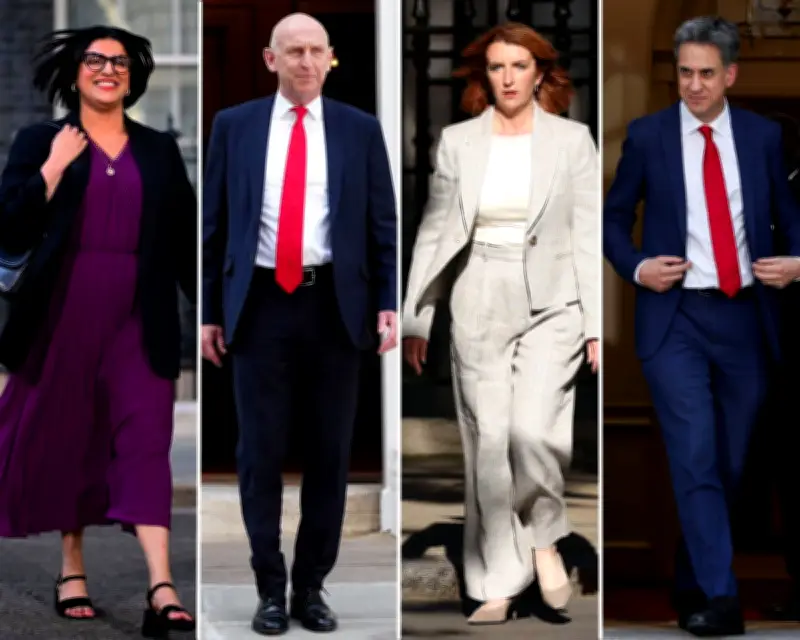
Andy Burnham has appointed his first cabinet, with the new prime minister rewarding those who have been loyal to his takeover efforts. He had promised to pick his top team from all wings of the party in an effort to show he is trying to run a more inclusive administration. But at the same time, his decision to have a brutal clearout of Starmer allies resulted in many considered to be on the right of the party or close to the former prime minister losing their jobs.
Who is in?
John Healey – Chancellor. The former defence secretary who quit the government over a lack of funding for the defence investment plan is the surprise appointment to the Treasury. Healey, 66, is a steady and experienced force, having been an MP since 1997, and serving as a Treasury minister under Tony Blair. The job had been expected to go to Ed Miliband and then it was mooted for Shabana Mahmood. Healey grew up in Wakefield, studied political science at Cambridge, and was a journalist, campaigns director at the Trades Union Congress and a disability rights campaigner before entering parliament. Unshowy and not part of the usual Westminster dramas or scandals, it was a shock when he resigned his role under Starmer, in what would be one of the fatal blows for his premiership.
Shabana Mahmood – Home secretary. Mahmood will keep her role in Burnham’s cabinet after being appointed home secretary by Keir Starmer last year and charged with driving through controversial immigration policies. She is considered to be on the Blue Labour right of the party, which is socially conservative and tough on crime. She grew up in Small Heath in inner-city Birmingham in the 1980s and 90s, where her father kept a cricket bat behind the till of the family shop to fend off would-be robbers. After going to the University of Oxford to study law, she worked as a barrister. The 45-year-old is an MP in Birmingham and ran Labour’s election campaign in 2024, before a stint as justice secretary overseeing an early release programme to ease overcrowding. A cabinet colleague told the Guardian earlier this year that she “never wastes a word” in meetings.

Ed Miliband – Foreign secretary. Miliband is a great survivor in the Labour party – almost as much so as Andy Burnham. A former cabinet minister under Gordon Brown, he led Labour to an election defeat in 2015 before serving in the shadow cabinet of Keir Starmer. He was a leading contender to be chancellor but there were fears his positioning on the soft left and as a firm defender of Britain’s net zero commitments would spook the financial markets. Born in north London in a political family, his father was a Marxist academic. He studied PPE at Oxford. As foreign secretary, he will be expected to take international matters off Burnham’s hands as much as possible, take a more pro-Gaza stance and potentially set a path to restoring Britain’s aid commitments to 0.7% of national income.
Yvette Cooper – Health secretary. Among the Starmer-era big beasts who had been tipped to survive, Cooper is shifted from the Foreign Office to the vital domestic post of secretary of state for health and social care. Cooper does have recent experience of a tricky UK-focused post, starting in Starmer’s government as home secretary, and she held several posts under Tony Blair and Gordon Brown. While still in her 50s, Cooper is approaching Labour “grandee” status, having been an MP since 1997. When Labour’s 2015 leadership campaign began she was initially viewed as a favourite, but finished third behind Corbyn and Andy Burnham.
Pat McFadden – Work and pensions secretary. McFadden, one of the more experienced operators in government, will be tasked with continuing to pilot through some sort of reform to social security. An MP since 2005, McFadden was soon propelled into the Blair and Brown frontbenches, and spent the buildup to the 2024 election as Starmer’s national campaigns coordinator.

Louise Haigh – Chancellor of the duchy of Lancaster, first secretary of state and Cabinet Office minister. Haigh became a linchpin of Burnham’s byelection operation, so it is no surprise she is now his chief organiser in government. It marks a return to cabinet for the 38-year-old Haigh, who was sacked by Keir Starmer as transport secretary for not having told him fully about a fraud conviction over a missing mobile phone when she was in her 20s. She grew up in Sheffield and studied politics and government at LSE, then Nottingham University, before working in parliament, for Unite and later at the insurer Aviva. Elected in 2015, she was one of 36 Labour MPs to nominate Jeremy Corbyn for the Labour leadership that year.
Wes Streeting – Defence secretary. Streeting is one of the only appointments to cabinet who is considered to be towards the right of the party. He is also one of the reasons Burnham is prime minister, after attempting unsuccessfully to challenge Starmer, kicking off the process of removing him. A former health secretary, the ambitious Streeting is likely to be pleased at getting an even bigger job, especially at such a crucial moment in the Ukraine war.
Angela Eagle – Environment secretary. A first full cabinet role for the former security minister, but not much of a jump given Eagle is hugely experienced. The twin of fellow Labour MP and minister Maria, Angela Eagle beat her sister into parliament by five years, winning her Wallasey seat for the first time in 1992.
Miatta Fahnbulleh – Energy secretary. Fahnbulleh is a rising star in the party who contributed heavily to Burnham’s policy ideas as he was preparing for government. She previously worked closely with Miliband so was a natural choice for the energy role.
Alex Norris – Justice secretary. The relatively low profile Alex Norris was a Home Office minister and an unexpected choice for justice secretary. A Nottingham MP, he was a trade union organiser for Unison and councillor before he entered parliament in 2017.
Heidi Alexander – Transport secretary. Part of the relatively small continuity brigade in the Burnham cabinet, Alexander remains in the post she took over in November 2024 when the incumbent, Louise Haigh, had to step down. A south London MP from 2010, Alexander quit parliament in 2018 to become Sadiq Khan’s deputy mayor for transport in London. She returned to the Commons in 2024 in a Swindon seat.
Jonathan Reynolds – Business secretary. Reynolds returns to his former role after being shuffled sideways to the job of chief whip against his wishes. A fellow north-west MP, Reynolds has long been a friend of Burnham and has been given a crucial role in a beefed-up department that will cover science as well as his old portfolio.
Angela Rayner – Housing secretary. Rayner will be pleased to get back the job of housing secretary less than a year after she resigned over underpaid stamp duty on the purchase of a second property. She had been the subject of speculation that she would be health secretary but sources had suggested she would take some persuading when her main interest is devolution and housing.
Lucy Powell – Education secretary. Powell is likely to be pleased with this substantive brief but Burnham has so far stopped short of making her deputy prime minister – despite her job as deputy leader of the party. Another Manchester area MP, Powell has long been an ally of Burnham.
Lisa Nandy – Culture secretary. One of the few survivors of the original Starmer cabinet, Nandy stays in the same job. Her Wigan constituency adjoins Burnham’s. She now gets to wrestle some more with a suite of challenges including the future of the BBC and the impact of social media.
Ellie Reeves – Attorney general. A bump up the ladder for the Reeves sister who remains in the cabinet – after nearly a year as solicitor general, she becomes attorney general, taking over from Richard Hermer. A lawyer by training, Reeves undertook a series of Labour party roles before winning her south London seat of Lewisham West and East Dulwich in 2017.
Anneliese Midgley – Chief whip. Midgley, a former political director for Unite, had been instrumental in helping Burnham with his Makerfield campaign. She was thought to be a contender for party chair but instead Burnham is seeking to harness her talent for organising as chief whip.
Emma Reynolds – Chief secretary to the Treasury. A cabinet survival – sort of, she will attend cabinet – for the former environment secretary who was very close to Starmer. The rationale appears to be that Reynolds can be both an overtly pro-business voice in the Treasury, as well as being an experienced hand to assist Healey.
Douglas Alexander – Scotland secretary. A continued stay in the cabinet for another Commons returnee, who has filled the role since Starmer’s September 2025 reshuffle. Being Scotland secretary was not new ground for Alexander – it was one of several cabinet roles he held under Blair.
Chris Bryant – Northern Ireland secretary. Another cabinet debutant, although Bryant has held a series of other ministerial roles. The Rhondda MP is known as a safe pair of hands. An MP since 2001, having studied theology and served briefly as a Church of England priest, Bryant is an expert in Commons procedures.
Stephen Kinnock – Wales secretary. Also a first dip of the toe into cabinet waters for the former minister for care in the health department. The MP for Aberafan Maesteg in south Wales, Kinnock has been in the Commons since 2015. He is the son of the former Labour leader Neil Kinnock.
Alan Campbell – Leader of the Commons. No change in this sometimes technical but highly important role, with Campbell tasked with piloting Burnham’s legislative agenda through the Commons. An MP since 1997, Campbell was called to the cabinet in 2025.
Who’s out?
Rachel Reeves – Former chancellor. Reeves had always wanted the job of chancellor and was proud to be the UK’s first female holder of the office. She had worked hard to instil ironclad fiscal discipline on Labour. However, some in Labour blamed early missteps from her Treasury for Starmer’s downfall. She made a valiant effort to stay in her job but ultimately was judged too close to the Starmer project to stay in the Treasury. In her departing statement, she said: “It has been the privilege of my life to serve as the chancellor of the exchequer. The economy today is stronger, fairer and more resilient because of the choices we have taken as a Labour government over the past two years.”
David Lammy – Former foreign secretary. Lammy has been a longstanding frontbencher after serving as a minister in the last New Labour governments. He served as foreign secretary for Keir Starmer and then won a promotion to deputy prime minister and justice secretary when Angela Rayner stood down. In a post on X announcing his departure, Lammy wrote: “I would have been proud to continue serving in cabinet. But a new prime minister is entitled to build his own team, and I wish Andy Burnham and the new cabinet every success.”
Darren Jones – Former chief secretary to the prime minister. From the centre of No 10 operations to nothing. As Jones put it in a bluntly worded social media post: “Andy Burnham has called to tell me I won’t be a part of his new cabinet. I wish him and his team every success.”
Steve Reed – Former housing secretary. Reed was one of most loyal cabinet ministers to the Starmer administration, although he had made a play to keep his job. His letter to Burnham after his departure from government was somewhat spiky, warning him not to disadvantage London.
Peter Kyle – Former business secretary. Kyle took on the job of business secretary last year in the emergency reshuffle prompted by the departure of Angela Rayner. He previously served as science secretary. Kyle entered parliament in 2015 and has been open about his struggles to get there.
Richard Hermer – Former attorney general. Hermer was probably Starmer’s closest friend in politics. A fellow human rights lawyer, he was made a peer so that he could join the prime minister’s first cabinet. However, he quickly became a bogeyman for the rightwing press, which disliked his role in signing over the Chagos Islands to Mauritius.
Liz Kendall – Former science and technology secretary. Kendall has always been on the right of Labour and ideologically much closer to Starmer than to the new PM. An MP from 2010, Kendall supported David Miliband in the Labour leadership election of that year. In a tweeted letter, Kendall thanked Starmer and other cabinet colleagues, saying she was ready to support Burnham “in any way I can”.
Jo Stevens – Former Wales secretary. Also not expected to stay on, the Cardiff East MP has been a fixture in the Wales office, filling the brief in opposition and then government since 2021. A backer of Starmer when he stood to be Labour leader, Stevens had served as shadow Wales secretary under Corbyn.
Hilary Benn – Former Northern Ireland secretary. Some had speculated that Benn could be among ministers to stay in their job and provide continuity, but Benn tweeted that he has gone. It is a return to the backbenches for a Labour grandee, in parliament for more than 25 years.