
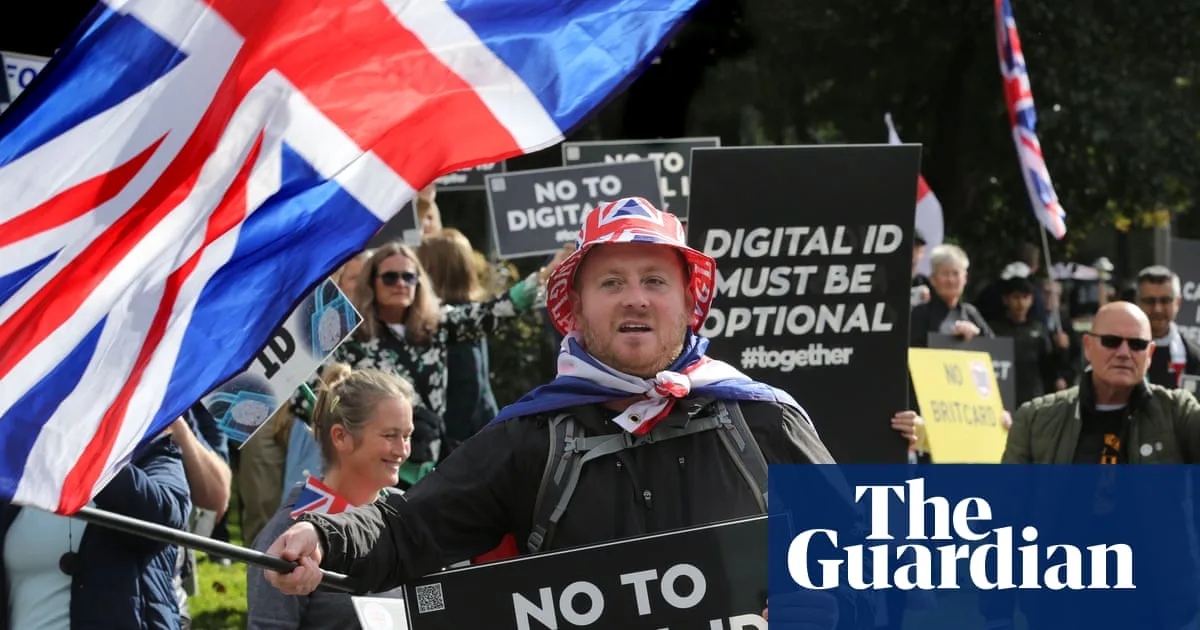
Public support for digital ID cards has fallen sharply after Sir Keir Starmer announced plans for their introduction, according to new polling. Net backing for the scheme dropped from 35% in the early summer to -14% over the weekend, a swing of 49 points. The findings, by the research group More in Common, suggest the proposal has been badly damaged by its association with an unpopular government.
In June, 53% of voters supported the introduction of digital IDs for all Britons, with 19% opposed. But after the prime minister set out the plan on Friday, only 31% were in favour, while 45% were against – including 32% who said they were strongly opposed. More than 2.6 million people have signed a petition opposing the scheme.
Luke Tryl, executive director of More in Common, said digital IDs were not unpopular in principle, but the government's involvement had caused a collapse in support. “Once the government announced the plans, support dropped,” he said. “If the government is to rebuild support it will have to start with making a clearer use case. The risk is that a policy that had the potential to be popular now becomes another millstone.”
The polling shows that dissatisfaction with Sir Keir Starmer is a key factor. Among voters who think the prime minister is doing a bad job, 58% oppose digital IDs and only 20% support them. Among those who approve of his performance, 71% are in favour. The prime minister's personal ratings have fallen to a record low, with Ipsos finding just 13% satisfied and 79% dissatisfied – a net score of -66, the worst for any premier since records began in 1977.
Peter Hyman, a former adviser to Sir Keir Starmer and Tony Blair, said the plans would be “dead in the water” within six months because ministers had failed to make a convincing case. He urged Downing Street to use social media influencers to counter conspiracy theories. The government says the IDs will be compulsory for anyone wanting to work in the UK and will be stored on smartphones, containing name, residency status, date of birth and nationality. Ministers aim to roll them out before the next election.




