
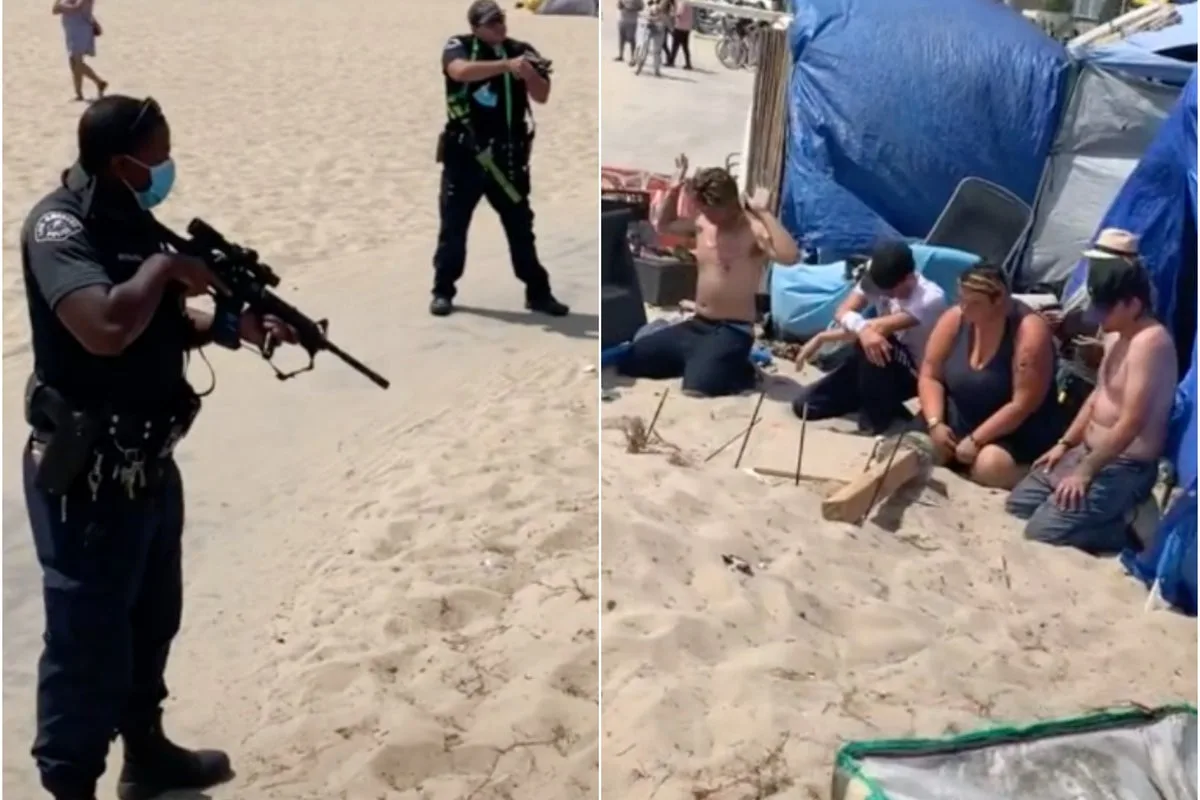
The Los Angeles Police Department (LAPD) has faced criticism after a video showing heavily armed officers raiding a homeless camp in Venice Beach went viral. The footage, which has garnered millions of views, depicts two officers—one holding a large rifle and the other a handgun—standing in front of several tents, with four individuals seated on the ground, one with his hands raised.
LAPD officer Norma Eisenman stated that officers were responding to a radio call on 25 July regarding an assault involving a deadly weapon. The suspect, described as a white man in a blue tent, was alleged to have threatened to shoot people. However, the suspect was later released after it was determined that the weapon was a pellet gun, possession of which is not illegal in California. No injuries were reported.
The incident has drawn attention to the city's ongoing homelessness crisis. Venice Beach is home to a significant portion of Los Angeles' homeless population, with approximately 1,600 homeless individuals among the neighbourhood's 40,000 residents. Citywide, there are an estimated 41,000 homeless people.
Last week, the Los Angeles City Council passed an ordinance, signed by Mayor Eric Garcetti, that criminalises sitting, lying, or sleeping near 'sensitive use' areas such as schools, parks, and libraries, as well as in public rights-of-way including streets and sidewalks. The law, which takes effect in 30 days, also prohibits storing personal property in these areas. Two council members voted against the measure, including Mike Bonin, who noted that the city only has shelter space for 39% of its homeless population.
Bonin shared his own experience of homelessness, stating, 'I cannot tell you how much turmoil is in your heart when the sun is setting and you don’t know where to sleep.' He argued that the ordinance tells the unhoused where they cannot sleep but fails to provide alternatives. A UCLA report has traced the roots of the crisis to post-Second World War housing shortages, exacerbated by racist zoning policies, cuts to mental health services, and other factors, disproportionately affecting Black and Latino communities.




