



Iranian Protester's Harrowing Escape: Urgent Plea to Save Death Row Activists
A protester who was brutally beaten during anti-regime demonstrations in Tehran last January and later managed to flee the country has issued a desperate plea for the world to act over the growing number of protesters facing death sentences. In a rare first-hand account shared with the Daily Mail, the individual, identified as Darius*, is speaking out for fellow demonstrators who were arrested and hanged after the unrest, calling on the international community to save Iranians on death row from what he describes as the clutches of 'monsters.'
Executions Amidst Growing Fears
According to the Norway-based NGO Iran Human Rights, 18-year-old musician Amirhossein Hatami was hanged on Wednesday after being sentenced by a so-called 'death judge' over his role in the protests. Images of his forced confession were aired on Iranian state TV, and his black curly hair was shaved off prior to the execution. In a further escalation, at dawn on Sunday, Mohammad Amin Biglari, 19, and Shahin Vahedparast Kolor, 30, were executed at Ghezel Hesar Prison.
Fears are now intensifying for dozens more individuals sentenced to death, with reports indicating that two other men, Ali Fahim, 23, and Abolfazl Salehi Siavashani, 51, are understood to be held at the same prison in an 'undisclosed location for execution.' Darius expressed profound anguish, stating, 'I will never get these images out of my mind, all those young people — it replays over and over in my mind and will haunt me for the rest of my life. All those young lives were just taken and murdered.'
The Night of the Crackdown
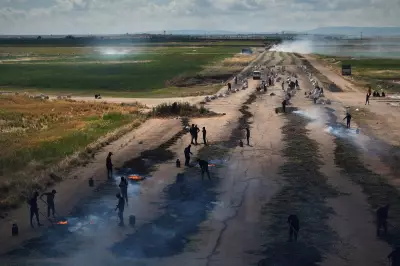
On January 8th, Darius and his wife were among hundreds of thousands who took to the streets across Iran after the former Shah's son, Reza Pahlavi, called for the regime to be overthrown. What began as mass demonstrations quickly spiralled into one of the bloodiest crackdowns in the country's modern history. Human rights groups estimate that around 40,000 people were killed and tens of thousands arrested as security forces moved to crush the uprising.
Speaking from hiding, Darius recounted the terrifying events: 'I was never at a demonstration in my life before, but we decided to go out on January 8th, on a Thursday evening. Reza Pahlavi called on us to go out at 8 pm, but as Iranians are fashionably late, we came out after dinner at 8:30. There were huge crowds building up.'
He described how the situation turned violent: 'By the time we got to Vanak Square, which is a very central place in north Tehran, there were maybe 50–60,000 people. As far as the eye could see, there was a crowd. My wife, a few friends, and I were there. We were about 50 rows away from the square when suddenly 16 or 17 motorcycles arrived, two men on each. We heard tear gas. One canister landed right next to my foot.'
Brutal Assault and Escape
Darius then detailed a harrowing assault: 'Everyone started running — total mayhem. A woman fell in front of me as I tried to run away. She was about 75 years old. I grabbed her hand and picked her up.' He heard a motorcycle racing up behind him and, turning to look, saw a second rider armed with a baton topped by a heavy ball and a gun. The man struck him on the head above the eyebrow, almost blinding him, and he collapsed to the ground.
When he tried to stand moments later, the officer swung again. He raised his hand to block the blow and instantly realised it was hanging limp from his wrist. 'I started running. They came after me. People were being shot. I think many were plain-clothes security forces. These 'Yegan Vijeh,' who are special forces, hit me, but among the crowd there were many plain-clothes security forces shooting people with real guns at close range — they were also pointing a green laser at people, and the snipers on the rooftops would shoot them.'
He added, 'They were inside the crowd, shooting demonstrators. They were probably among us from the beginning. People were falling, blood everywhere. Bodies kept going down like roulette, and we just kept on running for our lives.'
Aftermath and International Context
The executions occurred amidst Iran's war with Israel and the United States, which began on February 28 with airstrikes that killed the Islamic Republic's supreme leader, Ali Khamenei. Darius managed to escape with severe injuries, including a broken wrist and deep cuts, but avoided hospitals due to reports of security forces arresting and killing patients. 'We heard stories that some injured people in hospitals were killed. There were rumours that militias brought from Iraq were promised money for the injured and more for the dead, so some killed the wounded to get paid more. They took bodies from hospitals.'
After recovering in hiding, Darius eventually fled the country, though he cannot disclose the method for safety reasons. He concluded with a passionate appeal: 'We all want an end to this regime. We want Israel and the US to finish the job. We want Prince Reza Pahlavi to lead us. We want a democratic and free Iran.' The protests and violent crackdown have left deep scars, with activists warning the true death toll may never be fully known.
Breaking down in tears, Darius reflected, 'When you hear this story, it's hard to comprehend how such things can happen in only 2 nights. But really, they have been doing this for 47 years. How can the Islamic Republic do it to its own people? They are evil. You need to know what you're dealing with.'
*Names have been changed to protect identity.