UK Railways Disrupted as May Temperature Record Shattered at 35.1C
UK Railways Disrupted as May Temperature Record Hits 35.1C

Railways in parts of the country approached 50C today as UK temperatures broke May records for the second day running. South Western Railway (SWR) told the Daily Mail disruption on its network was due to 'the very high temperatures' as a record May high of 35.1C was recorded in London's Kew Gardens.

That temperature beat the previous high of 34.8C set on Monday, itself two degrees warmer than the record of 32.8C set in 1922 and 1944.

Passengers Removed from Trains

Passengers on a Chiltern Railways service from London Marylebone were kicked off their train for the second day in a row after staff said it was too hot to travel. Those on board the 4.37pm train were moved on to a different, 'crowded' train according to one passenger. The same service - headed to Stourbridge Junction in the West Midlands - terminated at Banbury, Oxfordshire, on Monday after its air conditioning system broke and staff were forced to hand out bottles of water and admit it was 'too hot to go on'. Passengers were advised to check for updates before travelling.

Wide Pickt banner — collaborative shopping lists app for Telegram, phone mockup with grocery list

Network Rail Challenges

Network Rail said 'hot summers can be as challenging as freezing winters', adding older overhead power lines could expand and sag in warm weather. To avoid damaging the power lines, trains must travel more slowly, which causes disruption. Many newer power lines have 'auto-tension' systems that can pull cables back into place, but older routes are not equipped with these, forcing trains to slow down. The rail maintenance authority added that steel tracks could become up to 20C hotter than the air temperature, expanding in the heat and causing damage to train location equipment on the lines.

Passengers on other services complained of a lack of air conditioning on their trains on Tuesday afternoon. One on board the 5.04pm Southern train from Haywards Heath to Littlehampton in West Sussex said: 'No air con at all on the carriages, extremely hot weather and risk to peoples [sic] health.' A company representative told the passenger they would pass the complaint to the fleet team.

Chiltern Railways apologised to another passenger on its 4.07pm service from London Marylebone to Birmingham Moor Street after he posted: 'There is no air conditioning on the train.' A representative said all Chiltern services were set to 21C but apologised if there was a fault on the passenger's train. Around an hour later another representative said the fault had been reported to the team on board.

Record-Breaking Heat and Health Warnings

Temperatures on Tuesday were around double the average for the time of year after the hottest May night reading ever recorded in Britain: 21.3C. Experts at the UK Health Security Agency (UKHSA) extended an amber health alert for much of the country into Thursday evening, warning that there could be deaths among the elderly and vulnerable. The heat may 'affect the ability of the workforce to deliver services', it said, warning that increased demand for power driven by the use of air-conditioning could see parts of the grid overloaded.

A pair of rollercoasters at Thorpe Park stopped working on Monday, leaving passengers stranded on the newest ride, Hyperia, and fan favourite Colossus. It is unknown if the heat was to blame.

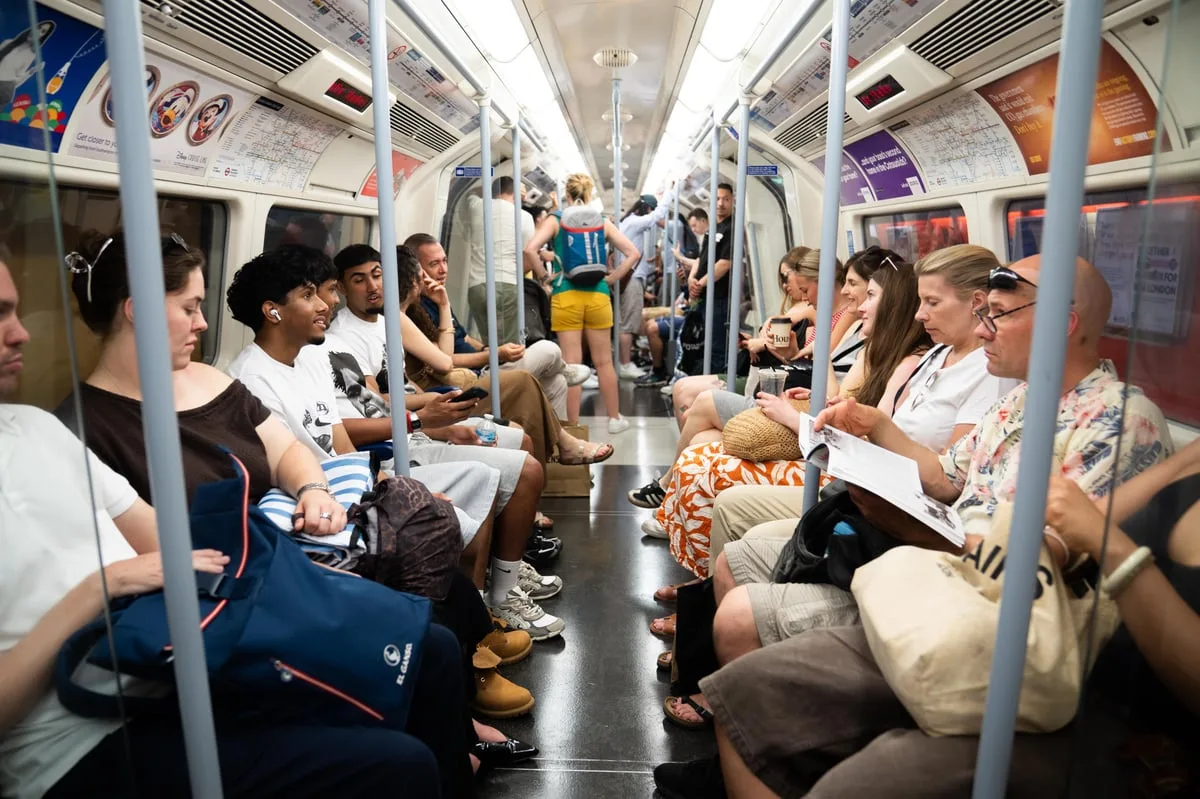
As millions packed onto sweltering Tubes, buses and trains this morning following the record-breaking Bank Holiday weekend, there was misery to come as train operators axed services due to the 'severe weather'. Images showed commuters stranded on the platform at Surbiton station in Surrey this morning after SWR cancelled services due to the heat. SWR said trains running on its network may be cancelled or delayed by up to 30 minutes until the end of today, affecting services running from London Waterloo to parts of Surrey, Hampshire and Dorset.

Elizabeth Line services in the capital were slowed down due to 'high track temperatures'; some services running from London Liverpool Street to Gidea Park have been cancelled for Tuesday afternoon due to the additional traffic caused by the speed restrictions. But the decision to cancel services due to the heat sparked derision among passengers on social media. One wrote: 'Services cancelled because of hot weather? How do they manage to run trains in Spain? Clown country.'

Pickt after-article banner — collaborative shopping lists app with family illustration

Road and Health Impacts

On the roads, the RAC said it had seen a 20 per cent increase in breakdown callouts, with a spike in engines overheating. As of Tuesday lunchtime, roadside engineers were 30 per cent busier than usual, a spokesperson said. The heatwave is causing additional problems in the NHS: Stuart Crichton, the director of 999 operations at the London Ambulance Service, told the BBC Monday had been 'our busiest day in the last 12 months as we get into the amber heat warning'. Urgent care doctor Dr Lorna Powell told the broadcaster more elderly patients with complex care needs were coming to her east London hospital as they struggle to cope with the heat. 'Your body has to work overtime to keep you cool and maintain a stable core temperature,' she said.

Calls for Workplace Temperature Regulations

The heatwave has prompted calls for Labour to introduce a fixed maximum temperature that would permit workers to down tools - a measure that environment secretary Emma Reynolds has said she will 'carefully consider'. At present, the law makes allowances for employers to provide a 'reasonable' working temperature, but does not go into specifics. John Kushnick, legal director of the National Accident Helpline, told the Daily Mail that it could be 'too little, too late'. 'If the temperature within the workplace rises to over 28 degrees Celsius, then it may have become too hot to safely work,' he said. At greatest risk, he said, were Tube drivers - who can endure up to 40C underground - and construction workers who spend all day in the sun. He added: 'Whilst there is no legal maximum temperature for work, if you feel that the conditions in your workplace are unsafe, you are entitled to stop.'

Wider Impacts and Tragedies

It comes as teen mobs have threatened a fresh wave of violent 'linkups' across the country after chaos erupted in Brighton, Hackney and Clapham on Monday. Fights also broke out on Seaham beach in Durham and in Southend, Essex, where police were filmed arresting a teenager. There have also been at least five deaths, including a 13-year-old boy who was pulled from the water at Leadbeater Dam in Halifax and a 15-year-old girl who died at a country park in north Warwickshire. A man also died in the sea in Cornwall after suffering a 'cardiac arrest' and another person passed away on a beach on Sunday in St Leonards, Hastings. Elsewhere, in Lincoln, the body of 15-year-old Declan Sawyer was recovered at Swanholme Lakes after he disappeared while swimming with a group of friends.

The Met Office has said the heat is 'exceptional in the UK even in mid-summer, let alone in May'. Temperatures did not drop below 21.3C overnight at Kenley Airfield, south London, making it a 'tropical night'. Britons have complained it was 'too hot to sleep' last night due to the 'tropical' temperatures. One person wrote on social media: 'We're melting. It's actually so hot it is insane.' Another added: 'It's 4:15 am in London and I haven't been to sleep because of this gross dirty heat. My neck is even sweaty.' A third joked: 'The secret to sleeping in THIS HEAT is 12 pints prior. You're welcome.'

Beach Litter and Water Supply Issues

Tens of thousands of Britons flocked to the coast and beauty spots to bask in the blistering heat despite official government guidance to stay out of the sun. Images of Bournemouth beach this morning show mounds of litter left on the sand by Bank Holiday revellers. Despite there being 300 bins along the seafront, virtually all of them were overflowing with rubbish. Bin bags were also piled up on the pavement next to them. One environmentalist partly blamed the 'social media generation' for assuming that somebody else will clear up after them.

To qualify as a heatwave, temperatures must meet or surpass a specific threshold for three consecutive days. The highest heatwave threshold in the UK at this time of year is 28C, which applies to London and north of the capital towards Cambridgeshire. If validated, the latest May record means seven of the 12 monthly highs have been set since 2003, the Met Office said. A previous study by the forecaster found breaking that record 'is around three times more likely now in our current climate than it would have been in a natural climate not impacted by greenhouse gas emissions'. This means that the once one-in-a-hundred year event is now a one-in-33 event, it said. 'We see these changes happening so much more dramatically,' Met Office senior forecaster Greg Dewhurst said on Monday morning, adding that climate change is boosting the heat. 'In the past, heatwaves built and built and built and built over days and days and days – these now just develop so quickly.'

About 500 properties supplied by South East Water have been hit by issues including outages and low pressure as temperatures soar. The water firm apologised after it had to hand out bottled water to some of its customers in Kent and Sussex. A total of 250 properties in three Kent villages were suffering intermittent water outages or low pressure on Monday. A burst water main in Eastbourne, East Sussex, affected 168 properties, while 64 customers suffered from issues with booster pumps at Radfall near Broomfield Gate in Whitstable, Kent. There were also 'ongoing water supply problems' for fewer than 20 properties on higher ground in the Ulcombe area of Kent. South East Water incident manager Steve Benton said in a statement: 'We're sorry to all impacted customers for the disruption caused. We know water supply issues during hot weather are deeply frustrating and incredibly inconvenient and we are working as quickly and safely as possible to resolve them.' He added: 'As a result of the recent hot weather, we're seeing increased demand across our network and we're having to pump far more drinking water than usual. We're working hard to maintain supplies to customers across our network as the hot weather and increased demand for drinking water continues. Some customers on higher ground may, however, experience low water pressure or intermittent supply at peak times.'




