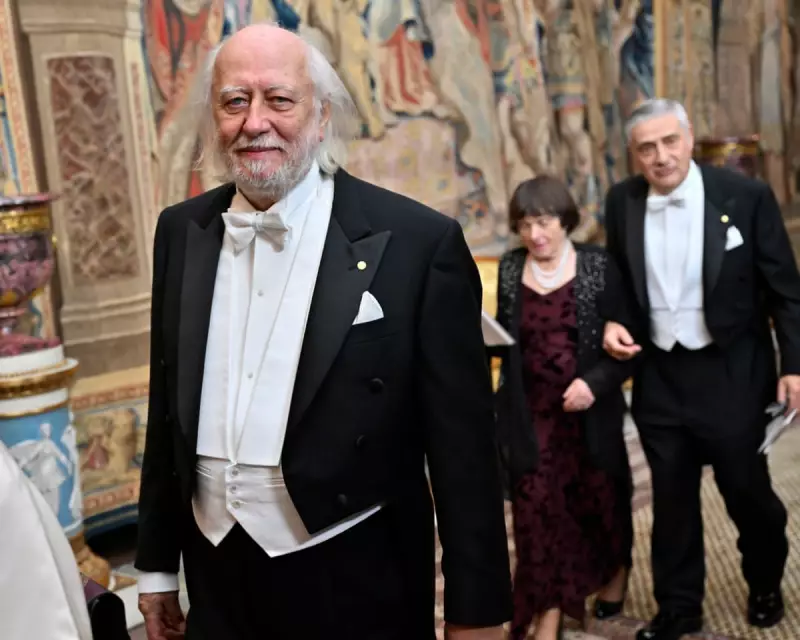
The awarding of the Nobel Prize in Literature to Hungarian author László Krasznahorkai has cast an international spotlight on a profound cultural and political divide within his homeland. While his hometown of Gyula celebrates, the win underscores a hostile environment that has driven many of the nation's leading literary voices abroad.
A Nobel Celebration Amidst Political Repression
In the quiet eastern town of Gyula, known for its sausages and castle, billboards now proudly congratulate László Krasznahorkai as its first Nobel laureate. The 71-year-old writer was honoured by the Swedish Academy for his "compelling and visionary oeuvre." Residents gathered in the local library to watch the ceremony in Stockholm live, followed by a week of celebratory events.
Yet the author himself was absent from the hometown festivities, and not merely due to his Nobel commitments. Like a growing number of Hungarian artists, Krasznahorkai no longer resides in the country of his birth. His poignant analogy in a Swedish television interview compared Hungary to an alcoholic parent: "My mother drinks, she loses her beauty, she fights. Still, I love her."

This sentiment resonates deeply within Hungary's intellectual circles. Since Prime Minister Viktor Orbán's far-right Fidesz party took power in 2010, authors and human rights groups report an increasingly repressive climate. The state has systematically gained control over universities, media, and cultural institutions.
The Squeeze on Independent Literature and Thought
The mechanisms of control are multifaceted. The national cultural fund, overseen by the culture minister, now funnels money away from independent publications and towards pro-government writers. Csenge Enikő Élő, a 32-year-old author, starkly illustrates the result: "I don't know any young writer [in Hungary] who makes a living." She describes a polarised literary landscape where funding is distributed disproportionately.
Concurrently, the government has invested hundreds of billions of forints into the conservative Mathias Corvinus Collegium (MCC), chaired by Orbán's political director. In a significant move in 2023, MCC acquired a 98.5% stake in Libri, Hungary's largest publisher and bookstore chain. This acquisition followed the introduction of Fidesz's so-called "child protection" law, which bans the promotion of homosexuality and gender reassignment.
In compliance, Libri stores began wrapping books depicting same-sex relationships in plastic. Krisztián Nyáry, creative director of the rival Líra chain, condemned this as a de facto ban on a significant portion of literature for political campaigning. Líra itself faces repeated fines for defying the law and is challenging them in court.
A Nation Divided Yet United in Nobel Pride
The government's cultural agenda extends to education. In 2020, the national curriculum sparked outrage by including works by József Nyírő, a member of Hungary's WWII-era far-right government, while excluding works by Holocaust survivor and Nobel laureate Imre Kertész.
Despite Krasznahorkai's own criticism of the Orbán government—which he recently called a "psychiatric case" for its stance on Russia and Ukraine—his Nobel achievement transcended political lines. His editor, János Szegő, noted the government did little to promote the author internationally, but the prize itself was a moment of national pride. "It's a great confirmation for a small language that's always wary of extinction," Szegő said.
Back in Gyula, the Fidesz mayor plans to install a plaque on Krasznahorkai's childhood home and name a school library after him. For resident Márta Becsiné Szabó, 75, politics is irrelevant: "The important thing is that he is from Gyula, and that he is Hungarian." This rare unity, however, cannot mask the exodus of talent and the profound challenges facing those who choose to remain and write freely in today's Hungary.