The Crown Prosecution Service has launched an appeal against a controversial court decision that overturned the conviction of a man who burned the Quran while shouting offensive remarks outside the Turkish consulate in London.
The Incident and Initial Conviction
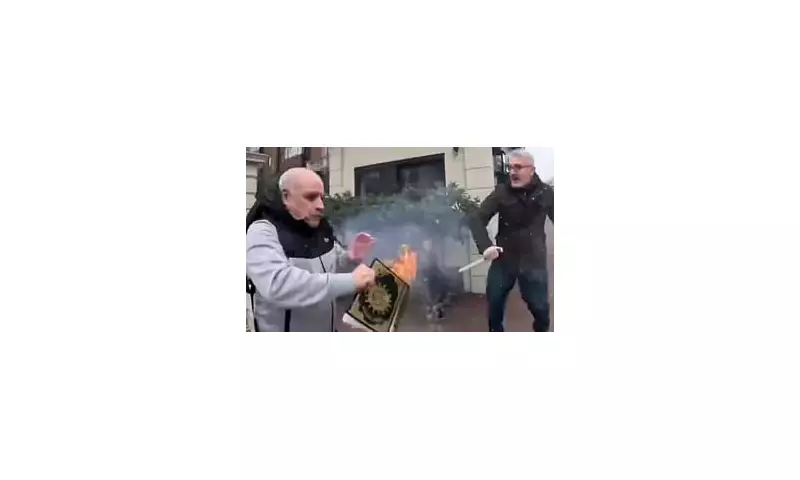
Hamit Coskun, a 51-year-old originally from Turkey, was initially found guilty of a religiously aggravated public order offence following his protest in February. The court heard how he set the Islamic religious text aloft while shouting 'f*** Islam' during the demonstration.
Coskun, who identifies as half-Kurdish and half-Armenian, claimed his actions were intended to highlight his belief that Turkish president Recep Tayyip Erdogan's government had transformed from a constitutionally secular administration into an 'Islamist regime'.

Court Overturns Conviction
Last month, Southwark Crown Court overturned Coskun's conviction in a ruling that sparked immediate controversy. Mr Justice Bennathan, presiding over the case, acknowledged that burning a book of such religious significance would be 'desperately upsetting and offensive' to many Muslims.
However, the judge emphasised that the right to freedom of expression 'must include the right to express views that offend, shock or disturb'. He noted that Coskun had acted alone and directed his 'political speech or conduct' rather than targeting any individual personally.
Legal Battle Intensifies
The Crown Prosecution Service has now confirmed it is appealing the decision. In an official statement, the CPS clarified its position: 'There is no law to prosecute people for 'blasphemy' and burning a religious text on its own is not a criminal act.'
The prosecution service maintains that Coskun's combination of words, choice of location and burning of the Quran amounted to disorderly behaviour. They argue he demonstrated hostility towards a religious group, which constitutes a criminal offence under existing legislation.
The original charge alleged Coskun violated the Crime and Disorder Act 1998 and section five of the Public Order Act 1986, specifically citing religiously aggravated disorderly behaviour likely to cause 'harassment, alarm or distress'.
Free Speech Organisations Respond
Coskun's legal defence received substantial backing from prominent free speech organisations. The National Secular Society and Free Speech Union jointly funded his appeal case, viewing it as a crucial test case for freedom of expression in Britain.
Stephen Evans, chief executive of the National Secular Society, stated: 'Mr Coskun's protest was a lawful act of political dissent. There is no need to condone the nature of his demonstration – what is important is that it was not criminal.'
Lord Young of the Free Speech Union warned that allowing the original conviction to stand would have sent a dangerous message to 'religious fundamentalists that all they need to do to enforce their blasphemy codes is to violently attack the blasphemer'.
Political Reactions and Wider Context
The case has drawn commentary from political figures, with Shadow Justice Secretary Robert Jenrick expressing his view that while he didn't agree with Coskun's actions, he didn't believe 'it was a crime'.
The incident took a violent turn when 59-year-old Moussa Kadri attacked Coskun with a knife during the protest. Kadri later told police he was acting to protect his religion.
This legal battle occurs against the backdrop of blasphemy laws being abolished in England and Wales in 2008, and more recently in Scotland in 2021, creating a complex legal landscape where religious sensibilities intersect with free speech protections.
Following the successful appeal last month, Coskun released a written statement expressing his relief, saying he had come to England 'to be able to speak freely about the dangers of radical Islam' and felt 'reassured that - despite many troubling developments - I will now be free to educate the British public about my beliefs'.
The case now moves to the High Court, where judges will consider whether Coskun's actions crossed the line from protected free expression into criminal disorderly behaviour motivated by religious hostility.