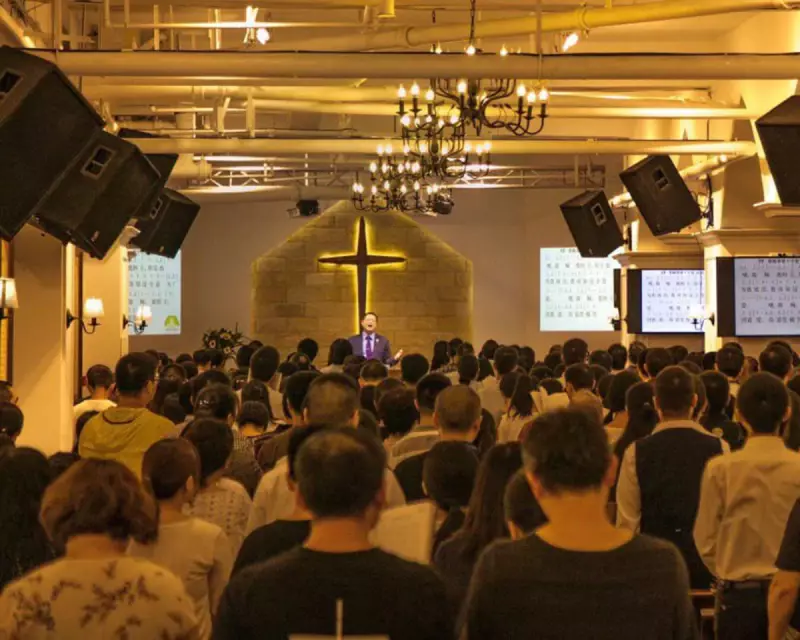
Chinese authorities have detained several leaders of a prominent underground Christian church in Sichuan province, in what appears to be the latest move in a sweeping nationwide crackdown on unregistered religious groups.
Leaders Taken in Coordinated Raids
According to a statement from the Early Rain Covenant Church, police took the church's leader, Li Yingqiang, from his home in Deyang on Tuesday. His wife, Zhang Xinyue, was also detained alongside pastor Dai Zhichao and lay member Ye Fenghua. The church confirmed that at least four other members were taken for questioning and later released, while several others remain out of contact.
This action follows a similar pattern from October, when 18 senior members of Zion Church, another well-known unregistered church, were arrested in a nationwide operation. Furthermore, in December, the NGO Human Rights Watch reported that approximately 100 members of an unofficial church in Zhejiang province were detained after protesting the demolition of a church building.

A Pattern of Intensifying Pressure
Yalkun Uluyol, a China researcher at Human Rights Watch, stated the detentions are part of a blatant attack on house churches. As Beijing tightens ideological control, unofficial churches are viewed as disobedient to Communist Party doctrine and face severe consequences.
One Early Rain member was summoned under the vague charge of "picking quarrels and provoking trouble," a commonly used legal pretext. It remains unclear if formal charges have been brought against those still in custody. Public security bureaus in Deyang and Chengdu declined to comment on the case.
In a statement, the besieged church urged its members to "hold fast to the faith, to love one another, and to remain united amid persecution." The US Congress select committee on China posted on X that Early Rain was targeted for refusing to bow to the Chinese Communist Party.
The Long Struggle of China's House Churches
Early Rain is one of China's most famous "house churches," where worshippers gather privately instead of in state-sanctioned venues. Its founder, the prominent legal scholar and activist Wang Yi, was sentenced to nine years in prison in 2019 for inciting subversion of state power.
Although China's constitution guarantees religious freedom and the government recognises five official religions, the space for independent practice has shrunk considerably under President Xi Jinping. The last major crackdown occurred in 2018, when Wang Yi and about 100 Early Rain members were arrested, and Zion Church's Beijing premises were shut down. Both congregations subsequently moved sermons online and continued meeting in small, private groups.
Corey Jackson, a former missionary and founder of the Luke Alliance, noted that church members have had to be increasingly clandestine and creative over the past seven years. He revealed that pastors were warned by police last year that there would be "no leeway for unlicensed churches in 2026." This warning was underscored in September when China introduced new rules banning unlicensed religious groups from holding online sermons.
Author Ian Johnson, author of "The Souls of China," believes the message is clear: large organised churches will be crushed. He noted that their online afterlives are now also ending.
Despite the repression, some experts argue China's Christian community will continue to grow. Official estimates place Christians at 3% of the population, though the true figure is likely higher. Professor Yang Fenggang of Purdue University argues it is impossible to eradicate house churches entirely, and authorities can only punish outspoken leaders and break large congregations into smaller, more effective cells.
Last year, Li Yingqiang himself highlighted the church's role, stating in an interview that "Chinese civil society is almost barren today. The church... is crucial in its continued activity, vitality, and growth amidst hardship." China's Public Security Bureau did not respond to requests for comment on the latest detentions.