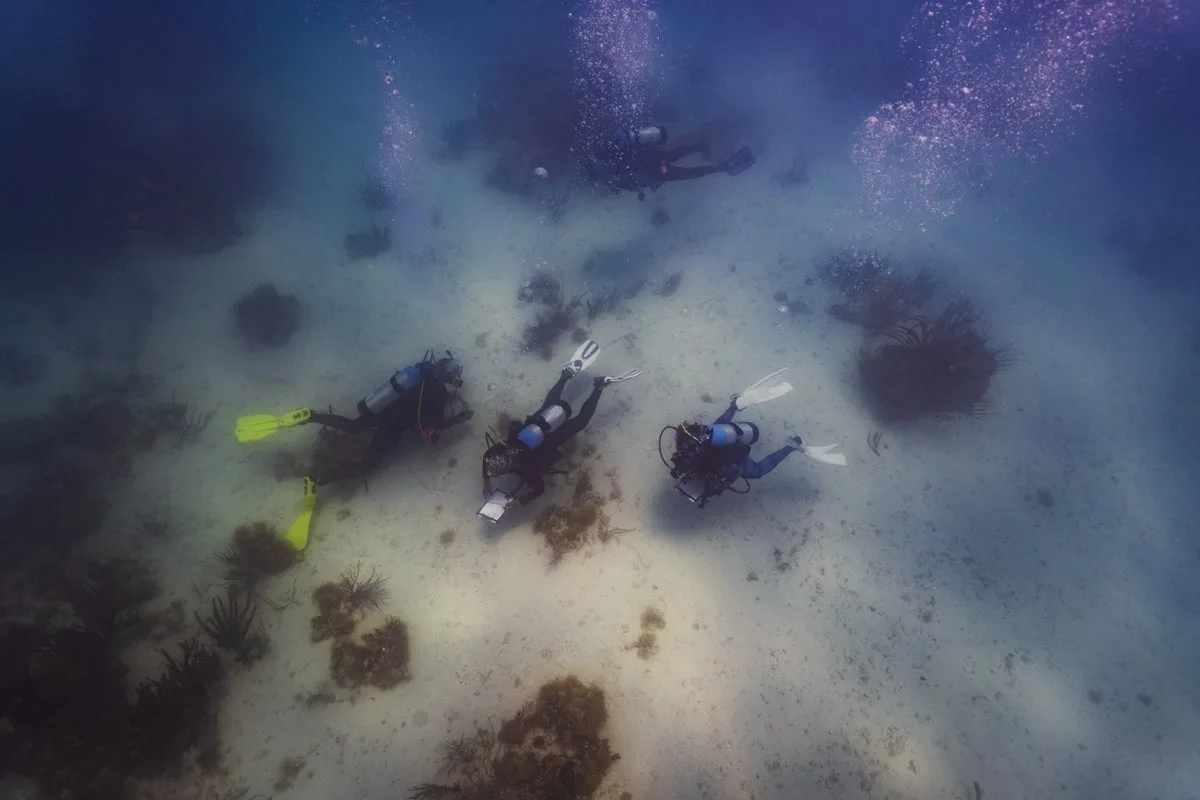
Ruthie Browning dove into the calm, blue water off Key West, Florida, expecting to see “a big, old rock with stuff growing all over it.” She was on a pilgrimage with other Black divers and community members, visiting sacred sites including one where a British slave ship — the Henrietta Marie — sank 326 years ago.
The vessel had delivered 200 enslaved people from West Africa to Jamaica and was heading back to Britain in 1700 — near the peak of the trans-Atlantic slave trade — when it was swallowed up in the churning waters of New Ground Reef where the Atlantic Ocean meets the Gulf of Mexico. A concrete marker at the site memorializes the people on that ship.
As Browning and her group prepared to dive in early May, the water was calm. The marker, 20 feet (6 metres) below, was visible from the glassy surface. “I thought I’d look at it, pay my respects and that’ll be that,” she said. But something unexpected happened. Tears filled her eyes. She gently told herself: If you can be quiet, maybe they will speak. Staring at the monument, which is now a small living reef covered in corals and sponges, she felt her ancestors’ words: “My daughter, we’re so glad you’re here.”
For the pilgrims in Key West, the gathering was an act of devotion, a quest for connection with their roots and for spiritually nourishing generations to come. They had tried to dive to the marker last summer, but the water was too choppy. “The ancestors were not smiling down on us then,” said Jay Haigler, master diving instructor with Underwater Adventure Seekers, the world's oldest Black scuba diving club. “This year was different.”
Such a pilgrimage was never meant to be easy, said Michael Cottman, who has written two books about the Henrietta Marie and was part of the National Association of Black Scuba Divers that installed the marker in 1992. “Even if it wasn't carrying enslaved people, it embodies the oppression of our people,” he said. The group organised an annual pilgrimage in the 1990s, but it didn't continue. The latest trip was spurred by an underwater interview project proposed by Stanford University anthropologist Ayana Omilade Flewellen, who serves on the board of Diving With a Purpose, a Black scuba diving nonprofit dedicated to documenting slave shipwrecks.
The pilgrims also gathered on land. At Higgs Beach on the south side of Key West, they visited a memorial and burial ground for 297 African refugees who died in 1860 after being rescued by the U.S. Navy from three slave ships — Wildfire, William and Bogota. Over 1,400 refugees were housed by the government in a compound and provided food and medical care, said Corey Malcom, the Florida Keys History Center’s lead historian. While many were sent back to Africa, hundreds died due to the horrific conditions on the ships, he said.
On Saturday, pilgrims met at the cemetery and held an emotional libation ceremony, a sacred, ancient ritual rooted in Afro-Caribbean spiritual tradition. One by one, group members tearfully thanked their ancestors and poured white rum on the beach. The clear spirit is believed to act as a messenger, inviting ancestral souls for their blessings. “To honour your ancestors and the road they’ve travelled is very, very important because we’re all connected,” said Addeliar Guy, one of the elders and an avid diver.