Spain's Mass Amnesty for Migrants Sparks System Collapse Warnings
Spain has officially approved controversial plans to grant legal status to approximately 500,000 undocumented migrants, a move that has immediately triggered warnings from migration officials about potential system collapse. The sweeping amnesty program represents a central pillar of Prime Minister Pedro Sanchez's progressive agenda, aiming to harness migration's economic benefits for Spain's aging population even as other European governments tighten border controls.
Immigration System Under Severe Strain
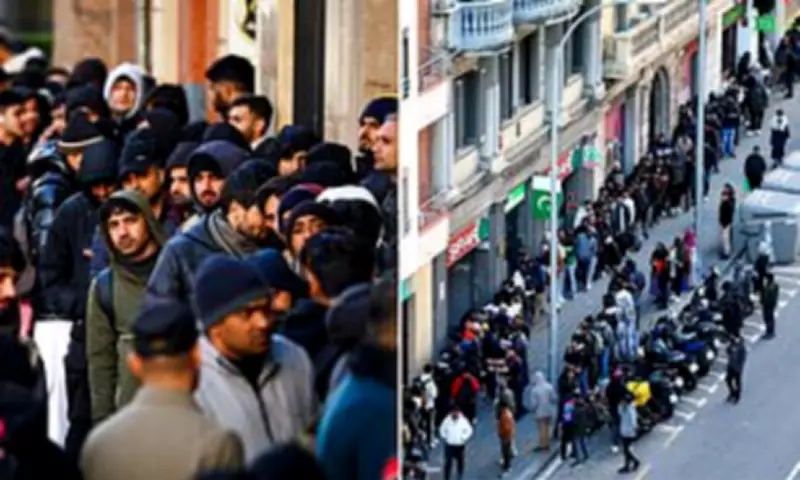
Immigration offices across Spain are threatening to strike next week in protest against what they describe as an unprepared system for handling the massive influx of applications. Online applications will open on Thursday following government approval at Tuesday's cabinet meeting, with in-person appointments commencing the following day. However, immigration officers have announced plans for a strike beginning April 21, which would halt all immigration applications in protest against what they claim are insufficient resources.
'The government is once again implementing a new regularization without giving offices enough economic resources to handle it,' declared Cesar Perez, a union leader representing Spain's immigration officers, in comments to Reuters. The strike threat highlights the severe pressure on Spain's already overburdened immigration infrastructure.

Unconventional Application Distribution
In a bid to manage the expected surge, authorities have devised an unconventional distribution system where only five of Spain's 54 dedicated immigration offices will handle applications directly. The remaining applications will be processed through social security offices, post offices, and non-governmental organizations according to plans outlined by the Spanish union CCOO.
This approach reflects the enormous scale of the challenge facing Spanish authorities. Recent population statistics reveal Spain's 50 million residents now include approximately 10 million people born abroad, with Spanish think tank Funcas estimating roughly 840,000 undocumented migrants currently participating in the workforce.
Political Opposition and Economic Arguments
The opposition Popular Party has condemned the initiative as reckless, despite previous conservative governments implementing similar measures. Isabel Diaz Ayuso, president of the Madrid community and prominent party figure, has threatened legal challenges against the program.
Prime Minister Sanchez defended the policy in a public letter published on social media platform X, describing it as 'not only an act of justice but also an economic necessity.' He emphasized Spain's demographic challenges, stating: 'Spain is aging... Without more people working and contributing to the economy, our prosperity slows, and our public services suffer.'
Economic data supports some of Sanchez's arguments. Spain's economy expanded by 2.8 percent last year, more than double the average growth expected across the eurozone. The country has outperformed other EU nations recently, with unemployment dipping below 10 percent for the first time since 2008. However, approximately 90 percent of new jobs have gone to immigrants, resulting in minimal growth in income per person.
Housing Crisis and Social Tensions
Critics highlight Spain's severe housing shortage as a critical concern exacerbated by the amnesty program. With about 140,000 new households forming annually but only 80,000 new homes being built, competition for affordable accommodation has intensified dramatically. Opponents argue that legalizing large numbers of migrants without simultaneous housing policy reforms will increase pressure on scarce accommodation, particularly in urban centers like Barcelona and Madrid where housing grievances already contribute to significant social tension.

International Controversy and Political Backlash
The political controversy has attracted international attention, with tech billionaire Elon Musk commenting on the policy via social media. Musk shared a post describing the amnesty as 'electoral engineering' designed to create 'a massive, loyal voting bloc' for left-wing parties, adding his own comment: 'Wow.' The shared post has garnered over 16 million views.
Sanchez responded directly to Musk on X with the message: 'Mars can wait. Humanity can't.' Meanwhile, domestic opposition has intensified, with Santiago Abascal, leader of the hard-right Vox party, accusing the Socialist-led coalition of accelerating what he termed an 'invasion.' Vox spokeswoman Pepa Millán pledged to appeal the program before Spain's Supreme Court, claiming it 'attacks our identity.'
Demographic trends underscore the policy's context: Spain's population increased by 1.5 million to 48.9 million over the past three years, with immigration accounting for nearly all growth. Latin Americans constitute approximately 70 percent of recent arrivals, highlighting shifting migration patterns as Spain positions itself as an alternative to traditional European destinations with stricter immigration policies.