
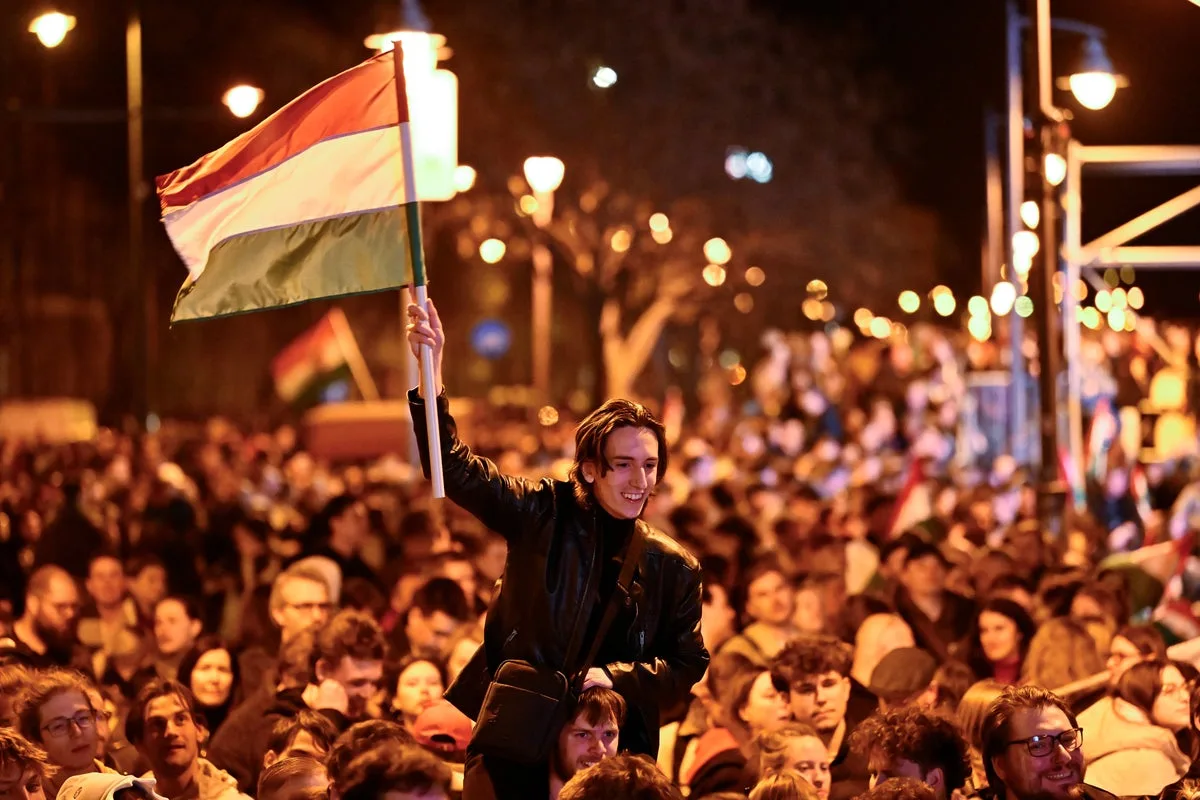
Young Hungarians who came of age during Viktor Orbán’s 16-year rule took centre stage in Sunday's election, helping to eject the prime minister from office. As hundreds of thousands celebrated the victory of pro-European candidate Péter Magyar, music from Hungary’s most Orbán-critical performers filled the air, with teenagers scaling Budapest’s Chain Bridge and blasting revolutionary anthems.
On trams, buses and the metro, young people led chants and played AI-generated fan music dedicated to Magyar. In front of the neo-Gothic parliament building, a group called “More Techno to Parliament!” marked Orbán’s defeat with a rave. These scenes underscored the pivotal role of a generation that had never known life outside Orbán’s political system.
Marcell Szabó-Temple, a 26-year-old architect, grew up in a politically muted household and felt ambivalent about the 2018 election, Orbán’s seventh victory. But at university, he experienced a political awakening. Studying under an outdated curriculum in a crumbling building, he wondered: “Was this really all they could achieve in 12 years of governance?”
In 2022, more than 20 Hungarian universities were disqualified from the EU’s Erasmus exchange programme after Orbán placed them under political appointees. Disenchanted, Szabó-Temple said he “stopped caring about politics” until Magyar emerged in 2024. Magyar, a former Fidesz insider, campaigned on repairing ties with the EU and spoke directly to young people at hundreds of rallies.
A new wave of musical stars, many from the internet, produced openly critical content. Anti-government chants broke out at summer festivals, and two days before the election, over 100,000 people attended a “system-breaking” concert in Budapest where 50 artists urged young people to vote. A poll showed 65% of under-30s supported Magyar’s Tisza party, against 14% for Orbán.
Szabó-Temple, currently on a work exchange in Portugal, plans to return to Hungary. “There was a growing sense that if we can’t change the regime now, we might not want to live here,” he said. “We put our faith in Tisza and expect them to deliver. If they do, I will settle down and build a family in Hungary.”




