Searching Warriors: The Relentless Hunt for Mexico's Missing
Under the relentless Mexican sun, Raúl Servín digs through earth filled with pain, hope, and frequent frustration. For eight years, he has searched for his missing son, dedicating his life to a quest that extends beyond personal loss to encompass "all the other missing people" in a nation scarred by violence. Every Tuesday, Servín loads a van with picks, shovels, water, and lunches, commends himself to God, and gathers three teammates. Together, they venture into perilous areas where the ground may conceal the victims of drug cartel atrocities.
The Guerreros Buscadores: Volunteers in a National Crisis
They call themselves the Guerreros Buscadores, or "Searching Warriors," one of dozens of grassroots groups scouring Mexico for the disappeared. Official records indicate more than 130,000 people have been reported missing since 2006, a staggering figure that underscores a humanitarian crisis. Balancing search efforts with daily life is arduous; Servín lost his job when he began looking for his son and now works as a waiter on weekends. Yet, he persists, driven by a need for answers that sometimes arrive in the form of a skull, a mutilated body, or evidence offering closure in its most literal sense.
On a recent day, the Guerreros allowed an Associated Press photojournalist to shadow them, revealing their methods and motivations. They targeted locations on the outskirts of Guadalajara, capital of Jalisco state—a World Cup host city and stronghold of the Jalisco New Generation Cartel. Operating without protection, their only safety measure is a "panic button" connecting to a federal network for rights activists. This work is fraught with danger in a country where thousands vanish annually amid cartel violence, and clandestine graves are discovered regularly. Over 70,000 unidentified remains languish in morgues and cemeteries, a testament to systemic failures.

Anonymous Tips and Grim Discoveries
The group relies on anonymous tips from their website, often from witnesses who fear authorities. On a previous outing, they dug over a yard deep at four sites, finding nothing but bloodstains or shell casings. Servín emphasizes, "There cannot be room for doubt." During this mission, a call redirected them to a residential area near a commuter train line, where an informant reported a buried body. Unable to scout the location beforehand—a security precaution to avoid cartel lookouts—they proceeded cautiously. Arches marked the entrance to the complex, a stark contrast to the fliers of missing people plastered across Guadalajara.
Mexican President Claudia Sheinbaum visited the region after violence erupted in February over the cartel leader's killing, assuring World Cup security. The search collectives hope to leverage global attention to highlight their plight. "I love soccer," Servín says, "but that’s not going to stop me from going out to search."
A Lullaby for the Dead: Unearthing Humanity
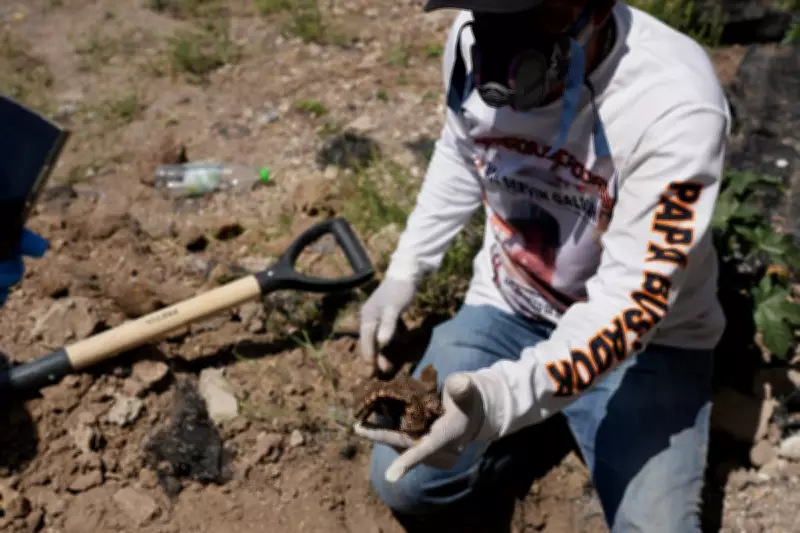
Shielded by caps and scarves, each searcher wears a personalized T-shirt with a photo of their loved one; Servín's reads "Searcher Dad." Their equipment includes a metal rod dubbed "the seer," a rudimentary tool used for over a decade to detect organic smells in the soil. After hours of digging in a dirt corner yielded nothing, Servín noticed soft ground near train tracks. Kneeling, he uncovered part of a skull, shouting, "We’ve got a positive!"
Masked and gloved, the team unearthed a jawbone, a bag of bones, a shoe, and a pelvis, placing each carefully outside the pit. Their voices softened into lullabies: "Hi baby, you’re going home soon." One lit a candle at the edge, transforming a macabre scene into an act of tenderness and solidarity. For families re-victimized by authorities—such as in 2021, when a prosecutor handed remains in a trash bag—this work is a beacon of hope. Criminals often hide victims to evade prosecution; nearly 20,000 missing have been found dead since 2010, making discoveries dangerous. Servín activated his panic button, a necessary precaution as at least 36 searchers have been killed since 2010, with the latest in mid-March.

Navigating Aftermath: Logistics and Emotion
After notifying federal officials and police, one woman went live on Facebook to document the find, a practice that lends credibility and aids recognition. Details like "gray underwear that says 'Sport' in orange letters" or a jawbone missing a tooth might help identify the remains. Servín, drawing on experience, estimated the body was buried about 18 months ago. While it wasn't his son, he felt a mix of sorrow and relief, knowing DNA testing could provide answers. "What hits us hardest is to think that our children might be in those conditions," he admits, yet finding remains offers a path to closure.
As they waited for authorities, searchers shared intimate conversations, united by grief and purpose. Neighbors arrived, including mothers of missing children, seeking recognition. Emotions overflowed as they embraced and advised on DNA tests. When police arrived, Servín answered questions warily, aware some officers collaborate with cartels. Despite past accusations of contaminating crime scenes, the collectives have gradually earned respect.
By evening, forensic teams began their work, but in Mexico, genetic tests can take days or years. The remains of a searcher's brother—Servín's partner—have been at an institute for six years, with matches pending processing. "It’s illogical," Servín says, his anguish palpable. At 9 p.m., he pressed the panic button to confirm he was home safely, reflecting, "I arrive feeling at peace, knowing the day was fruitful."
Reported from Mexico City, this story highlights the unwavering courage of volunteers who risk everything to bring light to Mexico's darkest corners.