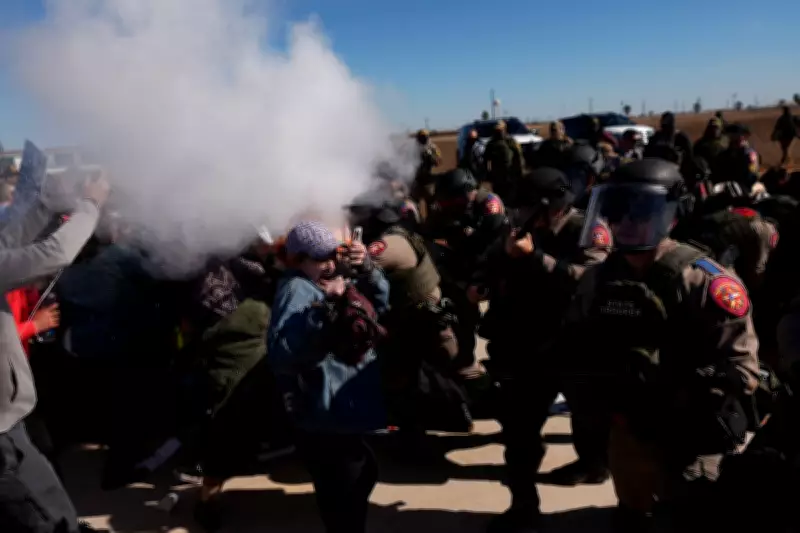
Police in Texas have deployed chemical irritants against protesters gathered outside a family detention centre, according to photographs released on Wednesday. The incident occurred at the South Texas Family Residential Center in Dilley, where a five-year-old Ecuadorian boy and his father are currently being held in custody.
Protest Against Immigration Crackdown
Demonstrators had rallied outside the facility to protest against the Trump administration's stringent immigration policies. The protesters were seen banging drums, chanting slogans, and holding signs with messages such as "Children are not criminals!". The gathering was part of a broader movement opposing the treatment of migrant families at detention centres across the United States.
Use of Pepper Balls by State Police
Texas state police responded to the protest by firing pepper balls, a type of chemical irritant designed to disperse crowds. These projectiles release a powdered chemical agent that causes temporary discomfort, including burning sensations in the eyes and respiratory tract. The deployment of such measures highlights the tense atmosphere surrounding immigration enforcement in the region.

Detainees at the Centre
The protest was specifically focused on the case of five-year-old Liam Conejo Ramos and his father, Adrian Alexander Conejo Arias, who are being held at the Dilley facility. Their detention has drawn significant attention from advocacy groups, who argue that holding young children in such centres is inhumane and violates their rights. The centre is one of several family residential facilities operated by U.S. Immigration and Customs Enforcement (ICE).
Photographic Evidence and Public Reaction
The events were captured in a photo gallery curated by Associated Press photo editors, providing visual documentation of the police action and the protesters' activities. These images have sparked debate on social media and among human rights organisations, with many criticising the use of force against peaceful demonstrators. The incident underscores the ongoing controversies surrounding immigration policy and enforcement in Texas and beyond.
As tensions continue to rise, calls for reform and greater transparency in the treatment of detainees are likely to intensify. The use of chemical irritants in this context adds another layer to the complex discourse on border security and humanitarian concerns in the United States.