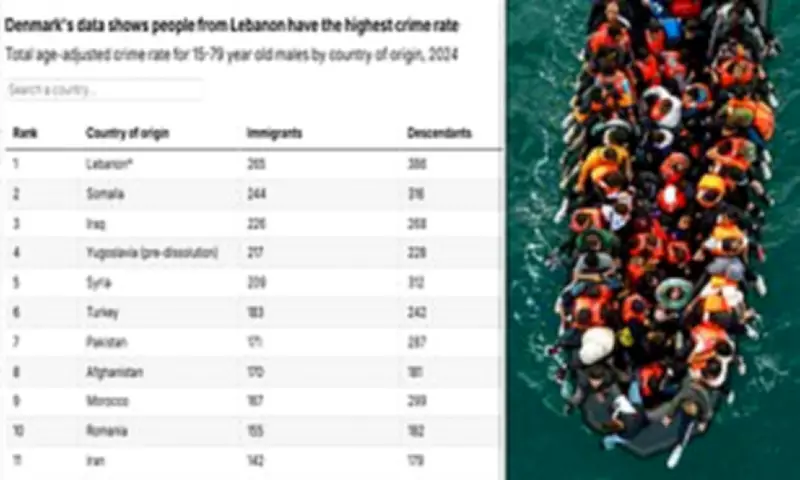
Immigrants are almost three times more likely to commit crimes than native-born citizens, according to a damning analysis of what Danish politicians describe as a 'cultural phenomenon'. The figures, published by the Danish government, have intensified pressure on the UK Labour government to release equivalent data. Conservative MP Neil O'Brien has urged Prime Minister Keir Starmer to 'be honest' with the British public about the situation.
Denmark's Transparency vs UK's Secrecy
Denmark has published nationality-based crime statistics for 25 years. In 2024, Lebanon-born men had an age-adjusted crime index score of 265, meaning they were 2.65 times more likely to be convicted than the total male population. Their descendants scored even higher at 386. Similarly high figures were seen for men born in Somalia and Iraq, while Danish males scored 92, below the baseline of 100.
The age-adjusted index accounts for the fact that younger age groups are statistically more prone to crime, ensuring fairer comparisons. Out of 31 nationalities listed, Danes ranked 17th, with Middle Eastern and African nations occupying the top spots. Danish politicians attribute the disparities to differing 'societal standards' among immigrant groups.

In contrast, the UK has withheld similar data, despite a promise by Labour in April 2024 to publish league tables of nationalities with the highest crime rates. Critics accuse the government of deliberately delaying publication to avoid public backlash. Conservative MP Neil O'Brien stated: 'There is no good reason for the government to be withholding this data... Sunlight is the best disinfectant.'
Academic and Political Reactions
Lars Højsgaard Andersen, a research professor in criminology at the Rockwool Foundation in Denmark, said the data 'shows pretty much what I would expect'. He added that 'people from specific types of backgrounds tend to have much higher conviction rates than natives'. Henrik Dahl, a Danish MEP, emphasised that the data plays a vital role in democracy, allowing authorities to 'grant too many permits to individuals from problem countries'. Steffen Larsen, a Danish MP, noted that the metrics help monitor assimilation and determine deportations when homelands are safe.
Denmark's tough policies have driven asylum applications down by almost 90% over the past decade, from over 20,000 in 2015 to just 2,333 in 2024. Measures include confiscating valuables from migrants, banning the burka, and requiring newcomers to learn Danish or lose benefits. Successful asylum seekers can also lose residency if their home country is deemed safe.
UK Data Gaps and Grooming Gang Scandal
The UK's lack of official data has led researchers to piece together estimates. The Centre for Migration Control reported that Afghan nationals are 22 times more likely to be convicted of sex offences than British nationals, though the Oxford Migration Observatory puts the figure at 14.5. A Sky News investigation found a much lower rate. Despite discrepancies, academics agree there is 'substantial variation in incarceration by nationality'. A Daily Mail investigation found Albanians had the highest incarceration rate—ten times higher than Brits.
Danish politicians argue that open data would have exposed scandals like the UK's grooming gang scandal earlier. Henrik Dahl said such wrongdoing would have been 'out in the open years ago'. Official reports have concluded that most perpetrators in cases like Rotherham were of 'Pakistani heritage', but poor data quality hampers nationwide analysis. Prime Minister Starmer ordered a national inquiry into the scandal in summer 2024 after pressure from figures like Elon Musk and Nigel Farage.
Calls for Policy Change
David Green, CEO of the think tank Civitas, urged the government to use migrant crime data to inform migration policy. He told the Daily Mail: 'It is wise for us to take into account the national culture that has shaped the personality of individuals who want to live here... Some people are drawn here because they are criminals who want to move to a nation where police are often ineffectual.' He added that publication is not an excuse for blanket bans but necessary for informed judgements.

The calls come amid record UK net migration of nearly one million in 2023 and 41,000 small boat arrivals in 2025, the second highest on record. A government spokesperson said: 'We recognise the importance of improving the availability of data on Foreign National Offenders and we will publish additional statistics in due course. It is essential we have confidence in their quality to ensure they are accurate and reliable before doing so.'