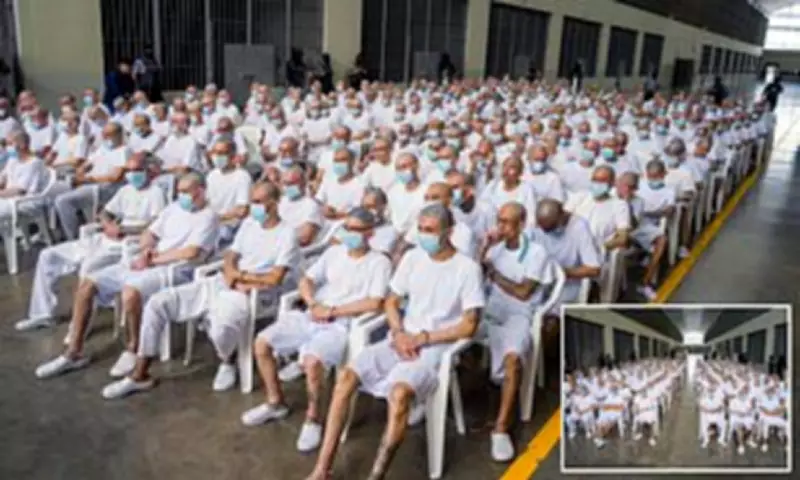
In a landmark legal proceeding, nearly 500 alleged members of the powerful Central American gang Mara Salvatrucha, commonly known as MS-13, went on trial collectively in El Salvador on Monday. The defendants are accused of involvement in a staggering 47,000 crimes committed between 2012 and 2022, which include approximately 29,000 homicides.
Unprecedented Scale of Prosecution
This trial represents a significant component of President Nayib Bukele's iron-fisted anti-gang crackdown, which has seen thousands of suspected gang members subjected to mass trials. Many of these individuals have reportedly spent years in prison without formal charges or regular visiting rights. The Attorney General's Office confirmed that 486 suspected MS-13 members are facing prosecution, with the charges encompassing a wide range of violent activities.
Leadership and Structure Targeted
El Salvador's court system disclosed that the trial includes members of the national leadership, street-level leaders, program coordinators from across the country, and even founders of MS-13. This comprehensive approach aims to dismantle the gang's hierarchy and operational capabilities. Salvadoran authorities have accused the group of numerous heinous crimes, including the killing of 87 people in a single weekend in March 2022.

Bukele's Declaration of War
In response to those brutal killings, President Nayib Bukele, a close ally of former US President Donald Trump, declared a 'war' on gangs. He asserted that these criminal organizations controlled approximately 80 per cent of Salvadoran territory at the time. The Attorney General's Office has charged MS-13 with the crime of rebellion, alleging that the gang sought to establish a parallel state within El Salvador.
Prosecutors have vowed to 'put them on trial, and settle a historic debt,' indicating the government's determination to hold the gang accountable for decades of violence. In 2022, Bukele imposed a state of emergency, which has facilitated the arrest of more than 91,000 suspected gang members. However, this campaign has not been without controversy, as thousands of those detained were later declared innocent.
Impact on Crime Rates
Despite the criticisms, Bukele's aggressive strategy has proven immensely popular among many Salvadorans, largely due to its dramatic impact on public safety. The campaign has transformed El Salvador from one of Latin America's most dangerous countries into one of its safest, with crime rates plummeting significantly. This shift has bolstered Bukele's political standing and garnered widespread domestic support.
Human Rights Concerns
Rights groups, including New York-based Human Rights Watch (HRW) and regional NGO Cristosal, have raised serious concerns about the mass trials. They have denounced gross human rights abuses, citing a lack of due process for detainees, reports of torture, and more than 500 deaths in prison. The fates of the detainees are being decided in these collective proceedings, with anonymous judges issuing one-size-fits-all punishments to large groups of defendants, often via video-link from prison.
Gang Origins and Operations
MS-13 and its rival, the Barrio 18 gang, operate extensive drug trafficking rings and extortion rackets across Central America. The Trump administration has designated both groups as terrorist organizations, a classification used in part to justify deadly military strikes on alleged drug-running boats. These gangs originated among Salvadoran youth on the streets of Los Angeles before spreading back to El Salvador, where they have terrorized the population for over three decades.
President Bukele has accused these gangs of murdering 200,000 people over three decades, including about 80,000 who disappeared without a trace. State prosecutors claim to have 'ample evidence to request the maximum sentences' against the defendants, though they have not specified whether this means life imprisonment. At the trial's opening, the judge emphasized that armed groups have disturbed 'the peace of the Salvadoran population and the security of the state' for decades and will be tried 'with the full force of the law.'

Broader Implications
The mass trials highlight the complex balance between security and human rights in El Salvador's fight against gang violence. While the crackdown has yielded tangible improvements in public safety, it has also sparked international scrutiny and condemnation from human rights advocates. The outcome of this trial could set a precedent for future prosecutions and influence regional approaches to organized crime.