
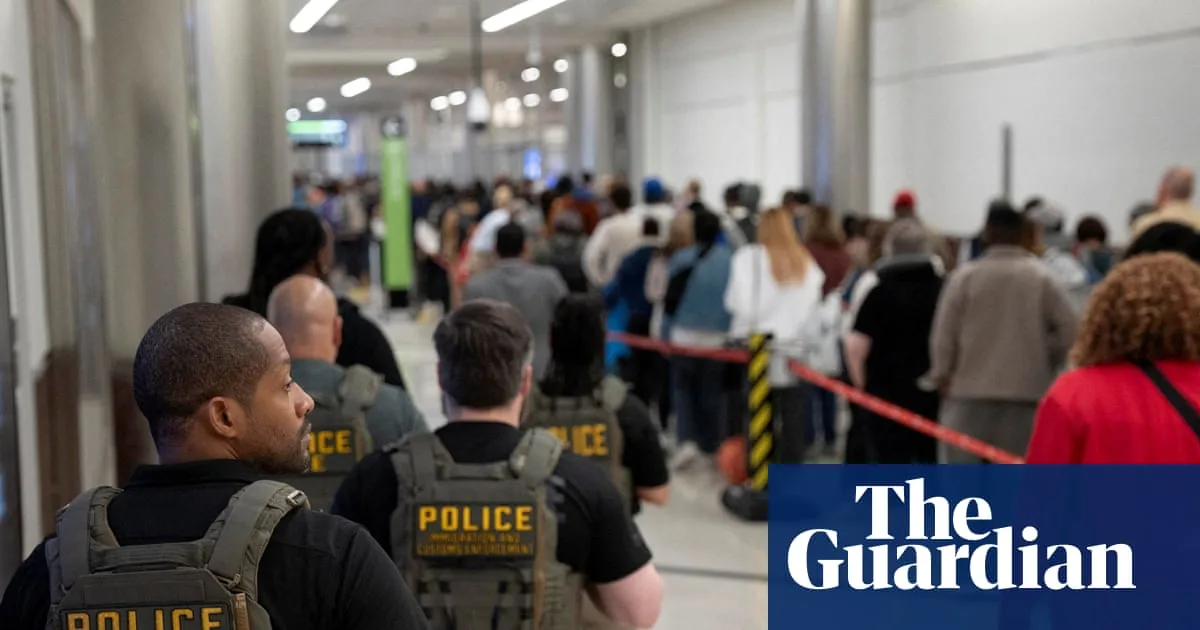
Security lines stretched for hours on Monday at US airports where unpaid Transportation Safety Administration (TSA) screening agents refused to report for duty, and ICE agents deployed by Donald Trump were reportedly seen in a dozen cities. The president claimed over the weekend that immigration agents could help manage long lines, but in Atlanta, little immediate impact of their presence could be observed.
Lines at Hartsfield Jackson International Airport had spilled out from the screening area, winding inside and out of the staging area, the baggage claim, and at 9am were in a loop on the curb. People hoping to make mid-morning flights had been standing in line since before sunrise. TSA agents missed their second paycheck on Friday; many are not showing up for work and hundreds have reportedly quit.
“Pay these people!” shouted Dr Paul Brown, president and dean of the Phillips School of Theology in Atlanta, an hour into his wait for screening before a flight to Indianapolis on Monday. “Help explain to me that the congresspeople – they’re getting paid on time regularly, no problem. But these people who work for $40,000 a year, you’re holding them up over some politics.” Brown scoffed at the suggestion that ICE agents at airports would be helpful. “It doesn’t matter,” he said, citing the budget impasse as a consequence of their conduct in the field. “They’re part of the problem.”
Trump deployed ICE agents to assist with passenger screening in 11 cities with busy airports on Monday, according to CNN, including Atlanta, Chicago, Philadelphia, Houston, Phoenix, Cleveland, Ft Myers, New Orleans and the New York City area’s three big airports, JFK, Newark and LaGuardia, where a plane crashed into a truck this morning, killing two pilots. The fatal crash has caused the airport to shut down and effects to ripple throughout the system.
“It’s total chaos,” said Tom Healey of Alpharetta, Georgia, trying to make a flight to Louisville from Atlanta. He had been in line for three hours by 8am; his flight was scheduled for about 9. “Look at what happened at LaGuardia,” he said. “My wife’s got to fly out of that place. She was supposed to fly out of LaGuardia today.” Karan Ghura had been in line since 4am; at 9.30, he had already missed his flight to Phoenix and was standing in line again to make a different flight home to the Bay Area.
Screening times have varied greatly depending on the airport and differences between the morning peak and midday travel. LaGuardia did not reopen after the crash until 2pm, and the closure affected connections across the country. In Houston, a joke that it might be faster to drive to Austin than fly there is being taken in earnest, given three-to-four-hour screening queues at the peak and a two-and-a-half hour drive. But Chicago’s wait times appear negligible, and while three screening stations have been shut down in Philadelphia for days, the airport is reporting wait times under 15 minutes.




