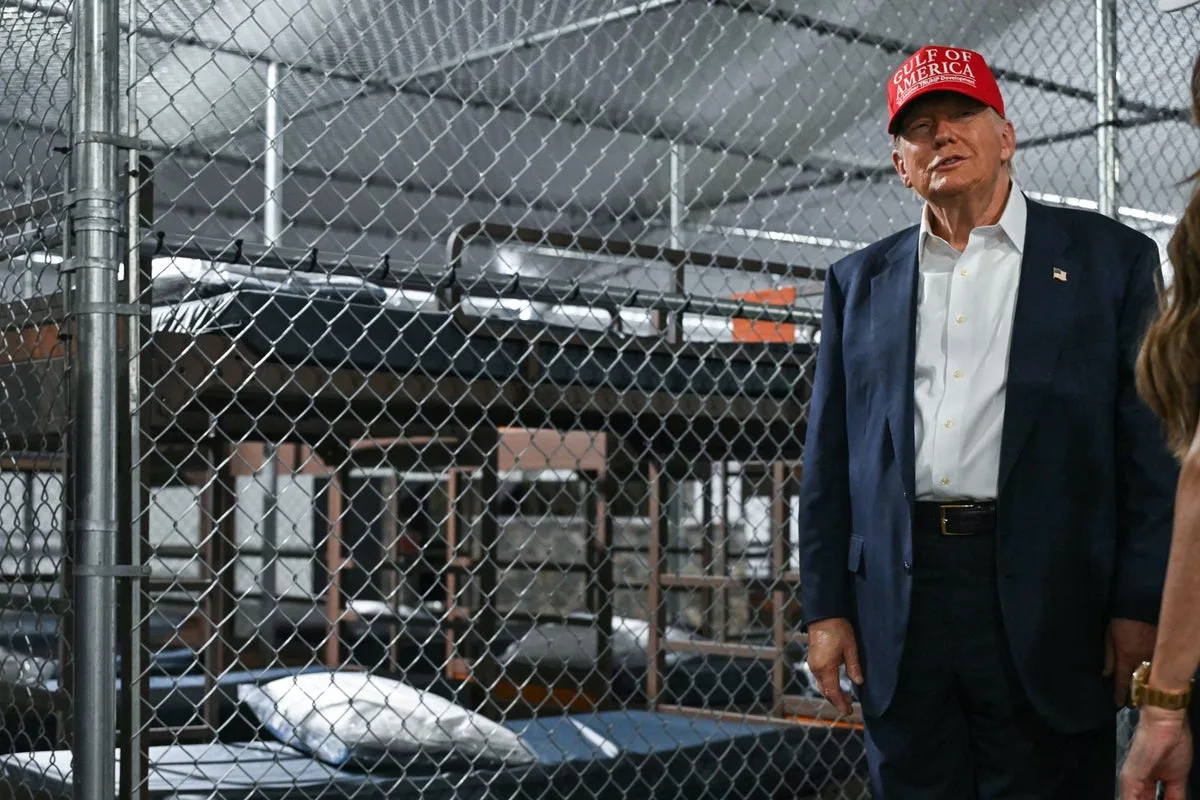
Florida's Alligator Alcatraz Guards Wear Grim Reaper Patches, Report Reveals
Guards inside Florida's notorious "Alligator Alcatraz" immigrant detention facility are reportedly wearing uniform patches that depict the Grim Reaper alongside the ominous words "You can't hide." This revelation has emerged from a recent report, adding to the growing controversy surrounding the hastily constructed detention center.
Former Detainee Describes 'Demonic' Imagery
Former detainee Lewis Ortigoza provided a chilling account of the patch to the Miami Herald. "What I saw was 'Alligator Alcatraz,' a skeleton dressed in black holding a hatchet and a crocodile underneath," he stated. "It looked like something demonic." Ortigoza further explained his fear, saying, "I always felt haunted by it, but I never said anything because I was so afraid."
The patch first came to public attention earlier this month when a discharged guard from Critical Response Strategies, a government contracting firm that staffs the facility, reportedly handed it to a protester outside Alligator Alcatraz.
Company Response and Staffing Issues
A spokesperson affiliated with Critical Response Strategies confirmed to the Miami Herald that the guard involved is named Steven Martinez. The spokesperson emphasized that the Grim Reaper patch is not an authorized part of the uniform. Additionally, it was revealed that Martinez and another staff member had been demobilized following an altercation between the two. The Independent has reached out to the company and Florida's law enforcement agency, which oversees the site, for further comment but was unable to locate Martinez for a statement.
Legal and Environmental Challenges Mount
Florida officials hastily built the Alligator Alcatraz detention center last summer, and it has since faced a string of complaints, legal challenges, and political difficulties. The facility, constructed within the sensitive habitat of the Big Cypress National Preserve, has been accused of housing individuals without criminal records and punishing detainees seeking legal assistance by disconnecting their calls.
Environmental groups and the local Miccosukee Tribe have also filed lawsuits to block the expansion of the facility, arguing that it violates environmental laws. Inmates have alleged they faced disease outbreaks and poor sanitary conditions inside Alligator Alcatraz, allegations that state and federal officials deny.
Ongoing Legal Battles and Financial Concerns
In August, a federal court ordered the state to shut down the facility, though that order was overturned on appeal, and the case remains ongoing. When Alligator Alcatraz was unveiled, Florida officials framed it as a joint state-federal endeavor, with the state shouldering initial costs and expecting federal reimbursement.
The state planned to commit roughly $1.5 billion in funds to building and operating the facilities, which are designed to house up to 3,000 people. However, a review by the Orlando Sentinel found that the federal government has only paid the state about $90 million out of the $403 million it has spent so far on detention facilities, highlighting significant financial discrepancies.
This situation continues to draw scrutiny from lawmakers, with one describing Alligator Alcatraz as an "internment camp" following a joint GOP-Democrat visit, underscoring the deep political and humanitarian concerns surrounding the facility.