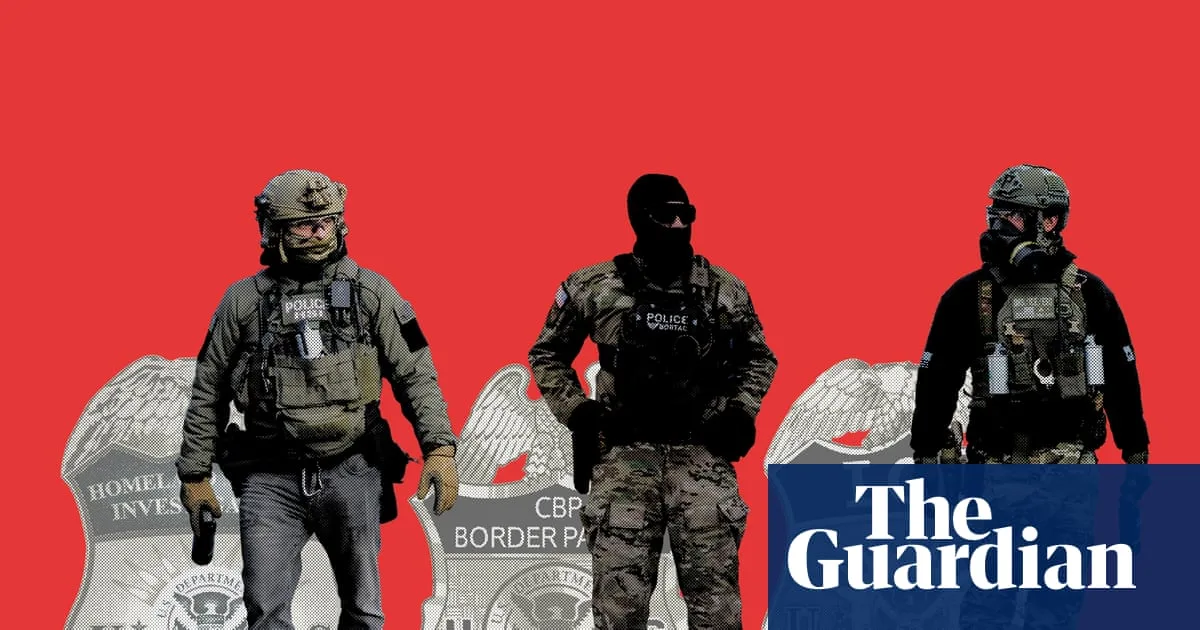
Since last January, the Trump administration has deployed a surge of armed federal immigration enforcement personnel to several prominent Democratic-led US cities, marking what the Department of Homeland Security (DHS) called the largest operation in its history. This escalation is central to President Trump's agenda of mass arrests and deportations from the US interior. The highest-profile efforts involve officers from multiple agencies rushing to cities like Minneapolis, against the wishes of local leaders. However, coast to coast, federal officers have been raiding homes, businesses, commercial parking lots, and even schools, hospitals, and courthouses. These actions have delighted the president's hardcore Make America Great Again voter base but are also tearing families apart and spreading fear and death on the streets and in detention.
Key Agencies Involved
The Department of Homeland Security (DHS) oversees Immigration and Customs Enforcement (ICE) and Customs and Border Protection (CBP), including the Border Patrol. ICE is the biggest cog in the machine, with its budget nearly tripled to $28.7 billion for 2025-2026 under the One Big Beautiful Bill Act. ICE officers and agents more than doubled from roughly 10,000 to 22,000 in 2025. The DHS itself received a total of $175 billion from Congress.
ICE: Enforcement and Removal Operations (ERO)
ERO deportation officers are the most visible face of immigration enforcement. Traditionally, they focused on hand-offs in jails from local police, but under this administration, they have ramped up arrests in public places and at job sites, targeting individuals already living within the US rather than recent border crossers.
ICE: Homeland Security Investigations (HSI)
HSI agents, typically focused on complex criminal cases like sex trafficking and drug cartels, have been increasingly reassigned to support ERO deportation operations, appearing at raids and on the streets.
Customs and Border Protection (CBP) and Border Patrol
Border Patrol officers, traditionally tasked with apprehending immigrants crossing the US-Mexico border, have become heavily involved in interior enforcement, conducting operations in US cities and confronting protesters. Their aggressive tactics have drawn scrutiny, especially as they operate beyond the 100-mile border zone where their authority is limited.
Other Federal Agencies
The Trump administration has also drafted personnel from the FBI, DEA, ATF, US Marshals Service, Federal Bureau of Prisons, and Diplomatic Security Service into immigration enforcement. The Minnesota National Guard, put on standby by Governor Tim Walz, stated that if activated, its troops would wear reflective yellow vests to distinguish themselves from the many agencies in similar paramilitary uniforms.
Local Police and Sanctuary Cities
Local police departments and sheriff's offices have been drawn into the issue. Some jurisdictions, especially in Republican-led states, cooperate closely with federal authorities under 287(g) agreements. However, many Democratic-led jurisdictions limit cooperation, labeling themselves as sanctuary cities to obstruct removals by declining to hold individuals for ICE based solely on immigration violations.
The crackdown has led to tragic incidents, including the killing of protester Alex Pretti by immigration officers in Minnesota, which former DHS Secretary Kristi Noem controversially justified. Her successor, Markwayne Mullin, promised a more low-key approach but faces ongoing challenges.






