
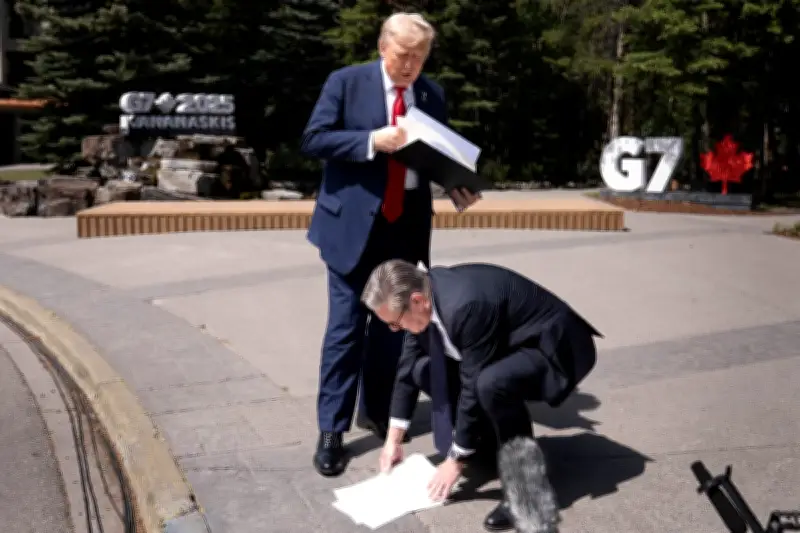
Sir Keir Starmer stooping at the feet of Donald Trump to pick up papers dropped by the US president was seen by some as indicative of the early relationship between the two men. The image taken at the G7 summit last June captured the Prime Minister in an apparent subservient role, seeming eager to please the bullish leader of the world superpower. For his part, Mr Trump also appeared to have forged a respectful, if unlikely, friendship with his political opposite.
But less than a year later, the first flush “bromance” was over with the pair publicly at loggerheads over the Iran conflict, with Sir Keir taking an increasingly emboldened stand against Washington in the face of repeated White House barbs.
Conciliatory Approach Tested
While transatlantic ties faced strains from the start, with several high-profile Labour figures having previously been strongly critical of Mr Trump, Sir Keir sought to pursue a conciliatory approach and initially even drew praise for his deft handling of the unpredictable president. This was to be tested from the outset with Mr Trump moving to impose tariffs on imported goods and renewing his criticism of the Nato military alliance, demanding members pay their share and increase military spending. In response, Sir Keir committed to increase UK defence funding by cutting overseas aid.
He also sought to smooth relations on his first meeting with Mr Trump at the White House by presenting him with a handwritten note from the King inviting the president for an unprecedented second state visit to the UK. But the president made it clear early on his administration would be taking a different direction to Britain and other traditional allies, shaking up the international order.
Ukraine and the Oval Office Clash
Shortly after Mr Trump took office, the US joined with Russia, North Korea and Iran at the United Nations in New York to vote against a European-backed resolution which condemned Moscow’s aggression in Ukraine and demanded an immediate withdrawal of Russian troops from the country. He also branded Ukraine’s president Volodymyr Zelensky a “dictator”, suggested Kyiv had started the war and ended Russian leader Vladimir Putin’s diplomatic isolation by the US. It culminated in an Oval Office clash, when Mr Trump and US vice president JD Vance accused Mr Zelensky of refusing to negotiate peace and berated him for being ungrateful for American support.
In the wake of the row, Sir Keir moved to bring together mainly European leaders with the aim of establishing a peacekeeping force aimed at deterring Russia in the event an end to the Ukraine war was agreed. The so-called “Coalition of the Willing” signalled a shift away from overreliance on the US and now looks to be repeated in the Middle East.
Energy Policy and Domestic Interventions
Mr Trump was also not afraid of intervening on UK domestic issues with Sir Keir at the helm, including on energy policy. He urged the Prime Minister repeatedly to further exploit the “great asset” of North Sea oil and to “drill baby drill”. Sir Keir’s Government previously ruled out new oil and gas licences, focusing instead on renewables and new nuclear power stations. But Mr Trump has long voiced his opposition to wind turbines, particularly those offshore, witnessed by his unsuccessful legal battle with the Scottish Government to stop a development visible from his Aberdeenshire golf course. It saw the president accuse Sir Keir of “windmilling the country to death”.
Highlighting his own record in securing the borders in the US, the president also suggested Sir Keir should use the military to tackle the small boats crisis and warned illegal migration could “destroy” countries. He argued the UK leader should “take a very strong stand” against immigration as it was “really hurting him badly”. Mr Trump subsequently branded Britain’s immigration policies “insane” and claimed the country was being “invaded”.
Free Speech and Ambassador Row
Free speech was a further bone of contention, with the UK Government coming under fire from influential US figures, including Mr Vance and tech billionaire Elon Musk, who have argued that new online safety laws would curb the right. The Labour administration’s reaction to the 2024 summer’s riots, including the prosecution of incitement to violence online, drew further dissent. In response, Sir Keir argued freedom of speech was “one of the founding values of the United Kingdom” that was guarded “jealously”. Mr Trump also waded into the row over Peter Mandelson and his appointment as US ambassador, branding it “a really bad pick”, but added the Prime Minister had “plenty of time to recover”.
Trade and State Visit
Despite the often bumpy ride, Sir Keir was successful in securing a trade deal last year with Mr Trump, although in the light of international developments, the president hinted it could be changed. And Mr Trump’s state visit to the UK in September provided a much-needed “diplomatic honeymoon”, while the nuclear submarine deal between the UK, US and Australia, known as Aukus, survived a formal, in-depth review by the Pentagon. In addition, officials have been at pains to point out that behind the political sparring, co-operation has continued as normal between the two countries, from economic issues through to defence.
Fresh Frictions over Greenland and Afghanistan
Nevertheless, the start of the year brought fresh frictions with the president renewing his threat to seize Greenland from Nato partner Denmark. Tensions were further fuelled when Mr Trump suggested Nato allied troops “stayed a little off the front lines” in Afghanistan. The president, who avoided military service in Vietnam, also claimed America had “never needed” its Nato partners, despite being the only member state to have ever invoked the alliance’s “all for one, and one for all” clause, in the wake of 9/11. Sir Keir condemned his remarks about British troops in Afghanistan as “insulting and frankly appalling” and paid tribute to the 457 UK personnel who died in the conflict and the many others injured.
Iran Conflict and Stand-off
Relations between the two leaders soured further over the Iran conflict, with the Prime Minister refusing to give the US free rein in its use of British military bases to conduct the bombing campaign. Limited permission was subsequently granted for defensive actions against Iran’s missile sites and installations threatening the Strait of Hormuz, but only after Tehran launched retaliatory strikes. It led Mr Trump to repeatedly criticise the Prime Minister, branding him weak, indecisive and “no Winston Churchill”. The White House signalled it could review its position on the UK’s claim to the Falkland Islands as punishment, while at the same time Mr Trump threatened to impose tariffs on the UK if it does not drop its digital services tax on US social media firms. In the face of threats, Sir Keir told MPs he was “not going to yield” and the UK was “not going to get dragged into this war”.
Tensions continued amid the ensuing stand-off in the Strait of Hormuz, with Washington berating the response of UK and other allies to the Gulf crisis, insisting other nations needed the strategic waterway more than the US. Britain and France have led plans for a defensive mission to secure freedom of navigation in the channel once hostilities ended – an initiative US secretary of state Marco Rubio branded a “catch-22″ and argued “doesn’t make sense” with countries getting involved “after it’s over”.
Chagos Islands and King’s Visit
Transatlantic strains appeared to govern the president’s constant flip-flopping over support for the British handover of the Chagos Islands to Mauritius, which would have seen a joint UK-US military base on Diego Garcia leased back. Mr Trump had at different times both backed the move and opposed it but latterly, with relations at a low ebb over Iran, hardened his stance against the deal, leading to it being shelved. The King’s state visit to the US, which had faced calls to be cancelled, won over the “instinctively Anglophile” president, with the soft power charm offensive rewarded with the removal of tariffs on Scotch whisky, in a major boost for the industry. But the warmth between the two heads of state also served to underline the cooler relations between the White House and Downing Street.
Further Flashpoints and Future
The temperature fell further more recently with interventions by the Trump administration, including the vice president, over the murder of student Henry Nowak, which saw No 10 hit back at those seeking to “interfere in our democracy”. A social media ban for under-16s, announced by Sir Keir after the pro-tech White House warned against such a move, also posed a further potential flashpoint in relations. At last week’s G7 summit, the Prime Minister insisted he and the president “get on really well” when pressed over why the pair did not hold a one-on-one meeting. But after an apparent lull in recriminations during the meeting in France, buoyed by an interim Middle East peace deal, Mr Trump chose to round it off with a parting salvo at the Prime Minister for refusing to be drawn into the Iran conflict. And even as Sir Keir mulled his political future at the weekend, Mr Trump declared on social media his UK counterpart would resign and again accused him of having “failed badly” with his immigration and energy stance, while wishing him well. With the departure of the sixth prime minister in 10 years, it will be left to his successor to tread the diplomatic tightrope with the most fickle and combative of partners.




