

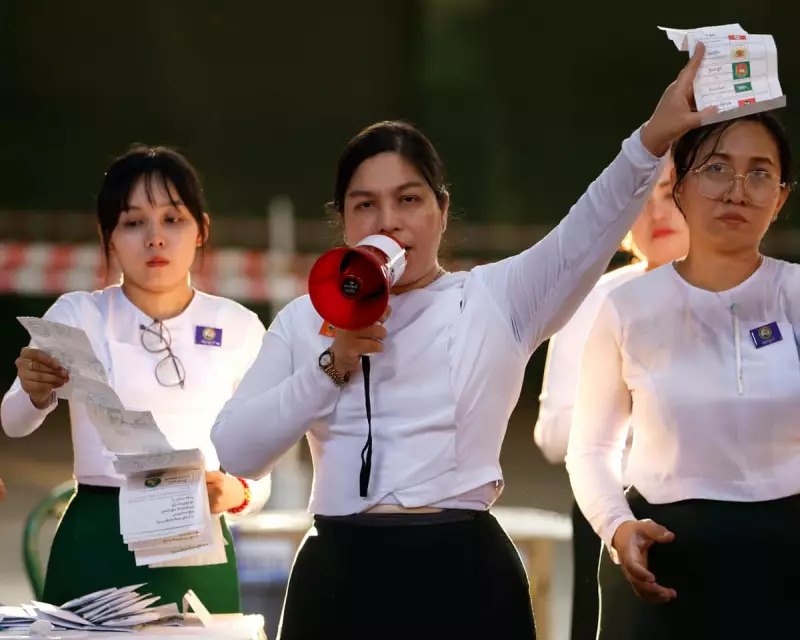
Myanmar's 'Sham' Election Concludes as Junta Proxy Set for Landslide Victory
Electoral officials in Myanmar have completed ballot counting following the closure of the third phase of the general election, with polling stations in Yangon and other urban centres witnessing a heavily controlled voting process. The election, held on 25 January 2026, has been widely condemned as illegitimate by international observers and met with deep scepticism by citizens who describe it as a "fake election" orchestrated by the military regime.
A Climate of Fear and Intimidation
Voters across Myanmar participated under duress, with many expressing fear of retaliation from junta officials if they abstained. "They are heartless people. Right now, we don't have a future, we don't have freedom, we can't speak freely," said one anonymous voter from Mandalay, who spoke briefly before hurrying away, nervous of being watched by police and election officials. He added, "They kill my brothers," reflecting the pervasive atmosphere of violence that has characterised the military's rule since the coup five years ago.
The election process unfolded against a backdrop of severe repression, including the arrest of political opponents, the banning of the most popular political party, and the systematic use of violence to crush dissent. In urban areas like Mandalay, voting proceeded under the watch of armed police, with families arriving at polling stations at sunrise, often packed on motorbikes, to file beneath blue gazebos to cast their ballots.

Ongoing Conflict and Economic Strain
Just hours from central Mandalay, fierce fighting continues to rage between the military and various opposition groups, including ethnic armed organisations and the Mandalay PDF, a powerful anti-junta faction formed after the coup. This conflict has led to the cancellation of voting in rural areas of the Mandalay region and has severely disrupted trade routes, causing prices for basic items such as rice and cooking oil to triple since the coup.
The economic strain is compounded by a soaring number of displaced people fleeing to cities like Mandalay to escape the violence, driving up housing costs and creating further instability. Additionally, last year's devastating earthquake has left many residential buildings damaged or unsafe, with residents living in constant fear of aftershocks and structural failures.
International Condemnation and Domestic Disillusionment
The United Nations, along with western governments including the UK and Australia, and the EU's top rights official, have rejected the election as lacking legitimacy. The Association of Southeast Asian Nations (ASEAN) did not send observers and has refused to endorse the poll. In contrast, China, a key military ally, has expressed support for the vote.
Domestically, turnout in early rounds of the month-long election has been notably low, at approximately 55%, compared to around 70% in previous elections. This decline persists despite reports of the military threatening residents with repercussions for non-participation. In Mandalay, local officials used loudspeakers and door-to-door visits to compel voting, yet many, like resident Thandar, defied these orders. "I don't care for their threats," she stated, echoing a sentiment of resistance among those who view the process as fundamentally unfair.
The Path Ahead: Continued Repression and Conflict
With the Union Solidarity and Development party, the military's proxy, fielding the most candidates and securing the majority of seats in previous rounds, a landslide victory is all but assured. It is widely expected that junta chief Min Aung Hlaing will assume the presidency, though questions remain about whether he will retain his role as military commander-in-chief.
As the election concludes, the reality for Myanmar's people remains bleak: repressive laws, ongoing conflict, and a pervasive climate of fear. "They cannot change reality," remarked Kyaw Kyaw, a Mandalay resident, summarising the widespread belief that the election will bring no meaningful change. With the military regaining momentum on the battlefield, supported by China, and ramping up airstrikes, the prospect of intensified fighting looms large, ensuring that the struggle for democracy and freedom in Myanmar continues unabated.






