Myanmar's Final Election Phase Proceeds Amid Military Strikes and Widespread Criticism
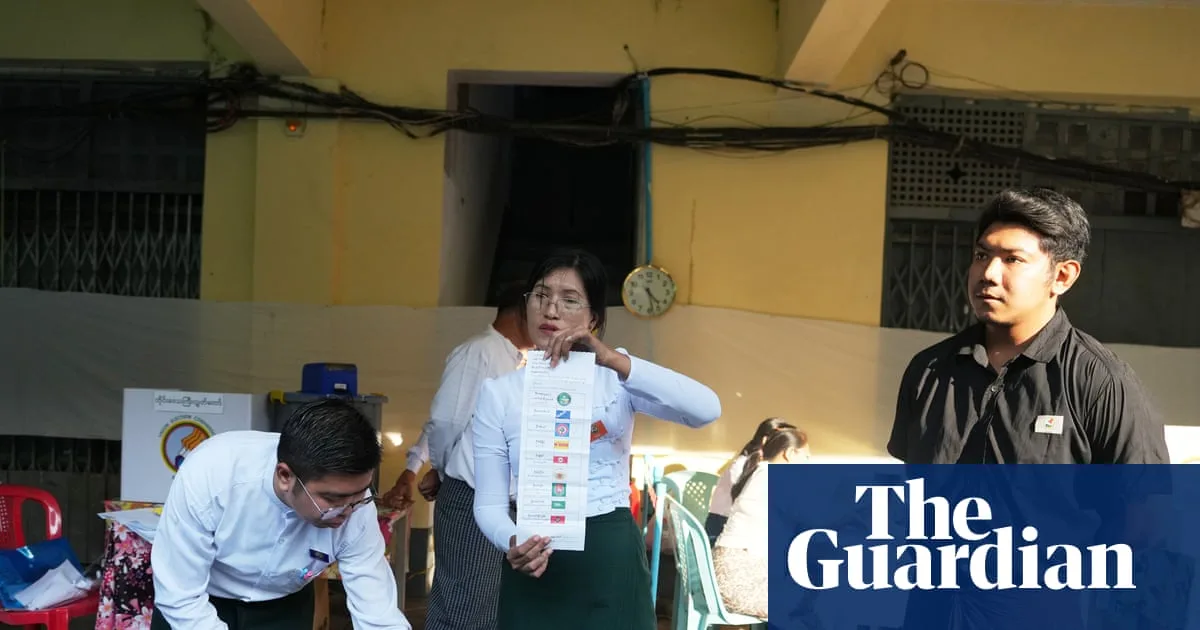
The third and final phase of Myanmar's highly contentious general election unfolded on Sunday, with voters in Yangon and other regions casting ballots under a cloud of military violence and international condemnation. The process, which has been staged in three separate stages since December, represents what the ruling junta describes as a return to democratic norms but is viewed by critics as a carefully orchestrated sham designed to cement military control.
A Vote Marred by Violence and Exclusion
Polling stations opened across the country just days after a military airstrike on a village in Kachin state resulted in the deaths of twenty-one people and left twenty-eight others injured. The attack targeted displaced individuals sheltering in the northern township of Bhamo, an area where voting was scheduled to take place during this final phase. This incident underscores the ongoing conflict that has ravaged Myanmar since the military seized power in a coup nearly five years ago, ousting the elected government led by Aung San Suu Kyi.
Analysts estimate that approximately one-third of Myanmar's territory has been excluded from the electoral process entirely. These regions are either under the control of various anti-junta resistance groups or are embroiled in such intense fighting that conducting a vote is impossible. The areas where voting did proceed, including populous cities like Mandalay and Yangon, witnessed notably lower turnout compared to previous elections, with a distinct absence of the large rallies and public excitement that once characterised the country's political landscape.
International Condemnation and a Lack of Legitimacy
The United Nations, numerous human rights experts, and several Western governments have outright rejected the election, stating it lacks any legitimate democratic foundation. Tom Andrews, the UN Special Rapporteur on the situation of human rights in Myanmar, asserted that the vote was orchestrated by the military to guarantee a landslide victory for its political proxy, the Union Solidarity and Development Party (USDP).
"The junta is banking on the world’s fatigue, hoping that the international community will accept military rule dressed up in civilian clothing," Andrews warned. "Governments must not allow that to happen." This sentiment was echoed by the regional bloc, the Association of Southeast Asian Nations (ASEAN), which, through Malaysia, confirmed it would not endorse the poll or send observers. In contrast, China, a key military ally of the junta, has expressed support for the election, viewing it as a potential pathway to stability.
A Political Landscape Stripped of Opposition
The electoral field has been systematically narrowed to ensure a predetermined outcome. The National League for Democracy, the party formerly led by Aung San Suu Kyi, has been banned, and many of its politicians remain imprisoned. According to the election monitoring group Anfrel, 57% of the parties that participated in the 2020 general election no longer exist, despite having secured over 70% of the votes and 90% of the parliamentary seats in that contest.
While fifty-seven parties are technically competing, only six are doing so nationwide, and analysts confirm that none genuinely represent anti-military sentiment. The USDP is fielding by far the largest number of candidates, positioning itself for an uncontested victory. The environment for free expression has been further stifled by a new election protection law enacted in July, which mandates a minimum three-year prison sentence—and potentially the death penalty—for any criticism of the vote.
Conflict Escalates Despite Electoral Theatre
Su Mon, the senior analyst for the Asia Pacific at the Armed Conflict Location & Event Data Project (ACLED), noted that the military's counter-offensives have intensified in the lead-up to the election. "In an effort to regain territory, the military continued its repeated airstrikes on civilian areas throughout 2025, leading to the highest number of airstrikes and associated fatalities in any single year since 2021," she stated.
ACLED has described Myanmar's conflict as "the most fragmented conflict in the world" and ranks the country second on its global conflict index due to its deadliness, danger to civilians, and the proliferation of armed groups. The organisation has recorded an estimated 92,000 fatalities since the 2021 coup. Su Mon concluded that the election's outcome is a foregone conclusion, predicting both a USDP landslide and a continued escalation of violence across the nation.
As the final ballots are cast, the international community watches a process that appears designed not to resolve Myanmar's profound crisis, but to provide a veneer of legitimacy for continued military rule amidst unrelenting conflict and widespread suffering.




