

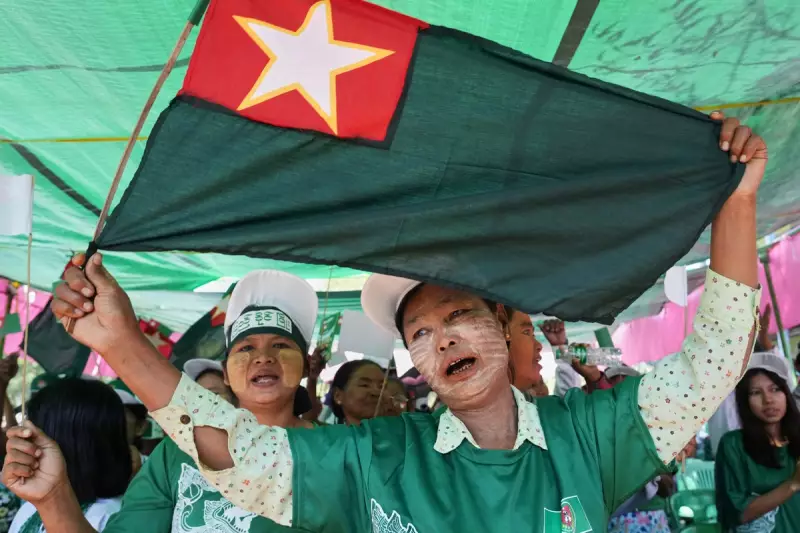
Myanmar's military-aligned political party has significantly strengthened its position following the second phase of a staged general election, official results indicate, moving it closer to securing a parliamentary majority.
Election Results and the Path to Power
According to figures released on Friday, 16 January 2026, by the state-backed Union Election Commission, the Union Solidarity and Development Party (USDP) secured 86 of the 100 contested seats in the lower house during the second round of voting held on Sunday, 11 January.
Combined with its earlier gains from the first phase in December, the USDP now holds 182 elected seats in the 330-member lower house. This represents more than half of the elected contingent, placing the party in a dominant position ahead of the final round scheduled for 25 January.

Myanmar's political system grants the military an automatic 25% of seats in each legislative house under the constitution. A party with a combined parliamentary majority can select the president, who then appoints a cabinet and forms a government.
Widespread Criticism and Security Concerns
The election has been widely condemned by human rights organisations, opposition groups, and international observers. Critics assert the poll is neither free nor fair, labelling it a calculated attempt by the military junta to legitimise its rule following the February 2021 coup that ousted the elected government of Aung San Suu Kyi.
The takeover sparked mass resistance that has since escalated into a nationwide civil war. Due to intense armed conflict, the election is being conducted in three phases across select areas.
The military government reported that armed opposition groups carried out attacks on polling stations and government buildings during the first two rounds. Consequently, 65 townships will not participate in any voting, while the final round will proceed in other designated areas.
Legal Crackdowns and Future Timeline
The junta has enforced a harsh Election Protection Law that criminalises most public criticism of the polls. Authorities have recently charged more than 330 people for activities such as leafleting or online commentary.
In a notable case, the People’s Pioneer Party, one of only six parties contesting seats nationwide, faces potential dissolution. Its chairwoman, Thet Thet Khine, is under scrutiny for holding an unauthorised meeting with foreign embassy representatives in Yangon.
Military spokesperson Maj. Gen. Zaw Min Tun stated that the new parliament will be convened in March, with a new government expected to take up duties in April. Final results for all national and regional legislature seats are anticipated by late January.






