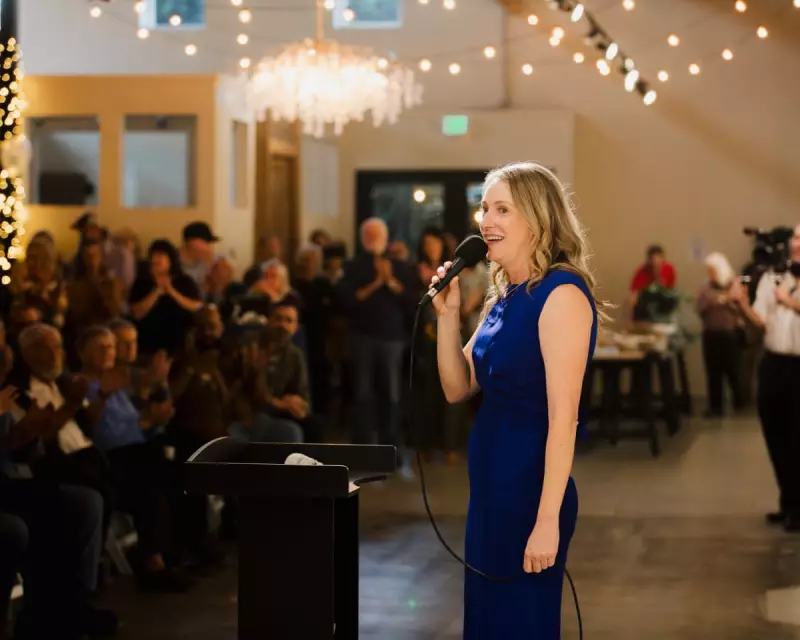
Audrey Denney's Uphill Battle in California's Chaotic Congressional Race
Rural California is witnessing one of its most extraordinary and turbulent election cycles in recent memory, with progressive Democrat Audrey Denney at the heart of the political storm. The 41-year-old educator and consultant is embarking on a remarkable dual campaign, attempting to secure a House seat not once, but twice within a single year, as the district undergoes dramatic transformation.
A District in Political Flux
California's first congressional district, stretching from the agricultural heartlands of the Sacramento Valley to the fire-prone foothills of the Sierra Nevada and Cascades, has become ground zero for political upheaval. For nearly half a century, this region remained comfortably in Republican hands, but recent redistricting has redrawn the electoral map, creating new opportunities for Democratic candidates.
The district's boundaries were significantly altered under a bold redistricting proposal designed to favour Democrats, incorporating counties to the west and south that have shifted the political calculus. This transformation occurred just as long-serving Republican representative Doug LaMalfa was preparing for what many considered a challenging re-election bid. Then, on January 6th, LaMalfa's sudden death created an unprecedented electoral scenario.

The Double Election Challenge
Voters in the district now face two separate elections: first, a special election to fill the remainder of LaMalfa's term using the old district boundaries, followed by a November election for the full term using the newly drawn map. This unusual situation has created what Denney describes as "one of the most chaotic and confusing election years" in this rural corner of California.
Denney, who has pledged not to accept corporate PAC money, spends her days making countless phone calls from an old Craftsman home in the Sacramento Valley, discussing pressing local issues with constituents. "There's all kinds of huge threats happening at once," she explains. "The economic and political systems that we are a part of are serving corporate greed and billionaires at the expense of regular people. This is not the democracy we want to live in."
Addressing Regional Challenges
The district faces multiple overlapping crises that Denney has made central to her campaign. Wildfires have scorched nearly 40% of land in the county over the past decade, leading to astronomical increases in home insurance premiums and destroying thousands of homes amid an existing severe housing shortage. Healthcare access has deteriorated, with one community recently losing its sole emergency room after the federal government eliminated a special designation that had sustained it for over two decades.
Denney, who brings a background in agriculture to her political work, argues passionately for systemic solutions. She spends considerable time considering wildfire insurance reform and advocates for non-profit single-payer healthcare as essential for saving rural medical services. Additionally, she wants to secure permanent increased funding for rural schools and work with federal agencies to ensure ecological health in a district where nearly 42% of land is federally owned.
Overcoming Historical Voting Patterns
Despite California's overall Democratic shift, this region has remained steadfastly conservative. The area sent LaMalfa, a fourth-generation rice farmer, to Congress seven times and consistently supported Donald Trump since 2016, giving him 61% of the vote in 2024 compared to Kamala Harris's 36%. LaMalfa built considerable trust through decades of community engagement, focusing particularly on water and forestry policy while maintaining loyalty to Republican leadership.
However, some discontent emerged in recent years. LaMalfa's challenges to the 2020 election certification and skepticism about climate change frustrated some constituents in a region repeatedly devastated by wildfires. Denney previously narrowed LaMalfa's lead significantly in 2018, reducing a historic 30-plus-point advantage to just 9.5% while raising $1 million, though she ultimately lost both that race and the 2020 contest.

The Republican Opposition
Denney faces formidable opposition from state lawmaker James Gallagher, a former minority leader in the assembly and friend of LaMalfa who has received endorsement from the late congressman's wife, Jill LaMalfa. In a statement, Jill LaMalfa expressed her belief that Gallagher represents continuity with her husband's approach to representation.
Republican political consultant Matt Rexroad argues that a Democratic victory in the special election represents an "impossibility," noting the district's overwhelming Republican character and strong support for President Trump. "I'm impressed with [Denney]," he acknowledges, "[but] this district is overwhelmingly Republican. They love President Trump and a Republican will win the seat."
National Implications
The outcome carries significance beyond district boundaries, potentially affecting the balance of Congress. Republicans currently maintain only a five-member majority in the House of Representatives following recent developments, making every seat crucial. Political scientist Christopher Witko, executive director of the University of California Center Sacramento, notes that while a Democratic victory in the special election remains unlikely, strong performance could improve prospects for November.
"If [Denney] does surprisingly well that's going to cause a lot of concern among Republicans in Washington DC, I imagine," Witko observes. Denney herself frames the contest in broader democratic terms, criticising what she describes as an "adjudicated sex offender and war criminal" president who "treats the constitution like it's an annoyance instead of the law of the land."
Grassroots Campaigning Against the Odds
Facing two elections, Denney maintains a packed schedule of events, candidate forums, and most importantly, personal outreach. She contrasts her approach with conventional political fundraising: "Politicians take corporate PAC money because it's easy. Corporations and PACs will walk in with a $5,000 or $10,000 check, and that's one phone call. Meanwhile, I'm spending hours and hours calling individuals who live in our communities, asking them for $50 at a time."
Her best day saw approximately 128 calls, a significant achievement she attributes to being a self-described "yapper." She finds inspiration in small donations from struggling constituents: "In the economic condition we live in, people are still willing to say, 'Here's my $10 a month contribution because I'm playing my part in this.' I think it's beautiful and it's inspiring and I'm honoured."
As she returns to her phone calls, Denney remains hopeful about providing stability and genuine representation to constituents who have long felt ignored by distant lawmakers. "I've been fighting for our communities in the north state, especially when things are hard, especially when things are challenging," she affirms. "That's what I want to keep doing."