Bangladesh's Crucial Election Tests Democracy After 2024 Uprising
Bangladesh is holding a pivotal election this Thursday, marking its first vote since the bloody 2024 uprising that toppled former Prime Minister Sheikh Hasina. The nation seeks to chart a democratic future after a turbulent period characterized by mob violence, rising religious intolerance, attacks on the press, the growing influence of Islamists, and a weakening rule of law.
Tarique Rahman Emerges as Front-Runner
When Tarique Rahman, son of former Prime Minister Khaleda Zia, returned to Bangladesh in December after 17 years of self-imposed exile, he declared to supporters: "I have a plan." His return came at a time of upheaval, with the country under an interim administration and many Bangladeshis viewing his arrival as a new chance for the nation. With his fiercest rival, Sheikh Hasina, absent from the election after being ousted by a violent student-led revolt, Rahman has quickly become the front-runner.
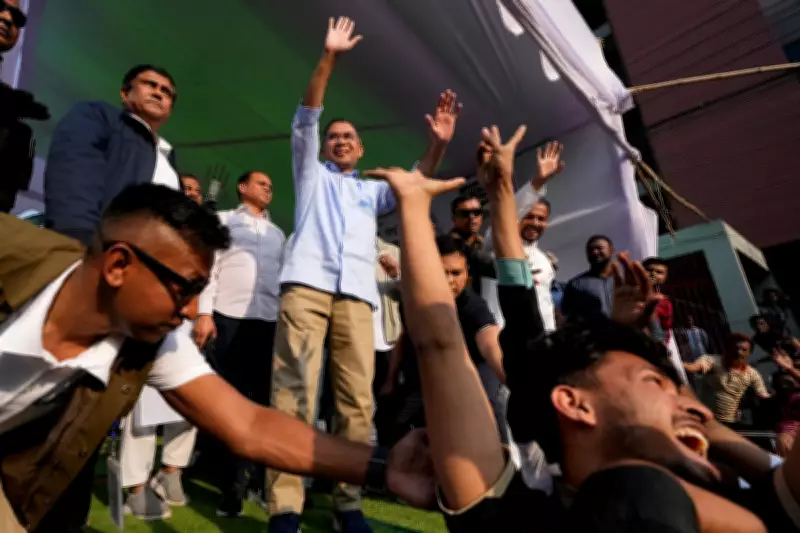
At a campaign rally in Dhaka on Monday, under heavy security, Rahman restated his ambitions to a cheering crowd: "The main goal and objective of this plan is to change the fate of the people and of this country." However, governing in the aftermath of this election may prove a stern test for democratic institutions weakened by over a decade of disputed polls and shrinking political space.

A Two-Way Contest Amid Democratic Challenges
The election is largely a two-way contest between Rahman's Bangladesh Nationalist Party (BNP) and an 11-party coalition led by Jamaat-e-Islami, the country's foremost Islamist party. Thomas Kean of the International Crisis Group noted: "An election with relatively little violence in which people are able to vote freely and all sides accept the outcome would be a significant step forward." Yet he cautioned that restoring democracy, after severe strains under Hasina's rule, would be a long-term challenge, with the process "only just started."
Rahman, who never held office in his mother's governments but wielded considerable influence within the BNP until her death in December, has campaigned on promises of job creation, greater freedom of speech, law and order, and an end to corruption. In contrast, Jamaat-e-Islami's ascent has sparked unease, particularly over its views on women. Party chief Shafiqur Rahman has stated that women are biologically weaker than men and should not work eight hours a day, raising fears of restricted fundamental rights for women.
Disillusionment Among Uprising Participants
Anxieties over Bangladesh's future are echoed by those who participated in the 2024 uprising. Initially, there was optimism when Nobel Peace Prize laureate Muhammad Yunus assumed office after Hasina's ouster, and student leaders launched the National Citizen Party (NCP) as a clean break from the old political order. However, that promise faded after the NCP joined the Jamaat-e-Islami-led alliance, leading to disillusionment among some leaders.
Tasnim Jara, a public health expert who resigned from the NCP and is running as an independent candidate, said the uprising had "opened a window" for new voices in politics but lamented that hope faded with the Islamist alignment. Arafat Imran, a Dhaka University student, added that while the uprising brought new political faces, the core state machinery—military, police, and bureaucracy—remains unchanged, emphasizing that true reform requires overhauling the entire system.
Press Freedoms Under Threat
Worries have spilled into areas crucial to a healthy democracy, particularly press freedom. Roksana Anzuman Nicole, a popular Dhaka talk-show host who challenged security forces during the uprising, is now off air and confined to her home after threats following a heated debate. She reflected: "A major pillar of that movement was the belief that everyone would be able to speak freely... just 10 days later, my dreams collapsed."

In December, a pro-uprising cultural activist was shot dead, and protesters set fire to the offices of the country's two largest newspapers. Last week, 21 journalists from an online outlet reporting critically on the military were briefly detained. Many journalists have curtailed movements or lost jobs after being branded as collaborators of Hasina. Global human rights groups, including the Robert & Ethel Kennedy Human Rights Center, have expressed concerns, with Catherine Cooper stating: "A free press is vital for a flourishing democracy. Protecting freedom of expression should be a top priority."
Uncertainty Over Democratic Change
Many Bangladeshis are putting their trust in the election, which includes a referendum for political reforms such as prime ministerial term limits and stronger checks on executive power. Iftekhar Zaman, a political analyst, described the poll as "extraordinary," noting it offers a genuine chance to vote after 16 years of elections marred by rigging allegations or boycotts. However, he warned that reinforcing democratic institutions would take time.
Kean added that while some proposed reforms are "significant and meaningful," they won't be enough alone: "The political culture has to change as well, and we are only seeing the first signs of that." As Bangladesh votes, the nation faces a critical juncture in its democratic journey, with the outcome poised to shape its future amid ongoing challenges.