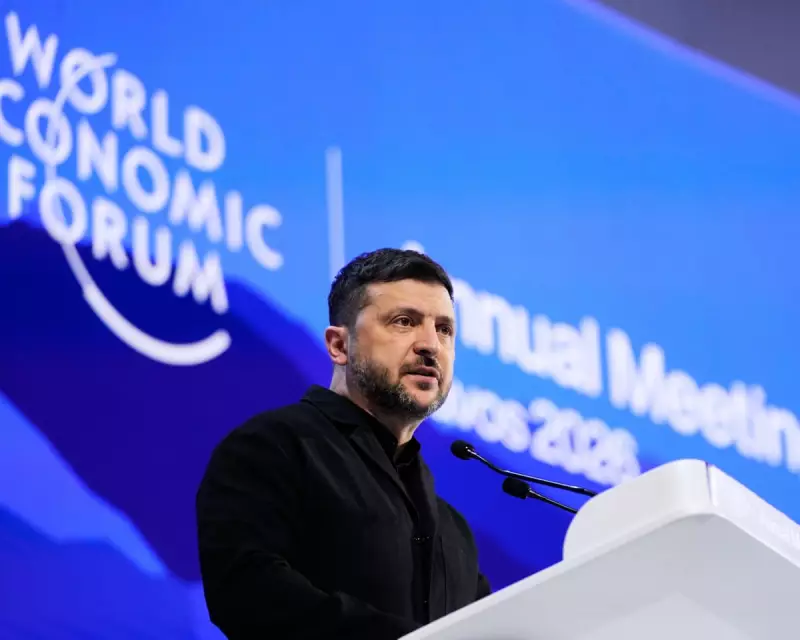
In a pointed address at the World Economic Forum in Davos, Ukrainian President Volodymyr Zelenskyy launched a stark critique of European leadership, accusing the continent's politicians of operating in what he termed a passive "Greenland mode". The president suggested that EU states are merely awaiting direction from an unpredictable United States, under Donald Trump, rather than taking decisive action to secure their own future.
A Year of Inaction on European Defence
Zelenskyy highlighted a frustrating lack of progress, noting that precisely one year prior, at the same prestigious forum, he had concluded his speech with the admonition that "Europe needs to know how to defend itself". He lamented that twelve months later, nothing substantive had changed in the continent's strategic posture, leaving it vulnerable to external threats.
The 'Greenland Mode' Critique
The Ukrainian leader's metaphor referenced the extraordinary geopolitical focus on Greenland following public demands from President Trump for the US to acquire the territory. Zelenskyy argued that European capitals appeared paralysed by this development, unsure how to respond and simply hoping the issue would dissipate.

"Everyone gave attention to Greenland, and it is clear most leaders are not sure what to do about it," Zelenskyy stated. "It seems like everyone is just waiting for America to cool down on this topic, hoping it will pass away. But what if it does not: what then?"
Symbolic Troop Deployments and a Stark Offer
He questioned the value of minimal, symbolic military deployments, asking what message sending "14 or 40 soldiers to Greenland" conveyed to adversaries like Vladimir Putin's Russia or to allies such as Denmark. In a striking declaration of capability, Zelenskyy suggested Ukraine could assist Europe directly, stating: "We know what to do if Russian warships go near Greenland, Ukraine can help with that. They can sink near Greenland just as they do near Crimea."
Call for a United European Armed Force
Moving beyond criticism, the president outlined an urgent prescription for European security. He argued that the continent's reliance on the theoretical protection of NATO, and specifically the assumption of American intervention, was a dangerous gamble.
"Today, Europe relies only on the belief that if danger comes, then NATO will react. But no one has really seen the alliance in action," he cautioned, posing a hypothetical attack on Lithuania or Poland. Europe, he asserted, requires a "united armed forces" capable of autonomous continental defence, reducing dependency on transatlantic guarantees that may not materialise.
Targeting Russia's War Economy
Zelenskyy also urged a more aggressive European stance against Russia's capacity to wage war. He pointed to the continued ease with which Moscow bypasses sanctions to produce missiles and highlighted the "shadow fleet" of oil tankers that finances its military campaign. A more muscular European policy here, he implied, is a necessary component of genuine self-defence.
Context of Stalled Diplomacy
The Davos speech followed a meeting between Zelenskyy and President Trump, where discussions on a potential peace deal for Ukraine remained, in Trump's words, "a ways to go". The US president's envoy, Steve Witkoff, accompanied by Jared Kushner, was scheduled to meet Vladimir Putin later that day, with Witkoff expressing cautious optimism that the conflict was "solvable".
When questioned at Davos, Trump's message to Putin was succinct: "The war has to end." Zelenskyy's broader address, however, framed the immediate crisis in Ukraine within a larger, existential warning for Europe: the imperative to forge its own path in an era of American unpredictability.