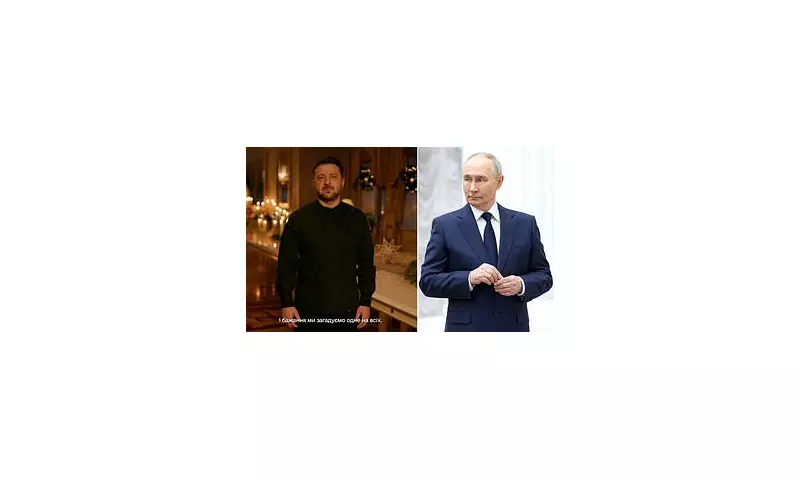
Ukrainian President Volodymyr Zelensky has used his annual Christmas message to deliver a powerful and personal condemnation of his Russian counterpart, Vladimir Putin, while simultaneously revealing significant progress in high-stakes peace negotiations with the United States.
A Stark Festive Message Amid Conflict
In a pre-recorded address posted to his X account on Christmas Eve, President Zelensky, dressed in a traditional embroidered shirt, stood before a warmly lit festive backdrop. His words, however, were far from celebratory. He articulated a private wish shared by many Ukrainians after nearly four years of brutal conflict. "May he [Putin] perish," Zelensky stated, acknowledging the sentiment many hold privately. He quickly added that public prayers were for peace, stating, "We ask for peace for Ukraine. We fight for it. And we pray for it."
The president framed the ongoing war as a struggle between good and evil, directly linking Russia's military actions to a lack of humanity. He referenced a massive Russian bombardment on the eve of Christmas, involving hundreds of Shahed drones and various missiles. "This is how godless people strike," Zelensky declared. "This is what those who have absolutely nothing in common with Christianity or with anything human do."

Peace Plan Progress and Sticking Points
This forceful rhetoric stands in sharp contrast to a major conciliatory move disclosed by the Ukrainian leader. Following marathon talks with US officials in Florida, Zelensky announced that Kyiv and Washington have reached a consensus on most elements of a proposed 20-point peace plan aimed at ending the war.
The framework, which reflects Ukraine's position, has been presented to Russian negotiators, with Moscow expected to respond. At its heart is a proposal to transform parts of the current eastern front line into either demilitarised zones or free economic zones, monitored by international forces to prevent any Russian military incursion.
However, two major obstacles remain. The first is the future of the Donbas region, specifically the Donetsk oblast. Russian forces control around 70% of Donetsk and most of Luhansk. The Kremlin demands Ukraine cede the remaining territory, a position Kyiv rejects. Zelensky described this as "the most difficult point" in negotiations, requiring eventual resolution by national leaders.
The second unresolved issue is the management of the Russian-occupied Zaporizhzhia Nuclear Power Plant (ZNPP). The US has proposed a consortium with equal Ukrainian and Russian stakes, while Kyiv favours a joint venture with the United States, allowing Americans to control their share's distribution.
Referendum and Security Guarantees
President Zelensky emphasised that any territorial arrangements, including the creation of demilitarised zones, would require approval via a nationwide referendum in Ukraine. The draft agreement proposes freezing the current contact line across five regions once a deal is signed, with a required 60-day ceasefire to allow a referendum to be held.
Ukraine insists that any demilitarised area must be policed by an international force to guarantee Russian troops or covert units—referred to as "little green men"—cannot re-enter. "Since there is no faith in the Russians, and they have repeatedly broken their promises," Zelensky explained, international oversight is non-negotiable.
The plan also calls for a full Russian withdrawal from Ukraine's Dnipropetrovsk, Mykolaiv, Sumy, and Kharkiv regions, with international forces stationed along the contact line to monitor compliance.
Despite the reported "solid" progress in talks, the war continues to rage on the ground. Russia has sustained its attacks on Ukrainian energy infrastructure and cities, causing civilian casualties and widespread power outages during freezing winter temperatures. The Ukrainian president's Christmas address poignantly noted the human cost: "Sadly, not all of us are at home this evening, not all of us still have a home, and not all of us, unfortunately, are with us today."

As negotiations enter a critical phase, the world watches to see if the stark wishes expressed in Zelensky's Christmas message will give way to a durable, if complex, diplomatic solution.