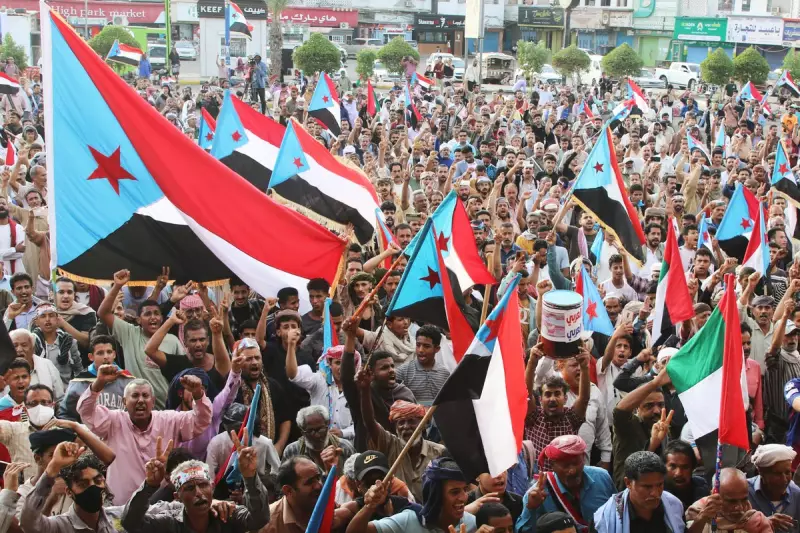
Yemen's primary separatist faction has issued a forceful denial of its own dissolution, plunging the complex conflict into fresh uncertainty and revealing a profound internal split. The Southern Transitional Council (STC) has stated that an earlier announcement of its disbandment, broadcast on Saudi media, was made "under coercion and pressure."
Contradictory Announcements Reveal Internal Split
The dramatic sequence of events began when a member of the STC appeared on Saudi state media and declared that the UAE-backed group had decided to dissolve itself. This announcement, if true, would have marked a seismic shift in Yemen's long-running war. However, the STC's subsequent denial has exposed a significant fracture within the organisation's leadership. The council, a coalition of groups seeking to restore the former state of South Yemen, has been a dominant force in the south, controlling key areas including the interim capital, Aden.
This public contradiction is more than a simple miscommunication; it highlights a critical power struggle. The STC has been a key, if often contentious, ally within the Saudi-led coalition fighting against the Houthi movement. However, its deeper ties to the United Arab Emirates have frequently caused friction with Riyadh. The reported flight of STC leader Aidarous al-Zubaidi from Yemen adds another layer of crisis, with the Saudi-led coalition directly accusing the UAE of facilitating his escape.

Rising Tensions and Security Crackdown
In response to the escalating situation, the STC has called for mass protests across southern cities, a move clearly intended to demonstrate its ongoing popular support and organisational strength. This call to action is a direct challenge to the Saudi-backed authorities currently administering Aden.
Those authorities have moved swiftly to pre-empt any unrest, issuing a ban on all demonstrations citing paramount security concerns. This sets the stage for potential confrontation on the streets, further complicating the fragile security landscape in a region already ravaged by years of conflict.
Implications for Yemen's Future
The unfolding crisis within the STC has immediate and serious ramifications for the future of Yemen. The group's control of southern territory is a pivotal factor in any political settlement. A fragmented or weakened STC could destabilise the south further, creating a power vacuum that other factions might seek to fill.
Moreover, the incident underscores the deepening complexities of the coalition dynamics. The public accusation by the Saudi-led coalition against the UAE marks a notable deterioration in their coordinated approach to the Yemen conflict. As of Saturday 10 January 2026, the situation remains highly volatile, with the STC's future direction—and its relationship with both Riyadh and Abu Dhabi—hanging in the balance.