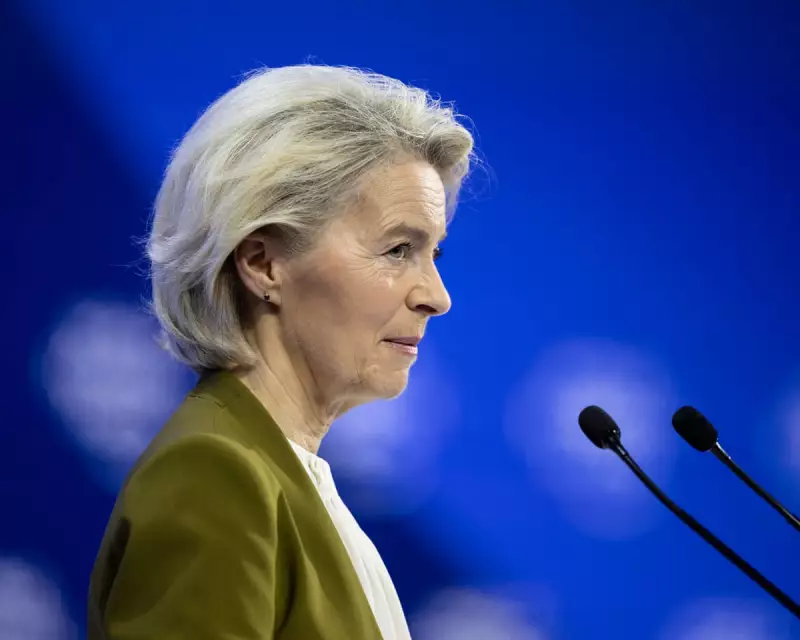
European Commission President Ursula von der Leyen has delivered a pointed critique of Donald Trump's planned tariffs related to Greenland, describing them as a significant error while casting doubt on the US president's reliability. Her remarks came during a high-profile address at the 56th World Economic Forum in Davos, Switzerland, where she emphasised the importance of trust and unity among longstanding allies.
Von der Leyen Questions Trust and Warns of Consequences
Speaking on Tuesday, von der Leyen explicitly called Trump's threat to impose a 10% tariff on imports from eight European nations an error, particularly between allies with deep historical ties. The countries targeted include Denmark, Norway, Sweden, France, Germany, the UK, the Netherlands, and Finland, all of which oppose a US takeover of the Arctic island of Greenland.
Appearing to challenge Trump's trustworthiness, von der Leyen referenced a trade deal agreed upon last July, stating firmly that in both politics and business, a deal should be honoured. She remarked, "When friends shake hands, it must mean something," underscoring the EU's view of Americans not merely as allies but as friends. She warned against allowing relations to spiral downward but assured that the EU's response, if necessary, would be unwavering, united, and proportionate.

Trump's Aggressive Push for Greenland Control
Donald Trump has intensified his efforts to acquire Greenland in recent weeks, declaring that the US will take control of the vast, mineral-rich Arctic territory "one way or the other." On Saturday, he threatened punitive tariffs starting at 10% from 1 February, potentially rising to 25%, unless European objections are withdrawn.
In a social media post on Tuesday, following discussions with Nato Secretary General Mark Rutte, Trump asserted that Greenland is imperative for national and world security, insisting there is "no going back." He shared an AI-generated image depicting himself, Vice-President JD Vance, and Secretary of State Marco Rubio planting a US flag in Greenland, with a sign reading "Greenland, US territory est 2026." Another image showed a map incorporating Canada and Greenland as part of the United States.
Separately, Trump posted a message from French President Emmanuel Macron, who expressed confusion over the Greenland strategy. This follows earlier threats from Trump to impose a 200% tariff on French wine and champagne, further complicating transatlantic trade dynamics.
Escalating Tensions Threaten EU-US Relations and Nato Alliance
The growing dispute has thrown trade relations between the European Union and the United States into fresh turmoil, compelling the bloc to contemplate retaliatory measures. This situation also risks undermining the Nato transatlantic alliance, which has been a cornerstone of Western security for decades.
Trump is scheduled to attend the World Economic Forum later this week, where he will meet with EU leaders who are considering various countermeasures. Options include implementing a suspended package of tariffs on €93 billion (£80 billion) of US imports or deploying the bloc's untested "anti-coercion instrument" (ACI), which could restrict US access to public tenders, investments, banking activities, and trade in services.
Danish Economy Minister Stephanie Lose emphasised in Brussels that this issue transcends the Kingdom of Denmark, impacting the entire transatlantic relationship. She stated, "At this point in time, we do not believe that anything should be ruled out," highlighting the gravity of the situation.
Mixed Reactions and Calls for Calm
In contrast, US Treasury Secretary Scott Bessent urged partners to "take a deep breath" and allow tensions over Greenland to subside. Speaking on the sidelines in Davos, he described US-European relations as strong and expressed confidence that a solution would be found, dismissing European "hysteria" as unjustified. Bessent advised, "It's been 48 hours. Sit back, relax. I am confident the leaders will not escalate and that this will work out in a manner that ends up in a very good place for all."

Trump has further unsettled the EU and Nato by not ruling out the use of military force to seize Greenland, despite the US already operating a military base on the island under a bilateral agreement with Denmark that permits significant expansion.
European Security Initiatives and Military Movements
In her speech, von der Leyen outlined that the EU is developing a package for Arctic security based on Greenlandic and Danish sovereignty, alongside a substantial investment surge in Greenland and cooperation with the US in the region. This aligns with broader European efforts to bolster security in the high north.
Danish public broadcaster TV2 reported that 58 Danish troops arrived in Greenland on Tuesday to join approximately 60 others dispatched earlier for Operation Arctic Endurance, a multinational military exercise. Swedish Defence Minister Pål Jonson indicated that European leaders are considering a more permanent military presence in the Arctic to enhance security, a key US demand. Jonson noted that European Nato members are conducting a reconnaissance tour to assess infrastructure and exercise needs in the region.
As the World Economic Forum continues, the escalating row over Greenland and tariffs underscores the fragile state of transatlantic relations, with von der Leyen's comments highlighting deep concerns over trust and alliance stability in an era of geopolitical uncertainty.