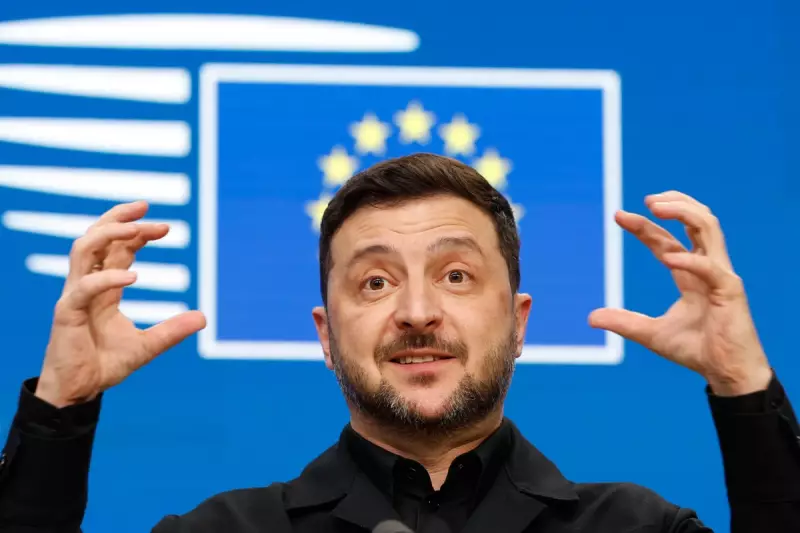
The United States and Ukraine have forged a consensus on a comprehensive 20-point draft plan aimed at ending the nearly four-year conflict with Russia, though two critical issues concerning territory and a major nuclear facility remain unresolved, President Volodymyr Zelenskyy has announced.
Marathon Talks Yield Draft, But Sticking Points Persist
President Zelenskyy briefed journalists on the plan, which was hammered out during intensive talks in Florida and presented to Russian negotiators. The Ukrainian leader stated that a response from Moscow is anticipated on Wednesday 24 December 2025.
The draft proposal intertwines political and commercial interests to bolster security while enhancing Ukraine's economic potential. However, Zelenskyy confirmed that consensus had not been reached on the future status of the Donetsk region or the management of the Russian-occupied Zaporizhzhia Nuclear Power Plant (ZNPP).

"We have significantly brought most of the positions closer together. In principle, all other consensus in this agreement has been found between us and them," Zelenskyy said.
The Donbas Dilemma: Free Economic Zones and Referendums
At the heart of the deadlock is the contentious future of Ukraine's eastern Donbas region, specifically Donetsk and Luhansk. Russia, which controls most of Luhansk and about 70% of Donetsk, continues to demand Ukraine relinquish the remaining territory—an ultimatum Kyiv has rejected.
In a bid to break the impasse, the United States has proposed transforming these disputed areas into free economic zones. Ukraine insists any such arrangement must be contingent upon a national referendum, granting the Ukrainian people the ultimate decision-making power.
"We are in a situation where the Russians want us to leave the Donetsk region, and the Americans are trying to find a way so that it is 'not a way out'," Zelenskyy explained. The proposed mechanism would require a 60-day process during which hostilities must cease.
The draft further stipulates that the current contact line—cutting across five Ukrainian regions—be frozen upon signing. It also demands a Russian withdrawal from Dnipropetrovsk, Mykolaiv, Sumy, and Kharkiv regions, with international forces stationed along the line to monitor compliance and prevent infiltration.
Zaporizhzhia Plant: A Three-Way Joint Venture?
The management of Europe's largest nuclear power plant, under Russian occupation since early in the conflict, presents another major hurdle. The US has put forward a proposal for a consortium where Ukraine, Russia, and the US would each hold an equal one-third stake, with American oversight.
Zelenskyy countered with an alternative: a joint venture solely between Ukraine and the US, where the American side could independently decide how to distribute its 50% share, presumably to Russia. He questioned the viability of direct commercial partnership with Moscow after years of war.
"There were about 15 hours of conversations about the plant. These are all very complex things," Zelenskyy noted, adding that billions in investment are needed to restore the facility and its adjacent dam.
Security Guarantees and Economic Reconstruction
Beyond the immediate disputes, the draft plan contains several other pivotal elements. It promises Ukraine "strong" security guarantees mirroring NATO's Article 5, to be detailed in a separate bilateral pact with the US. This would obligate partners to act in case of renewed Russian aggression and establish a high-tech monitoring mechanism using satellites and early-warning systems.
On the economic front, the proposal seeks to accelerate a free trade agreement between the US and Ukraine and aims to attract a staggering $800 billion for reconstruction and development through equity, grants, loans, and private investment. This fund would target industries like technology, AI, data centres, and gas.
The document also outlines that Ukraine's army be maintained at 800,000 personnel during peacetime, sets a specific date for EU ascension, and requires Kyiv to hold elections after the agreement is signed. Furthermore, Ukraine demands the immediate release of all prisoners detained since 2014.