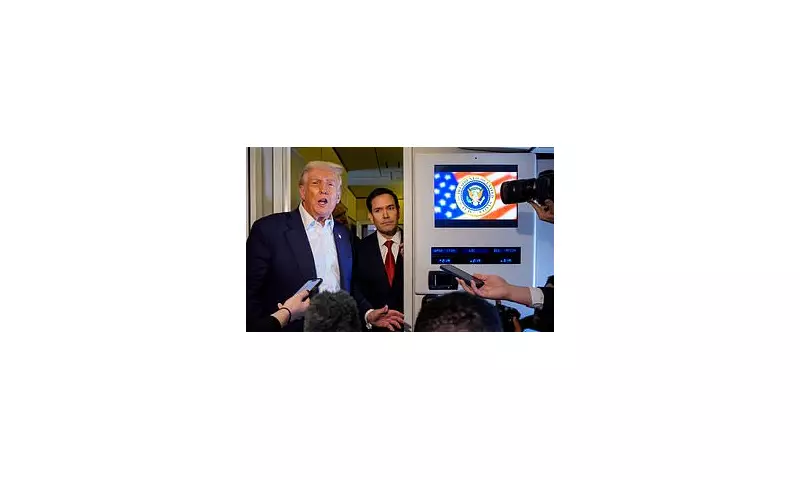
In a move that has sent shockwaves through diplomatic circles, US Secretary of State Marco Rubio was conspicuously absent from a critical NATO foreign ministers' meeting in Brussels this Wednesday. This marks the first time since 1999 that America's top diplomat has skipped such a gathering, leaving European allies stunned as they convened for urgent talks on the rapidly evolving Russia-Ukraine war.
A Hemisphere-First Strategy Takes Precedence
While his counterparts debated the most significant European security crisis in decades, Rubio was immersed in a separate geopolitical battleground: Venezuela. The oil-rich nation, accused by Washington of facilitating the industrial-scale supply of drugs into the United States, has become Rubio's primary focus. In a revealing interview with Sean Hannity, Rubio articulated his 'America First' philosophy, stating, 'If you are focused on America and "America First," you start with your own hemisphere.' He argued that threats closer to home resonate more with American citizens than distant conflicts.
This stance has been widely interpreted in Washington as a subtle but pointed critique of Donald Trump and the growing circle of envoys—both official and unofficial—dedicated to brokering peace with Russian President Vladimir Putin. The snub has intensified scrutiny of the political crosscurrents shaping the administration's inner foreign-policy circle.
Power, Politics, and the Venezuelan Agenda
According to an American diplomat focused on Europe, who spoke to the Daily Mail, Rubio's fixation on Venezuela extends beyond mere policy. 'Rubio's top priority is his Latin American agenda - he needs to satisfy his wealthy Venezuelans in Florida who are useful for his political future. He sees Ukraine as a loser topic in the MAGA world,' the source claimed. The diplomat suggested Rubio is avoiding a public clash with Trump's personal envoy, real-estate magnate Steve Witkoff, and senior adviser Jared Kushner, by steering clear of the NATO forum.
Despite being regarded inside the White House as one of the administration's most pro-Ukraine voices, Rubio is said to hold a dim view of Witkoff's negotiation tactics. 'He doesn't necessarily respect him and how he is going about his negotiations. But he would never say that publicly,' a second State Department source revealed.
Rubio's increasing presence at the White House and relative absence from traditional State Department diplomatic missions is noted by insiders. A traditionalist hardliner from Miami's Cuban exile community, he is unwavering in his refusal to negotiate with Venezuelan President Nicolás Maduro, whom he labels the head of a 'narco-terror government.'
Military Moves and Legal Questions
The focus on Venezuela has escalated into military action. The Trump administration has recently labelled Maduro and his inner circle a foreign terrorist organisation, a designation used to justify strikes on suspected drug-smuggling vessels. Rubio charged that the Cartel de los Soles, allegedly under Maduro's control, was 'responsible for terrorist violence.'
These strikes have sparked legal debates in Congress, with officials potentially seeking to add provisions to the National Defense Authorization Act to shield the administration. A controversial report alleged that Pentagon lead Pete Hegseth issued a verbal directive during the first US strike in the Caribbean to 'leave no survivors,' an accusation flatly denied by the White House and Pentagon as 'fake news.'
Amidst this, reports suggest the US is considering offering Maduro a comfortable exile in a country like Qatar, following a call from Trump urging the Venezuelan leader to step down.
In response to queries about Rubio's NATO absence, a State Department spokesperson stated, 'Secretary Rubio has already attended dozens of meetings with NATO allies and it would be completely impractical to expect him at every meeting.' Dismissing criticism of Witkoff, they added that Rubio is 'honored to be a part of President Trump's team' and denounced 'anonymous gossipers slinging baseless smears.'
The empty chair in Brussels now symbolises a profound recalibration of American diplomatic priorities, placing hemispheric concerns above transatlantic unity and exposing significant fissures at the heart of US power.