US and Israel Escalate Strikes on Iran as Tehran Celebrates New Supreme Leader
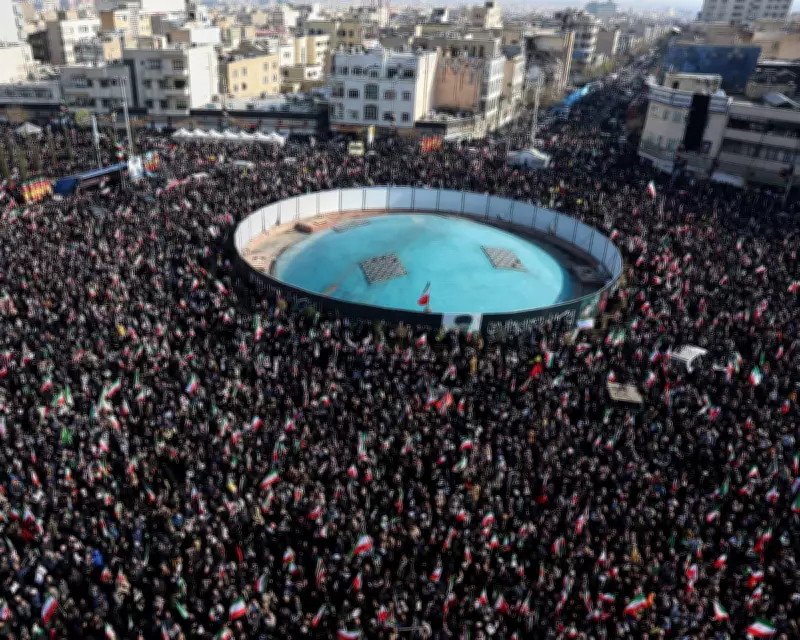
US and Israeli warplanes launched fresh waves of strikes on targets across Iran on Monday, intensifying a conflict now in its second week. The military escalation coincided with large crowds gathering in Tehran's Enghelab Square to offer allegiance to Mojtaba Khamenei, Iran's newly appointed supreme leader.
Defiant Rally in Tehran Amid Regional Attacks
Thousands of supporters chanted "Death to America, Death to Israel" and "God is Great" while waving Iranian flags and banners bearing portraits of Ayatollah Ali Khamenei, the new leader's father who was killed by an Israeli airstrike at the war's outset. Armoured vehicles lined nearby roads with security personnel stationed on surrounding rooftops.
Hosseinali Eshkevari, a member of Iran's assembly of experts responsible for selecting the supreme leader, declared: "The path of the martyred Imam Khamenei will carry on under the name of Khamenei." Another assembly member, Mohsen Heydari, stated the late Ali Khamenei had recommended selecting a candidate "hated by the enemy."

Regional Conflict Expands Across Middle East
The conflict continued to escalate with multiple fronts:
- Iran launched fresh missile and drone attacks targeting Israel, US bases across the Middle East, and energy infrastructure in Gulf states
- Israel pressed its offensive against Hezbollah in Lebanon with raids in the south and airstrikes in Beirut
- Drone strikes were reported in Bahrain, United Arab Emirates, and Saudi Arabia
- An Iranian missile was shot down over Turkey, marking the second such incident since the war began
French President Emmanuel Macron announced France and its allies were preparing a defensive naval mission to protect oil supplies in the Gulf. Speaking during a visit to Cyprus, Macron said the mission would escort container ships and tankers to gradually reopen the Strait of Hormuz after "the hottest phase of the conflict" ends.
Economic and Humanitarian Consequences Mount
The appointment of Mojtaba Khamenei, viewed by analysts as a hardliner with close ties to the Revolutionary Guards, intensified fears the conflict could last for weeks or months, potentially leaving deep regional instability. Global stock markets fell sharply on Monday as oil prices surged above $100 per barrel for the first time since 2022.
Iran's attacks in the Strait of Hormuz have virtually halted tanker traffic through the crucial shipping lane that carries one-fifth of the world's oil. Iran's security chief Ali Larijani stated on social media that safe passage through the strait would not be restored "amid the fires ignited by the United States and Israel in the region."
Gulf States Report Significant Damage
The United Arab Emirates reported two people wounded by shrapnel from intercepted Iranian missiles over Abu Dhabi. Emirati authorities said 15 ballistic missiles and 18 drones were fired at the country on Monday alone, bringing the total since the war began to 253 missiles and 1,440 drones. Four foreign nationals have been killed and 117 wounded in the UAE.
In Bahrain, an attack hit a residential area, wounding 32 people including several children, and appeared to start a fire at the country's only oil refinery. Bahrain also accused Iran of damaging one of its desalination plants, raising concerns about water supplies for millions in the parched region.
Kuwait's emir described Iran's strikes as "a brutal attack by a neighbouring Muslim country, which we consider a friend," while Saudi Arabia warned Tehran would be the "biggest loser" if it continues attacking Arab states.
Humanitarian Crisis Deepens in Lebanon
The conflict has killed at least 1,230 people in Iran, 397 in Lebanon, and 11 in Israel according to official reports. Israel reported its first military deaths on Sunday when two combat engineers were killed in southern Lebanon.
An Israeli military spokesperson accused Iran of deliberately targeting densely populated civilian areas with cluster bombs. The Israeli military has ordered inhabitants to leave southern Beirut suburbs, much of south Lebanon, and parts of the eastern Bekaa valley region - all Hezbollah strongholds.

UNICEF regional director Edouard Beigbeder reported nearly 700,000 people have been displaced in Lebanon, including approximately 200,000 children. "Children are being killed and injured at a horrifying rate, families are fleeing their homes in fear, and thousands of children are now sleeping in cold and overcrowded shelters," he stated.
Turkish President Tayyip Erdoğan said Turkey's main goal is keeping the country out of the "blaze" of the conflict after NATO air defences intercepted a ballistic missile that entered Turkish airspace.