US and Iran in Tense Race to Find Downed F-15E Pilot After Dramatic Shootdown
The war in the Middle East escalated dramatically on Friday when an American F-15E fighter jet operating over southern Iran was shot out of the sky, sparking a high-stakes race between the United States and Iran to locate one of the two crew members.
Daring Rescue and Propaganda Battle
One of the two-person crew was rescued within hours in a daring Special Forces mission involving low-flying US helicopter gunships. However, the hunt for the second crew member has become a head-to-head competition between the warring sides, with significant propaganda implications.
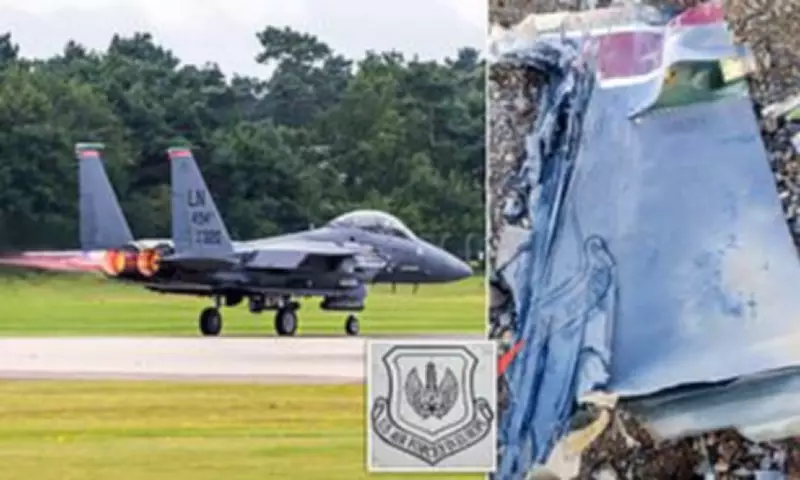
In a major propaganda boost for Iran, images of debris from the downed jet—including an ejector seat and tail fin—were flashed around the world. Iranian state media then showed videos of Pave Hawk helicopters, a C-130 Hercules aircraft, and drones making low passes over a mountainous valley, with locals frantically firing at them.

Bounty and Taunts from Tehran
The Tehran regime placed a £50,000 bounty on the missing pilot's head and urged locals near the crash site to seize the American. Iranian broadcasters told viewers: 'If you capture the enemy pilot or pilots alive and hand them over to the police you will receive a precious prize.'
News channels also flashed messages on screen reading 'shoot them if you see them' and showed footage of villagers scouring a rocky hillside. Iranian parliamentary speaker Mohammad Ghalibaf taunted the US and Donald Trump's numerous proclamations of winning the war, writing online: 'After defeating Iran 37 times in a row, this brilliant no-strategy war they started has now been downgraded from "regime change" to "Hey! Can anyone find our pilots? Please?"'
Military Details and Political Fallout
The £60 million F-15E is said to be part of 494 Squadron of the 48th Fighter Wing based at USAF Lakenheath in Suffolk. This marks the first shooting down of a US fighter jet in the conflict, coming after President Trump repeatedly boasted that Iran has no air defence capabilities.
Around the same time, a second US Air Force combat plane—an A-10 Warthog attack aircraft—crashed in the Persian Gulf region. Officials confirmed the pilot had been safely rescued after it went down near the Strait of Hormuz.
President Trump was being closely briefed on the Combat Search and Rescue (CSAR) mission for the F-15E, which, if unsuccessful, could prove politically damaging. White House officials were reportedly 'war-gaming' the prospect of a US pilot being held hostage by the Iranians—a scenario that would likely turn more Americans against the conflict launched alongside Israel's Prime Minister Benjamin Netanyahu six weeks ago.
Search Operations and Regional Implications
US Colonel Mike Jernigan stated: 'We have two US Marine Expeditionary Units in the conflict zone. They are the best people to rescue downed aviators. Those guys have the mission for the Tactical Recovery of Aircraft and Personnel (TRAP). Right now, there are marines who are either on their way or they are in the helicopter ready to go.'
The F-15E was conducting a routine sortie over Tehran on Friday when it was struck. The plane is thought to have come down around 100 miles from the border with Iraq, where the US-UK Basra airbase is situated. The fighter jet, with a top speed of Mach 2.5 (1,650mph), was downed in the province closest to Kharg Island, the epicentre of Iran's oil industry.
Technical Capabilities and Intelligence Assessments
While Tehran's radar systems have been destroyed, Iran still possesses infrared heat equipment that can track aircraft. Unconfirmed US intelligence reports have challenged Trump's suggestion that Iran's attack capabilities have been decimated, with claims that its military still has half of its missile launchers and thousands of drones. Other assessments, denied by the White House, insist Iran has thousands of missiles stored at underground sites.

The former British ambassador to Iran, Nicholas Hopton, said: 'This is a significant moment. It is obviously deeply concerning for the families of the pilot and all service people. What worries me particularly is that this incident is likely to trigger an escalation in the conflict, rather than a better situation in Iran and stabilisation in the region.'
Survival Prospects and Diplomatic Stalemate
It is possible the missing pilot may not have survived the crash, as only a single ACES II ejector seat was photographed at the scene. US pilots are trained in SERE ('Survive, Evade, Resist and Escape') techniques at a flight school in Florida, and crews are equipped with trackers on their uniforms and encrypted communication devices.
The two-person crew consisted of a lead pilot seated to the front and an Electronic Warfare officer seated behind. It remained unclear on Friday which had been rescued. The F-15E is a non-stealth aircraft, making it easier to shoot down than an F-35 fifth-generation fighter.
When asked if Friday's events would affect any negotiations with Iran, President Trump responded: 'No, not at all. No, it's war. We're in war.' His words came as Iran's semi-official Fars news agency reported that Tehran had rejected a US proposal for a 48-hour ceasefire, allegedly made through an unnamed country, though there was no immediate comment or confirmation from the US.