

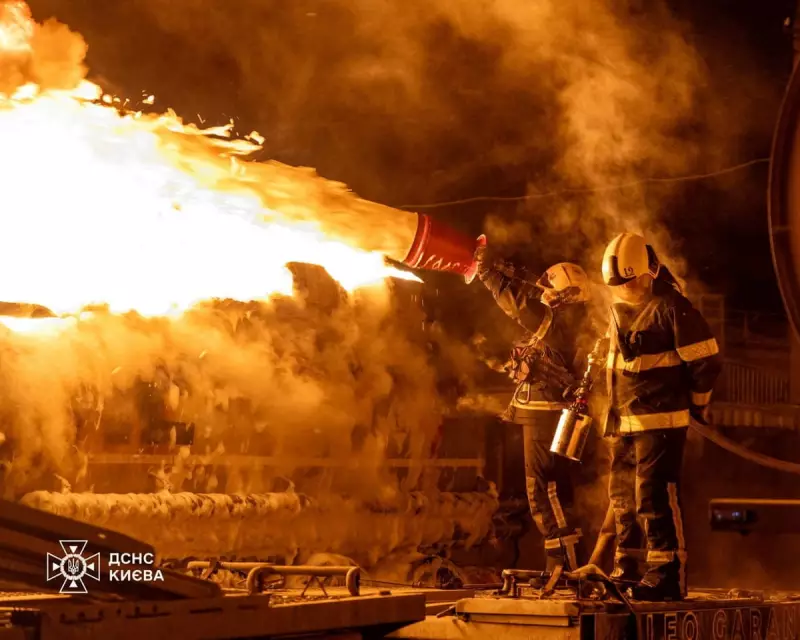
Ukrainian emergency services were engaged in a grim and urgent task in the capital on Saturday, working at the site of a fresh Russian drone and missile strike. This latest assault unfolded even as diplomatic efforts to end the nearly four-year conflict took a tentative step forward, with both sides agreeing to further face-to-face negotiations.
Progress in Abu Dhabi Talks Despite Ongoing Violence
The first round of trilateral meetings in Abu Dhabi, involving Ukrainian, Russian, and US officials, concluded with a US official hailing the discussions as "a big step" forward. The official stated that "a lot of progress has been made to date in really defining the details needed to get to a conclusion." These talks marked the first known direct contact between Ukrainian and Russian officials on a peace plan being advanced by former US President Donald Trump.
Ukrainian President Volodymyr Zelenskyy characterised the conversations as constructive, noting that "a lot was discussed." However, the diplomatic efforts were starkly juxtaposed with a renewed Russian military offensive. During the talks in the UAE, Russian forces launched coordinated drone and missile attacks on Ukraine's two largest cities, Kyiv and Kharkiv.

Ukrainian Condemnation of 'Night of Terror'
Ukraine's Foreign Minister, Andrii Sybiha, condemned the timing of the strikes, stating, "Peace efforts? Trilateral meeting in the UAE? Diplomacy? For Ukrainians, this was another night of Russian terror." The assault targeted critical infrastructure, exacerbating widespread outages of heat, water, and power across Kyiv and other cities following previous attacks on energy facilities.
Officials in the capital reported that one person was killed and at least fifteen others were injured in the strikes, which continued relentlessly until morning. Firefighters and emergency crews worked through the night to contain the damage and assist civilians.
Pre-Talks Diplomacy and Escalating Frontline Action
In a significant diplomatic precursor, US envoys Jared Kushner and Steve Witkoff held a four-hour meeting with Russian President Vladimir Putin in Moscow ahead of the trilateral talks. A US official described the discussion as "very, very productive," focusing on the final unresolved issues.
Meanwhile, the conflict continued to rage along the frontline. The governor of Russia's Belgorod region, Vyacheslav Gladkov, reported a "massive" Ukrainian attack on the region's main town, which damaged energy infrastructure but caused no casualties. He stated on Telegram that a building was set ablaze and a downed drone damaged homes in a nearby village.
Contested Ground in Kharkiv Region
The Russian defence ministry claimed its forces had completed the takeover of the village of Starytsya in Ukraine's north-eastern Kharkiv region. This village is near the town of Vovchansk, close to the border, where Russian forces launched a significant incursion in May 2024. Moscow's troops have been attempting to consolidate and extend these gains despite fierce Ukrainian resistance.
The Ukrainian military's general staff reported late on Saturday that Russian forces had launched six attacks on an area including Starytsya but made no acknowledgement that the village had fallen. The influential Ukrainian DeepState military blog noted that Russian forces "are continuing their pressure in the Vovchansk area" in a report on Friday. These battlefield reports remain difficult to independently verify.
International Enforcement: Shadow Fleet Tanker Intercepted
In a related development highlighting the global dimensions of the conflict, French authorities intercepted an oil tanker suspected of belonging to Russia's so-called 'shadow fleet.' The vessel, named the Grinch, was intercepted in international waters between Spain and North Africa on Thursday morning.
French President Emmanuel Macron announced the action on social media. Prosecutors suspect the tanker is part of a network of vessels Moscow uses to circumvent sanctions imposed over its invasion of Ukraine. The regional maritime prefecture stated the tanker would be anchored at Fos-sur-Mer near Marseille and placed at the disposal of prosecutors as part of an investigation for failing to fly a flag.

The agreement to hold a second round of talks on 1 February underscores the fragile and contradictory nature of the current moment—where diplomacy inches forward even as the war's violence intensifies on the ground and in the skies over Ukrainian cities.





