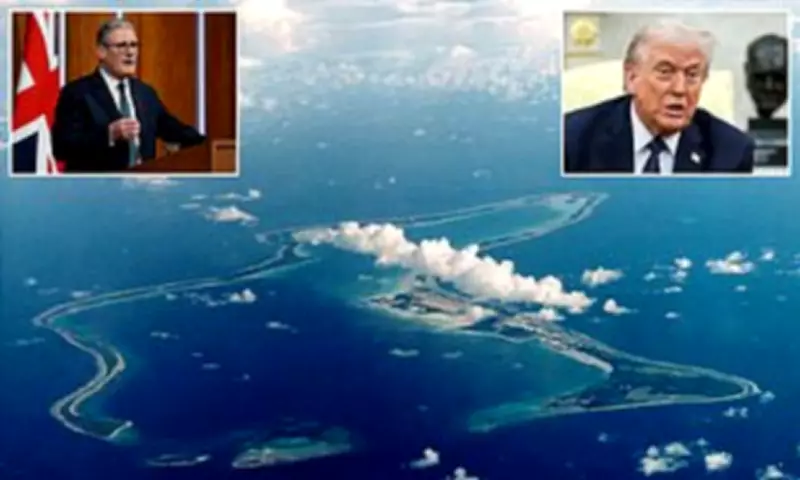
The United Kingdom has firmly dismissed threats from Mauritius to pursue legal compensation should the controversial Chagos Islands agreement ultimately collapse. The Indian Ocean nation has publicly stated it is actively 'exploring legal avenues' after the legislation required to implement the bilateral deal was effectively placed on hold by the British Parliament.
Diplomatic Strains and Military Base Concerns
Prime Minister Keir Starmer has been engaged in desperate diplomatic efforts to convince former US President Donald Trump that the proposed treaty represents the only viable pathway to secure the long-term future of the critically important Diego Garcia military base. The remote installation, located in the Indian Ocean, holds immense strategic value for Western defence operations.
President Trump had initially expressed support for the complex plan, which involves the United Kingdom ceding sovereignty of the Chagos archipelago to Mauritius while simultaneously leasing back the Diego Garcia site for a staggering sum of £35 billion over a 99-year period. However, his position has dramatically shifted following a significant diplomatic dispute.

Trump's Reversal and Farage's Influence
The American leader has since condemned the arrangement amid an escalating spat over Sir Keir's initial refusal to grant permission for American forces to utilise UK military bases, including facilities in Cyprus, for conducting strikes against Iranian targets. This refusal has created substantial friction in the transatlantic security partnership.
Adding further complexity to the situation, Reform UK leader Nigel Farage has declared he will vigorously advocate for the complete abandonment of what he terms a 'surrender' treaty. Farage plans to push this case directly when he dines with Donald Trump at the Mar-a-Lago resort in Florida this coming weekend, seeking to influence American policy on the matter.
Mauritius Ramps Up Legal Pressure
Mauritian Prime Minister Navin Ramgoolam has explicitly raised the prospect of initiating legal proceedings if Britain fails to proceed with the negotiated deal. In a statement to the local newspaper DefMedia, Mr. Ramgoolam confirmed, 'We are exploring legal avenues in the Chagos case.'
An inter-ministerial committee in Port Louis, chaired by Prime Minister Ramgoolam, has formally expressed its 'profound concern' that the Chagos Islands agreement has still not come into force, highlighting growing impatience within the Mauritian government.
UK's Firm Stance and Internal Dissent
Despite these threats, it is understood that Sir Keir's government maintains a firm belief that there are no legitimate grounds in established international law for any compensation claim should the treaty ultimately fail to be ratified by the UK. A Downing Street spokesman reiterated that work on the deal is ongoing, stating, 'Maintaining control of Diego Garcia is the entire basis of the agreement that we have reached. It means we maintain our control, protects against legal challenges to its operation and locks out our adversaries from being able to compromise our operation.'
Meanwhile, significant internal dissent has emerged within the British diplomatic corps. It has been revealed that a senior UK diplomat has resigned from the Foreign Office, citing the government's decision to cede control of the Chagos Islands and Sir Keir's perceived failure to act decisively immediately after Iran's attack on a British base in Cyprus as key factors influencing his departure.
Broader Geopolitical Tensions
Sir Keir continues to face mounting domestic fury over his decision to transfer the strategically vital Indian Ocean archipelago to Mauritius, a nation increasingly viewed as a diplomatic and economic ally of China. This move has sparked concerns about long-term Western influence in the region.
Earlier this week, Donald Trump issued a fresh verbal blast against the deal, fuming over Sir Keir's initial prohibition on using Diego Garcia for the Iranian strikes. In a related development, Mauritius itself has demanded an 'immediate ceasefire' between the United States and Iran, formally branding the American strikes on Tehran as 'illegal' under international law.

In a partial policy shift, Prime Minister Starmer has now stated that he is permitting British bases to be used for the 'specific and limited defensive purpose' of targeting Iran's missile storage depots and launchers, potentially aiming to mend fences with the American administration while navigating the volatile Chagos situation.