Trump's Cryptic Stance on Greenland Acquisition Fuels Transatlantic Tensions
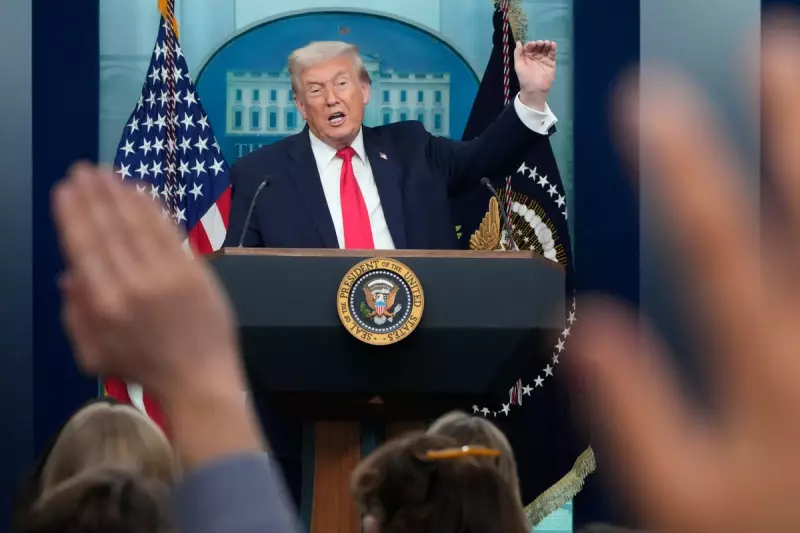
President Donald Trump has offered characteristically enigmatic responses regarding the scope of his administration's ambitions towards Greenland, while simultaneously casting doubt on NATO's willingness to defend the United States. During a wide-ranging White House press conference marking the first year of his second term, the US leader played down the fallout from a growing rift with European allies over his persistent threats to acquire the semi-autonomous Danish territory.
'You'll Find Out' on Greenland Plans
When pressed by reporters on how far he was willing to go to secure control of the strategically important Arctic island, President Trump replied with a teasing "you'll find out". He reiterated his long-standing position that the acquisition is vital for national and global security purposes. "I think something's going to happen that's going to be very good for everybody," Trump stated optimistically. "I think that we will work something out... But we need it for security purposes, we need it for national security and even world security. It is very important."
Questioning NATO's Mutual Defence Commitment
In a significant departure from traditional alliance rhetoric, President Trump expressed deep-seated uncertainty about whether NATO members would honour their collective defence obligations to come to America's aid if required. "The big fear I have with NATO is we spend tremendous amounts of money with NATO, and I know we'll come to their rescue but I just really do question whether or not they'll come to ours," he told journalists. This remark directly challenges the principle of Article 5 of the NATO treaty, which has been invoked only once in history following the September 11 attacks.

Tariff Threats and Market Jitters
The US president has explicitly threatened to impose 10% tariffs on Britain and other European allies from February 1 unless they acquiesce to his proposed purchase of Greenland. He has notably refused to rule out the potential use of military force to seize the island. These aggressive economic warnings have already triggered volatility in financial markets, with London's FTSE 100 index declining alongside similar drops across European exchanges and in the United States.
Bank of England Governor Andrew Bailey warned MPs that the escalating tensions could have serious consequences for global financial stability, though he noted that "market reactions have actually been more muted than we would have feared and expected" thus far.
Allied Response and Diplomatic Fallout
In Downing Street, Prime Minister Sir Keir Starmer led a Cabinet discussion focused on the emerging crisis. A Number 10 spokesperson clarified the UK government's position, stating Sir Keir "reiterated that Greenland's future was a matter for Greenlanders and the Kingdom of Denmark, and that the prospect of tariffs imposed against allies by the US was wrong". The Prime Minister emphasised continued engagement with European leaders over the proposed tariffs, which he described as being "in no-one's interests".
During a Tuesday evening call with European Council President Antonio Costa, Sir Keir affirmed the UK's readiness to "play its part to protect Arctic security alongside NATO". Meanwhile, at the World Economic Forum in Davos, Chancellor Rachel Reeves appealed for calm, urging the White House to consider "how your allies can also help you achieve your objectives". European Commission President Ursula von der Leyen issued a stern warning that Brussels could respond to US actions in an "unflinching" manner.
Personal Dynamics and Broader Criticisms
President Trump insisted he maintains good personal relationships with both Prime Minister Starmer and French President Emmanuel Macron, despite acknowledging they had not spoken since his provocative Truth Social posts earlier on Tuesday. In those messages, he attacked the UK's decision on the Chagos Islands and shared imagery depicting Greenland as US territory. "I mean, they always treat me well. They get a little bit rough when, you know, when I'm not around, but when I'm around they treat me very nicely," he remarked.

However, he proceeded to criticise both leaders as "liberal" and suggested they needed to "straighten out their countries", specifically citing immigration and energy as problem areas. He took particular aim at wind energy, derisively referring to turbines as "windmills". Trump's underlying rationale for the Greenland push centres on perceived national security risks from Russia and China in the Arctic, coupled with his assertion that Denmark is incapable of protecting the territory.
As the situation develops, President Trump hinted at ongoing diplomatic efforts, telling reporters in Davos that "we have a lot of meetings scheduled on Greenland" and expressing confidence that "things are going to work out pretty well". The coming weeks will reveal whether his cryptic prediction holds true or if the transatlantic alliance faces its most severe test in decades.