Trump's Video Game War: How AI and Memes Flatten Iran Conflict Narrative
Trump's Video Game War: AI and Memes Flatten Iran Conflict

Trump's Video Game War: AI, Memes and a Simplistic Narrative Flatten Iran Conflict

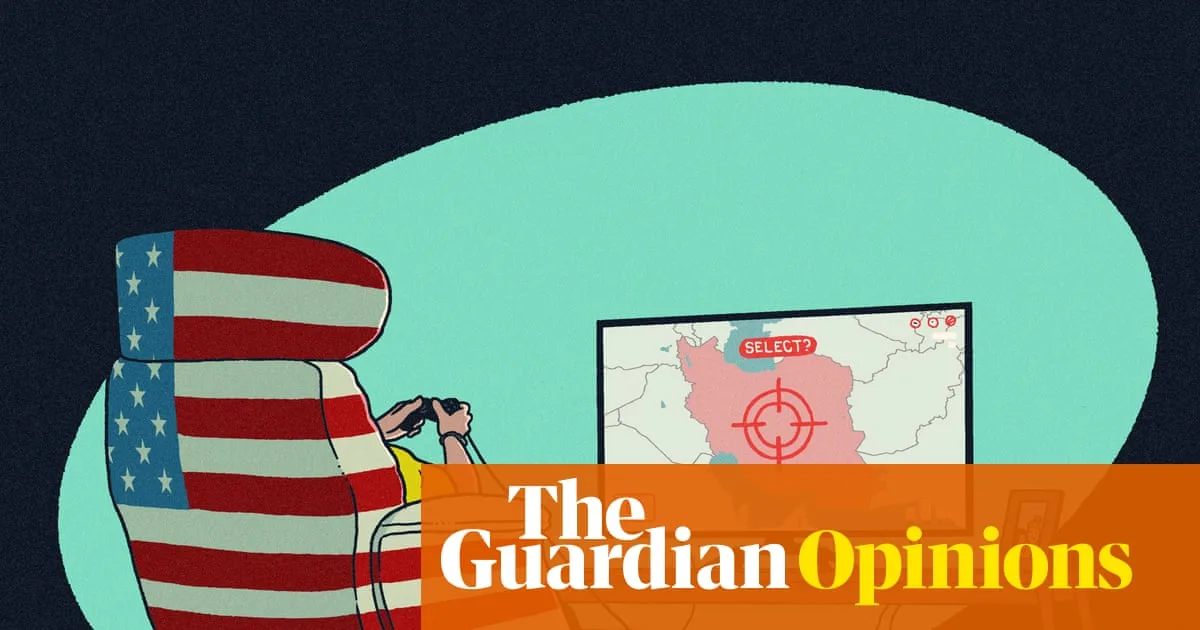
What was initially envisioned as a swift military victory has descended into a protracted quagmire, compelling the Trump administration to reframe the entire conflict as a dopamine-fueled spectacle. The war on Iran, despite its profound destabilisation of the Middle East and global economy, is being systematically portrayed as unreal—a video game, a spectator sport, and a social media festival of dunking.

The architects of this conflict have elevated stupidity to a virtue, bolstered by an information ecosystem that actively stupefies. This US-led war feels distinctly remote and profoundly ignorant, marking it as a first of its kind in the modern era.

The Meme Warfare Strategy

Just one week into the hostilities, the White House uploaded a clip to its social media channels featuring dramatic montages from Top Gun, Braveheart, and Breaking Bad, captioned "Justice the American way"—a repurposed Superman motto. Another video, entitled Touchdown, showed NFL players tackling each other, with contact triggering footage of a strike explosion tagged as "unclassified".

Wide Pickt banner — collaborative shopping lists app for Telegram, phone mockup with grocery list

Even SpongeBob SquarePants made an appearance, asking "Wanna see me do it again?" before cutting to an explosion. Operation Epic Fury was rendered as a Nintendo Wii game, complete with the declaration: "Will not stop until the objectives are met. Unrelenting. Unapologetic."

"We're over here just grinding away on banger memes, dude," a senior White House official told Politico. "There's an entertainment factor to what we do." This approach is pure Donald Trump and his Maga base, for whom everything is not merely a game but a competition. Politics, both domestic and international, becomes about scoring points, winning, and humiliating opponents.

Simplifying a Floundering Conflict

To make this competition enjoyable, it must be portrayed as low-stakes. Consequently, the war is stripped of its realities—death, destruction, and calamitous geopolitical fallout—and reduced to the boom, the score, the fist pump. One clip begins with "Wake up, Daddy's home," encapsulating an administration likened to a gamer in a dark basement, downing beers and self-soothing through flashes of colour and noise on a screen: maximum hit, minimum effort.

Beyond sublimated masculine anxiety, this rendering serves a critical political purpose by eliminating any need for complex narratives or justifications. The Trump regime is intellectually incapable of formulating sophisticated reasoning for the war, a failure compounded by the conflict's immediate floundering.

The original objective of creating conditions for regime change was not achieved. Iran retaliated by pummelling Gulf countries and Israel with drones and missiles, shutting the Strait of Hormuz and blocking the passage of oil, gas, and commodities, which spiked global energy costs overnight. With a quick win turning into a quagmire, simplification into viral, triumphant content became essential.

The Role of AI and Remote Warfare

Deepening this state of unreality is the conflict's remote nature. Never before has a war with such devastating, wide-reaching consequences been waged with such physical detachment. Artificial intelligence has been deployed on an unprecedented scale.

In a mid-March video, Admiral Brad Cooper, Centcom commander for Operation Epic Fury, summarised that AI played a crucial role in over 5,500 strikes on Iran. "Humans will always make final decisions on what to shoot and what not to shoot and when to shoot," he stated, "but advanced AI tools can turn processes that used to take hours and sometimes even days into seconds."

This process, grimly termed "streamlining the kill chain," reduces the effort required for surveillance, intelligence collection, and target selection. In this regard, the war becomes an actual video game, with another layer of human connection to ground details removed and outsourced to code.

Pickt after-article banner — collaborative shopping lists app with family illustration

There are no boots on the ground, no one seeing the whites of the eyes of those killed, and no sense of the colossal incursion into the lives and lands on the other side of the bombs. American and Israeli casualties remain relatively low compared to the assault's scale, unlike the face-to-face killing, civilian torture at places like Abu Ghraib, and soldier death tolls apparent during the Iraq invasion. All that remains is a faceless enemy, with success or defeat measured only by boosts or injuries to the US's ego.

The Information Ecosystem's Grotesque Detachment

This war lands in an information ecosystem already primed for grotesque detachment. Gone are the days when war was consumed exclusively through rolling coverage on CNN or the BBC, with correspondents and camera people on the ground beaming events to viewers, or newspaper reporters filing investigations.

Now, all events—from the mundane to the high-octane—are flattened into the feed. On Instagram, TikTok, and X, users toggle between recipes, influencers, White House videos, and scenes of smoke rising from Tehran, Doha, and Dubai. Reflexive scrolling, seeing but not absorbing, has dulled many to the sheer glut of life, compounded by a flood of takes, shit-posting, AI-generated fake footage, and countless talking heads on YouTube and streaming sites.

The line between true and false constantly jostles in the content slipstream, making nothing feel real. Entire businesses have been erected to capitalise on this confusion. On Polymarket, an online prediction platform allowing users to gamble on conflict outcomes, stakes became so intricate and huge that a journalist recently received death threats from users who lost bets due to his reporting.

The Challenge of Retaining Humanity

Amid these swirling forces, retaining empathy, following a moral compass, and understanding that thousands of innocent people are dying—their homes destroyed, nations destabilised for a generation—becomes enormously difficult. There remains a duty towards them, exercisable through pressure on the architects of their suffering.

This is the central challenge of this war and, indeed, our entire age: to retain and insist on humanity in the face of political leaders who benefit from effacing it and platform owners who profit from its erosion. The video game narrative may provide viral dopamine hits, but it dangerously obscures the profound human costs unfolding in real time.




